MolDraw › 3D molecule models › Nicotine structure
Nicotine structure and 3D model (C10H14N2)
Nicotine is an alkaloid made of a flat pyridine ring joined to a puckered N-methylpyrrolidine ring. Tobacco makes the (S) enantiomer.
Drag to rotate · pinch or scroll to zoom. 3D coordinates: computed with RDKit (ETKDG conformer, force-field optimised).
Nicotine at a glance
| Formula | C10H14N2 |
|---|---|
| Molar mass | 162.24 g/mol |
| IUPAC name | 3-[(2S)-1-methylpyrrolidin-2-yl]pyridine |
| Atoms / bonds | 26 / 27 |
| H-bond donors / acceptors | 0 / 2 |
| logP (estimated) | 1.8 |
| SMILES | CN1CCC[C@H]1C2=CN=CC=C2 |
| InChIKey | SNICXCGAKADSCV-JTQLQIEISA-N |
| PubChem | 89594 |
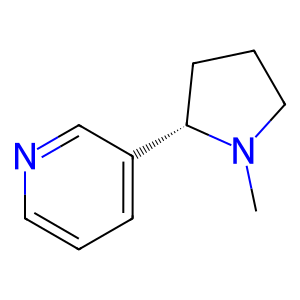
What the 3D model of Nicotine shows
The model contains 26 atoms (12 heavy atoms and 14 hydrogens) joined by 27 bonds; in ball-and-stick mode every stick is one bond, and double or aromatic bonds are drawn as multiple sticks. Switch to space-filling to see the molecule as its electron cloud, scaled to van der Waals radii: this is the shape other molecules actually "feel". It can donate 0 and accept 2 hydrogen bonds, and its estimated logP of 1.8 means it is fairly balanced between water and fat. Its topological polar surface area is 16 Ų.
Shape and bond angles
| Atom(s) | Geometry / hybridisation | Angles & lengths |
|---|---|---|
| pyridine ring atoms | Trigonal planar, sp²; aromatic ring | 120° |
| pyrrolidine carbons | Tetrahedral, sp³; puckered 5-ring | ≈ 104–109° |
| pyrrolidine N | Trigonal pyramidal, sp³ | ≈ 109° |
Is Nicotine polar?
Yes. Both nitrogens accept hydrogen bonds, so nicotine mixes with water in all proportions below about 60 °C. It also dissolves in oils, which helps it cross membranes.
Elemental composition of C10H14N2
| Element | Atoms | Mass (g/mol) | Mass % |
|---|---|---|---|
| Carbon (C) | 10 | 120.110 | 74.03% |
| Hydrogen (H) | 14 | 14.112 | 8.70% |
| Nitrogen (N) | 2 | 28.014 | 17.27% |
Calculated from IUPAC standard atomic weights. Check any formula with the molar mass calculator.
Uses of nicotine
- Stimulant found in tobacco and e-cigarettes
- Nicotine replacement products such as patches and gum
- Historically used as an insecticide
Interesting facts
- Nicotine is named after Jean Nicot, who brought tobacco to the French court in 1560.
- It acts on nicotinic acetylcholine receptors in the brain and muscles.
- Pure nicotine is a colourless oily liquid that turns brown in air.
Drawing structures for your notes? MolDraw is a free online chemical structure editor for molecules, reactions and lab diagrams.
Open MolDraw editorFrequently asked questions
What is the structure of Nicotine?
Nicotine is an alkaloid made of a flat pyridine ring joined to a puckered N-methylpyrrolidine ring. Tobacco makes the (S) enantiomer. Its SMILES is CN1CCC[C@H]1C2=CN=CC=C2.
Is nicotine a base?
Yes. It has two basic nitrogen atoms, and the pyrrolidine nitrogen is the more basic one (pKa of its conjugate acid about 8).
Is nicotine chiral?
Yes. It has one stereocentre where the two rings join. Natural nicotine from tobacco is the (S) form.
What is the chemical formula and molar mass of Nicotine?
Nicotine is C10H14N2 with a molar mass of 162.24 g/mol. It contains 26 atoms: 10 carbon, 14 hydrogen, 2 nitrogen.
What is the IUPAC name of Nicotine?
The IUPAC name is 3-[(2S)-1-methylpyrrolidin-2-yl]pyridine.
How do I draw Nicotine?
Open the MolDraw editor, paste the SMILES CN1CCC[C@H]1C2=CN=CC=C2 or type "Nicotine" in name search, and the structure is drawn for you. You can then export it as PNG, SVG, MOL or CDXML.