MolDraw › 3D molecule models › Penicillin G structure
Penicillin G structure and 3D model (C16H18N2O4S)
Penicillin G (benzylpenicillin) has a strained four-membered beta-lactam ring fused to a sulfur-containing thiazolidine ring. A phenylacetyl side chain is attached through an amide.
Drag to rotate · pinch or scroll to zoom. 3D coordinates: computed with RDKit (ETKDG conformer, force-field optimised).
Penicillin G at a glance
| Formula | C16H18N2O4S |
|---|---|
| Molar mass | 334.40 g/mol |
| IUPAC name | (2S,5R,6R)-3,3-dimethyl-7-oxo-6-[(2-phenylacetyl)amino]-4-thia-1-azabicyclo[3.2.0]heptane-2-carboxylic acid |
| Atoms / bonds | 41 / 43 |
| H-bond donors / acceptors | 2 / 4 |
| logP (estimated) | 0.9 |
| SMILES | CC1([C@@H](N2[C@H](S1)[C@@H](C2=O)NC(=O)CC3=CC=CC=C3)C(=O)O)C |
| InChIKey | JGSARLDLIJGVTE-MBNYWOFBSA-N |
| PubChem | 5904 |
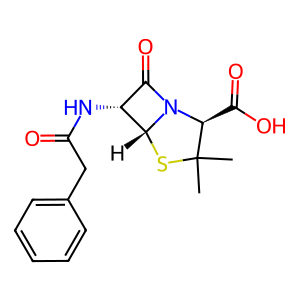
What the 3D model of Penicillin G shows
The model contains 41 atoms (23 heavy atoms and 18 hydrogens) joined by 43 bonds; in ball-and-stick mode every stick is one bond, and double or aromatic bonds are drawn as multiple sticks. Switch to space-filling to see the molecule as its electron cloud, scaled to van der Waals radii: this is the shape other molecules actually "feel". It can donate 2 and accept 4 hydrogen bonds, and its estimated logP of 0.9 means it is fairly balanced between water and fat. Its topological polar surface area is 87 Ų.
Shape and bond angles
| Atom(s) | Geometry / hybridisation | Angles & lengths |
|---|---|---|
| beta-lactam ring | Four-membered ring, strained | ≈ 90° ring angles |
| beta-lactam N | Pyramidalised, less planar than a normal amide | reduced amide resonance |
| C=O carbons | Trigonal planar, sp² | ≈ 120° |
| benzene ring | Trigonal planar, sp²; planar ring | 120° |
Is Penicillin G polar?
Yes. It has a carboxylic acid, two amide C=O groups and an N–H. It is usually given as a water-soluble sodium or potassium salt.
Elemental composition of C16H18N2O4S
| Element | Atoms | Mass (g/mol) | Mass % |
|---|---|---|---|
| Carbon (C) | 16 | 192.176 | 57.47% |
| Hydrogen (H) | 18 | 18.144 | 5.43% |
| Nitrogen (N) | 2 | 28.014 | 8.38% |
| Oxygen (O) | 4 | 63.996 | 19.14% |
| Sulfur (S) | 1 | 32.067 | 9.59% |
Calculated from IUPAC standard atomic weights. Check any formula with the molar mass calculator.
Uses of Penicillin G
- Antibiotic for bacterial infections
- Starting point for making semi-synthetic penicillins
- Classic example of ring strain in organic chemistry
Interesting facts
- Alexander Fleming noticed the antibacterial effect of Penicillium mould in 1928.
- Dorothy Hodgkin confirmed the beta-lactam structure by X-ray crystallography in 1945.
- The strained beta-lactam ring opens to acylate enzymes that bacteria need to build their cell walls.
Drawing structures for your notes? MolDraw is a free online chemical structure editor for molecules, reactions and lab diagrams.
Open MolDraw editorFrequently asked questions
What is the structure of Penicillin G?
Penicillin G (benzylpenicillin) has a strained four-membered beta-lactam ring fused to a sulfur-containing thiazolidine ring. A phenylacetyl side chain is attached through an amide. Its SMILES is CC1([C@@H](N2[C@H](S1)[C@@H](C2=O)NC(=O)CC3=CC=CC=C3)C(=O)O)C.
What is the beta-lactam ring in penicillin?
It is a four-membered cyclic amide. Its ring strain makes the C=O very reactive, which lets it bind to and block bacterial cell-wall enzymes.
Why is penicillin G not taken by mouth?
Stomach acid breaks down much of it, so it is usually given by injection. Penicillin V is a more acid-stable relative.
What is the chemical formula and molar mass of Penicillin G?
Penicillin G is C16H18N2O4S with a molar mass of 334.40 g/mol. It contains 41 atoms: 16 carbon, 18 hydrogen, 2 nitrogen, 4 oxygen, 1 sulfur.
What is the IUPAC name of Penicillin G?
The IUPAC name is (2S,5R,6R)-3,3-dimethyl-7-oxo-6-[(2-phenylacetyl)amino]-4-thia-1-azabicyclo[3.2.0]heptane-2-carboxylic acid.
How do I draw Penicillin G?
Open the MolDraw editor, paste the SMILES CC1([C@@H](N2[C@H](S1)[C@@H](C2=O)NC(=O)CC3=CC=CC=C3)C(=O)O)C or type "Penicillin G" in name search, and the structure is drawn for you. You can then export it as PNG, SVG, MOL or CDXML.