MolDraw › 3D molecule models › Metformin structure
Metformin structure and 3D model (C4H11N5)
Metformin is a biguanide: two guanidine units joined through a shared nitrogen, with two methyl groups on one end. Its many nitrogens make it a strong base.
Drag to rotate · pinch or scroll to zoom. 3D coordinates: computed with RDKit (ETKDG conformer, force-field optimised).
Metformin at a glance
| Formula | C4H11N5 |
|---|---|
| Molar mass | 129.17 g/mol |
| IUPAC name | 3-(diaminomethylidene)-1,1-dimethylguanidine |
| Atoms / bonds | 20 / 19 |
| H-bond donors / acceptors | 3 / 1 |
| logP (estimated) | -1.2 |
| SMILES | CN(C)C(=N)N=C(N)N |
| InChIKey | XZWYZXLIPXDOLR-UHFFFAOYSA-N |
| PubChem | 4091 |
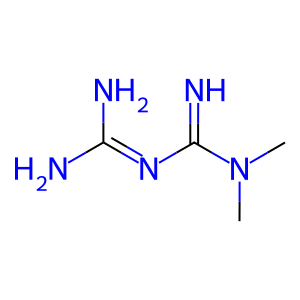
What the 3D model of Metformin shows
The model contains 20 atoms (9 heavy atoms and 11 hydrogens) joined by 19 bonds; in ball-and-stick mode every stick is one bond, and double or aromatic bonds are drawn as multiple sticks. Switch to space-filling to see the molecule as its electron cloud, scaled to van der Waals radii: this is the shape other molecules actually "feel". It can donate 3 and accept 1 hydrogen bonds, and its estimated logP of -1.2 means it is very water-loving (hydrophilic). Its topological polar surface area is 91 Ų.
Shape and bond angles
| Atom(s) | Geometry / hybridisation | Angles & lengths |
|---|---|---|
| guanidine carbons | Trigonal planar, sp² | ≈ 120° |
| NH₂ and C=N nitrogens | Near-planar, delocalised | ≈ 120° |
| methyl carbons | Tetrahedral, sp³ | ≈ 109.5° |
Is Metformin polar?
Yes, very. It has many N–H donors and nitrogen acceptors, and in the body it is almost fully protonated. Its logP is strongly negative.
Elemental composition of C4H11N5
| Element | Atoms | Mass (g/mol) | Mass % |
|---|---|---|---|
| Carbon (C) | 4 | 48.044 | 37.20% |
| Hydrogen (H) | 11 | 11.088 | 8.58% |
| Nitrogen (N) | 5 | 70.035 | 54.22% |
Calculated from IUPAC standard atomic weights. Check any formula with the molar mass calculator.
Uses of metformin
- First-line medicine for type 2 diabetes
- Lowers glucose production by the liver
- Studied in research on ageing and cancer
Interesting facts
- Metformin is related to galegine, a compound from the plant goat's rue (Galega officinalis).
- It is on the World Health Organization's List of Essential Medicines.
- It is made from dimethylamine hydrochloride and dicyandiamide.
Drawing structures for your notes? MolDraw is a free online chemical structure editor for molecules, reactions and lab diagrams.
Open MolDraw editorFrequently asked questions
What is the structure of Metformin?
Metformin is a biguanide: two guanidine units joined through a shared nitrogen, with two methyl groups on one end. Its many nitrogens make it a strong base. Its SMILES is CN(C)C(=N)N=C(N)N.
Is metformin a base?
Yes. As a biguanide it is a strong organic base, and it is sold as metformin hydrochloride.
What does the bi- in biguanide mean?
It means two guanidine groups joined together. Guanidine itself is HN=C(NH₂)₂.
What is the chemical formula and molar mass of Metformin?
Metformin is C4H11N5 with a molar mass of 129.17 g/mol. It contains 20 atoms: 4 carbon, 11 hydrogen, 5 nitrogen.
What is the IUPAC name of Metformin?
The IUPAC name is 3-(diaminomethylidene)-1,1-dimethylguanidine.
How do I draw Metformin?
Open the MolDraw editor, paste the SMILES CN(C)C(=N)N=C(N)N or type "Metformin" in name search, and the structure is drawn for you. You can then export it as PNG, SVG, MOL or CDXML.