MolDraw › Templates › Stereochemistry › Felkin–Anh model
StereochemistryPremium
Felkin–Anh model template
Premium template. Preview and edit it free in MolDraw; downloading and exporting it is part of MolDraw Pro.
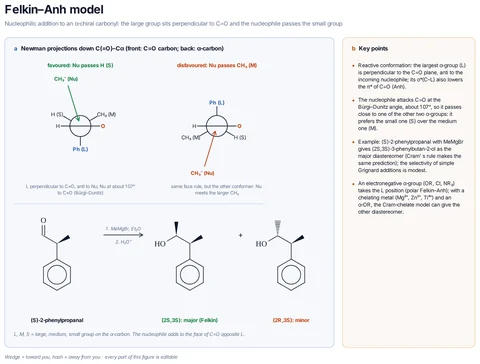
Newman projections down the C1–C2 bond of (S)-2-phenylpropanal: in the favoured transition state Ph (L) is perpendicular to the carbonyl and anti to the incoming nucleophile, which approaches at the Bürgi–Dunitz angle (about 107°) past H (S) rather than CH₃ (M). MeMgBr gives (2S,3S)-3-phenylbutan-2-ol as the major diastereomer.
What the template shows
- Nucleophilic addition to an α-chiral carbonyl: the large group sits perpendicular to C=O and the nucleophile passes the small group
- Newman projections down C(=O)–Cα (front: C=O carbon; back: α-carbon)
- favoured: Nu passes H (S)
- disfavoured: Nu passes CH₃ (M)
- L perpendicular to C=O, anti to Nu; Nu at about 107° to C=O (Bürgi–Dunitz)
- same face rule, but the other conformer: Nu meets the larger CH₃
- (2S,3S): major (Felkin)
- L, M, S = large, medium, small group on the α-carbon. The nucleophile adds to the face of C=O opposite L.
- Reactive conformation: the largest α-group (L) is perpendicular to the C=O plane, anti to the incoming nucleophile; its σ*(C–L) also lowers the π* of C=O (Anh).
- The nucleophile attacks C=O at the Bürgi–Dunitz angle, about 107°, so it passes close to one of the other two α-groups: it prefers the small one (S) over the medium one (M).
- Example: (S)-2-phenylpropanal with MeMgBr gives (2S,3S)-3-phenylbutan-2-ol as the major diastereomer (Cram’s rule makes the same prediction); the selectivity of simple Grignard additions is modest.
- An electronegative α-group (OR, Cl, NR₂) takes the L position (polar Felkin–Anh); with a chelating metal (Mg²⁺, Zn²⁺, Ti⁴⁺) and an α-OR, the Cram-chelate model can give the other diastereomer.
- Wedge = toward you, hash = away from you · every part of this figure is editable
Drawn with 32 atoms, 108 shapes – every one editable in MolDraw.
Sources
How to use this template
- Press Edit in MolDraw. The template opens on the canvas of the free MolDraw editor.
- Change anything: move structures, edit atoms and labels, recolour highlights or delete what you do not need.
- Add your own structures, arrows and text next to it, or combine several templates on one page.
- Export the drawing as PNG, SVG or PDF for slides, worksheets, theses and papers.
Frequently asked questions
Is the Felkin–Anh model template free?
You can preview the Felkin–Anh model template here and open and edit it in MolDraw for free. Downloading or exporting it is part of MolDraw Pro, together with the other premium templates.
Can I edit the Felkin–Anh model template?
Yes. It opens as an ordinary MolDraw drawing, so every structure, arrow, label and colour can be changed, and you can add your own content around it.
Is the chemistry checked?
Every structure is checked with RDKit and every curly arrow passes MolDraw’s electron-flow audit. The sources used are listed on this page.
Are the R/S labels in the stereochemistry templates checked?
Yes. Every R/S and E/Z descriptor is computed with RDKit from the drawn structure, so the labels match the wedges and dashes.