MolDraw › Templates › Stereochemistry › CIP priority rules
StereochemistryPremium
CIP priority rules template
Premium template. Preview and edit it free in MolDraw; downloading and exporting it is part of MolDraw Pro.
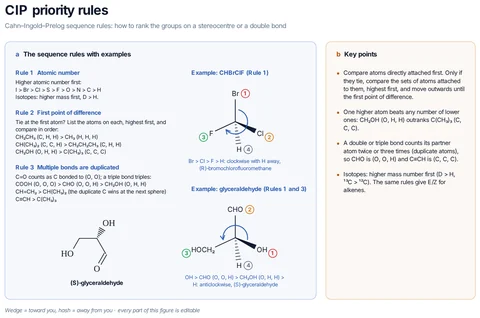
Rule 1 atomic number (and mass for isotopes), first point of difference along each branch, and duplicated atoms for double and triple bonds, with ranked examples, CHBrClF and glyceraldehyde.
What the template shows
- Cahn–Ingold–Prelog sequence rules: how to rank the groups on a stereocentre or a double bond
- The sequence rules with examples
- Rule 1 Atomic number
- Higher atomic number first: I > Br > Cl > S > F > O > N > C > H Isotopes: higher mass first, D > H.
- Rule 2 First point of difference
- Tie at the first atom? List the atoms on each, highest first, and compare in order: CH₂CH₃ (C, H, H) > CH₃ (H, H, H) CH(CH₃)₂ (C, C, H) > CH₂CH₂CH₃ (C, H, H) CH₂OH (O, H, H) > C(CH₃)₃ (C, C, C)
- Rule 3 Multiple bonds are duplicated
- C=O counts as C bonded to (O, O); a triple bond triples: COOH (O, O, O) > CHO (O, O, H) > CH₂OH (O, H, H) CH=CH₂ > CH(CH₃)₂ (the duplicate C wins at the next sphere) C≡CH > C(CH₃)₃
- Example: CHBrClF (Rule 1)
- Br > Cl > F > H: clockwise with H away, (R)-bromochlorofluoromethane
- Example: glyceraldehyde (Rules 1 and 3)
- OH > CHO (O, O, H) > CH₂OH (O, H, H) > H: anticlockwise, (S)-glyceraldehyde
- Compare atoms directly attached first. Only if they tie, compare the sets of atoms attached to them, highest first, and move outwards until the first point of difference.
- One higher atom beats any number of lower ones: CH₂OH (O, H, H) outranks C(CH₃)₃ (C, C, C).
- A double or triple bond counts its partner atom twice or three times (duplicate atoms), so CHO is (O, O, H) and C≡CH is (C, C, C).
- Isotopes: higher mass number first (D > H, ¹³C > ¹²C). The same rules give E/Z for alkenes.
- Wedge = toward you, hash = away from you · every part of this figure is editable
Drawn with 6 atoms, 290 shapes – every one editable in MolDraw.
Sources
How to use this template
- Press Edit in MolDraw. The template opens on the canvas of the free MolDraw editor.
- Change anything: move structures, edit atoms and labels, recolour highlights or delete what you do not need.
- Add your own structures, arrows and text next to it, or combine several templates on one page.
- Export the drawing as PNG, SVG or PDF for slides, worksheets, theses and papers.
Frequently asked questions
Is the CIP priority rules template free?
You can preview the CIP priority rules template here and open and edit it in MolDraw for free. Downloading or exporting it is part of MolDraw Pro, together with the other premium templates.
Can I edit the CIP priority rules template?
Yes. It opens as an ordinary MolDraw drawing, so every structure, arrow, label and colour can be changed, and you can add your own content around it.
Is the chemistry checked?
Every structure is checked with RDKit and every curly arrow passes MolDraw’s electron-flow audit. The sources used are listed on this page.
Are the R/S labels in the stereochemistry templates checked?
Yes. Every R/S and E/Z descriptor is computed with RDKit from the drawn structure, so the labels match the wedges and dashes.