MolDraw › Educational materials › Chirality & R/S Configuration Worksheet

Chirality & R/S Configuration Worksheet

Organic chemistryGrades 11–12 · A-level / IB · AP Chemistry · CBSE/JEE · Intro college organic15 items · answer key included

This chirality worksheet gives students plenty of practice finding stereocentres and assigning R and S configuration with the Cahn–Ingold–Prelog (CIP) priority rules. The molecules are real ones students meet in biology and medicine: alanine, cysteine, lactic acid, glyceraldehyde, ibuprofen, carvone, thalidomide, ephedrine, penicillin G and both natural and meso tartaric acid. Each structure is drawn with wedges and dashes; students mark every chiral centre, rank the four groups and give the R/S label. Every answer in the key was verified with a computer CIP labeller, so this R and S configuration worksheet with answers is dependable for homework, revision and printable PDF quizzes.

Live A4 preview. “Download PDF” opens the print dialog: choose Save as PDF. Click a structure to open it in MolDraw.

Chirality & R/S Configuration Worksheet

Name Class Date

Find the stereocentres and assign R/S

Mark every stereocentre with an asterisk (*), number the four groups by CIP priority, and label each stereocentre R or S.

1.
Alanine (natural L-alanine)
Structure for the question
1 stereocentre (C2, the α-carbon): S. Priorities: NH2 > COOH > CH3 > H.
2.
Lactic acid (from muscle)
Structure for the question
1 stereocentre (C2): R. Priorities: OH > COOH > CH3 > H.
3.
Butan-2-ol
Structure for the question
1 stereocentre (C2): S. Priorities: OH > CH2CH3 > CH3 > H.
4.
Glyceraldehyde (D-glyceraldehyde)
Structure for the question
1 stereocentre (C2): R. Priorities: OH > CHO > CH2OH > H. D-Glyceraldehyde is (R).
5.
Bromochlorofluoromethane
Structure for the question
1 stereocentre (the only carbon): R. Priorities: Br > Cl > F > H.
6.
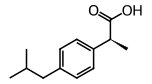
Ibuprofen (active enantiomer)
Structure for the question
1 stereocentre (C2 of the propanoic acid, bearing CH3): S. Priorities: COOH > aryl > CH3 > H. (S)-ibuprofen is the active painkiller.
7.
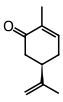
Carvone (spearmint oil)
Structure for the question
1 stereocentre (ring C5, bearing the isopropenyl group): R. (R)-carvone smells of spearmint; its enantiomer (S)-carvone smells of caraway.
8.
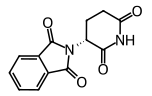
Thalidomide
Structure for the question
1 stereocentre (the glutarimide CH bonded to N): R. Priorities: N(phthalimide) > C(=O)N > CH2 > H. (R)-thalidomide is the sedative; the two enantiomers interconvert in the body.
9.
Cysteine (natural L-cysteine)
Structure for the question
1 stereocentre (α-carbon): R. Priorities: NH2 > CH2SH > COOH > H (S outranks O). L-Cysteine is R, unlike most L-amino acids, which are S.
10.
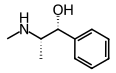
Ephedrine
Structure for the question
2 stereocentres: C1 (bearing OH and phenyl) is R; C2 (bearing NHCH3 and CH3) is S. (1R,2S)-ephedrine.
11.
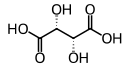
(+)-Tartaric acid (natural, from grapes)
Structure for the question
2 stereocentres: C2 R and C3 R — (2R,3R)-tartaric acid. Chiral (no internal mirror plane).
12.
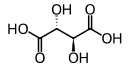
meso-Tartaric acid
Structure for the question
2 stereocentres: one R and one S — (2R,3S). The molecule has an internal mirror plane, so it is a meso compound and is achiral (optically inactive) despite having two stereocentres.
13.
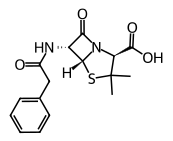
Penicillin G
Structure for the question
3 stereocentres: C2 (bearing COOH) S; C5 (ring-fusion CH next to S) R; C6 (bearing the amide NH) R — (2S,5R,6R). The C(CH3)2 carbon is not a stereocentre.

Check your understanding

Answer each question in the space provided.

14.
Which of these molecules are chiral: propan-2-ol, glycine, butan-2-ol, 2-chloropropane, 2-chlorobutane?
Only butan-2-ol and 2-chlorobutane. In the others, the central carbon carries two identical groups (two CH3 groups, or two H atoms in glycine).
15.
A pure sample of (S)-ibuprofen rotates plane-polarised light. What would you observe for a racemic mixture, and why?
No rotation. A racemic mixture contains equal amounts of the R and S enantiomers, which rotate plane-polarised light by equal amounts in opposite directions, so the effects cancel.

moldraw.com/educational-materials/chirality-rs-worksheet/

Answer key: Chirality & R/S Configuration Worksheet

Find the stereocentres and assign R/S

1.
1 stereocentre (C2, the α-carbon): S. Priorities: NH2 > COOH > CH3 > H.
2.
1 stereocentre (C2): R. Priorities: OH > COOH > CH3 > H.
3.
1 stereocentre (C2): S. Priorities: OH > CH2CH3 > CH3 > H.
4.
1 stereocentre (C2): R. Priorities: OH > CHO > CH2OH > H. D-Glyceraldehyde is (R).
5.
1 stereocentre (the only carbon): R. Priorities: Br > Cl > F > H.
6.
1 stereocentre (C2 of the propanoic acid, bearing CH3): S. Priorities: COOH > aryl > CH3 > H. (S)-ibuprofen is the active painkiller.
7.
1 stereocentre (ring C5, bearing the isopropenyl group): R. (R)-carvone smells of spearmint; its enantiomer (S)-carvone smells of caraway.
8.
1 stereocentre (the glutarimide CH bonded to N): R. Priorities: N(phthalimide) > C(=O)N > CH2 > H. (R)-thalidomide is the sedative; the two enantiomers interconvert in the body.
9.
1 stereocentre (α-carbon): R. Priorities: NH2 > CH2SH > COOH > H (S outranks O). L-Cysteine is R, unlike most L-amino acids, which are S.
10.
2 stereocentres: C1 (bearing OH and phenyl) is R; C2 (bearing NHCH3 and CH3) is S. (1R,2S)-ephedrine.
11.
2 stereocentres: C2 R and C3 R — (2R,3R)-tartaric acid. Chiral (no internal mirror plane).
12.
2 stereocentres: one R and one S — (2R,3S). The molecule has an internal mirror plane, so it is a meso compound and is achiral (optically inactive) despite having two stereocentres.
13.
3 stereocentres: C2 (bearing COOH) S; C5 (ring-fusion CH next to S) R; C6 (bearing the amide NH) R — (2S,5R,6R). The C(CH3)2 carbon is not a stereocentre.

Check your understanding

14.
Only butan-2-ol and 2-chlorobutane. In the others, the central carbon carries two identical groups (two CH3 groups, or two H atoms in glycine).
15.
No rotation. A racemic mixture contains equal amounts of the R and S enantiomers, which rotate plane-polarised light by equal amounts in opposite directions, so the effects cancel.

How to use this worksheet

  1. Recap the CIP rules first: rank by atomic number at the first point of difference; double bonds count as duplicated atoms.
  2. Remind students: if the lowest-priority group (usually H) points towards the viewer (wedge), the direction 1→2→3 gives the opposite label.
  3. Ask students to write the priorities 1–4 next to each group before deciding R or S — this is where most marks are lost.
  4. Cysteine (a9) and meso-tartaric acid (a12) are good discussion questions about why L ≠ S and why two stereocentres do not always make a molecule chiral.
  5. Set the title, student lines and answer option on the left, then press Download PDF and choose “Save as PDF” (or print directly). Your choices are remembered on this device.

Draw and edit structures in MolDraw. Make your own questions: draw any molecule, then export it as PNG or SVG for your worksheets.

Draw and edit structures in MolDraw

Frequently asked questions

How do you assign R or S configuration?

Rank the four groups on the stereocentre by the CIP rules (higher atomic number = higher priority). Orient the molecule so the lowest-priority group points away from you, then trace 1 → 2 → 3: clockwise is R, anticlockwise is S. If the lowest-priority group points towards you, reverse the answer.

How do you identify a chiral centre (stereocentre)?

Look for an sp3 carbon bonded to four different groups. CH2 and CH3 carbons, carbons in C=C or C=O, and carbons with two identical substituents (such as the C(CH3)2 in penicillin) are not stereocentres.

What is a meso compound?

A meso compound has two or more stereocentres but also an internal mirror plane, so it is superimposable on its mirror image and is achiral. meso-Tartaric acid (2R,3S) is the classic example.

Is L the same as S for amino acids?

Usually, but not always. Most natural L-amino acids are S, but L-cysteine is R because the CH2SH group outranks COOH (sulfur has a higher atomic number than oxygen).

Are the R/S answers checked?

Yes. Every R/S label in the answer key was checked with RDKit's implementation of the current CIP rules. You can download the worksheet as a PDF with or without answers.

Related worksheets