MolDraw › Templates › Mechanisms › Electrophilic substitution: pyrrole vs pyridine
MechanismsPremium
Electrophilic substitution: pyrrole vs pyridine template
Premium template. Preview and edit it free in MolDraw; downloading and exporting it is part of MolDraw Pro.
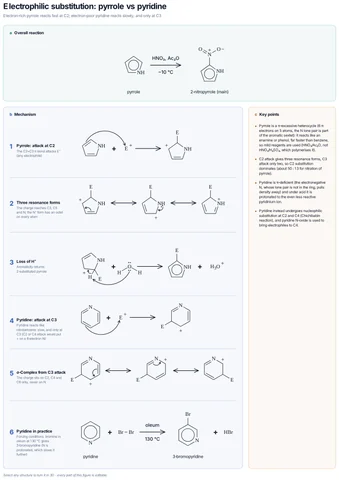
Attack at C2 of pyrrole gives a σ-complex with three resonance forms (one with the positive charge on N, every atom an octet), so C2 is favoured over C3. In pyridine, attack at C3 is the only position that keeps the positive charge off the electronegative nitrogen.
Mechanism step by step
Electron-rich pyrrole reacts fast at C2; electron-poor pyridine reacts slowly, and only at C3
- Pyrrole: attack at C2 – The C2=C3 π bond attacks E⁺ (any electrophile)
- Three resonance forms – The charge reaches C3, C5 and N; the N⁺ form has an octet on every atom
- Loss of H⁺ – Aromaticity returns: 2-substituted pyrrole
- Pyridine: attack at C3 – Pyridine reacts like nitrobenzene: slow, and only at C3 (C2 or C4 attack would put + on a 6-electron N)
- σ-Complex from C3 attack – The charge sits on C2, C4 and C6 only, never on N
- Pyridine in practice – Forcing conditions: bromine in oleum at 130 °C gives 3-bromopyridine (N is protonated, which slows it further)
Key points
- Pyrrole is a π-excessive heterocycle (6 π electrons on 5 atoms, the N lone pair is part of the aromatic sextet): it reacts like an enamine or phenol, far faster than benzene, so mild reagents are used (HNO₃/Ac₂O, not HNO₃/H₂SO₄, which polymerises it).
- C2 attack gives three resonance forms, C3 attack only two, so C2 substitution dominates (about 50 : 13 for nitration of pyrrole).
- Pyridine is π-deficient (the electronegative N, whose lone pair is not in the ring, pulls density away) and under acid it is protonated to the even less reactive pyridinium ion.
- Pyridine instead undergoes nucleophilic substitution at C2 and C4 (Chichibabin reaction), and pyridine N-oxide is used to bring electrophiles to C4.
Drawn with 109 atoms, 17 arrows, 8 shapes – every one editable in MolDraw.
Sources
How to use this template
- Press Edit in MolDraw. The template opens on the canvas of the free MolDraw editor.
- Change anything: move structures, edit atoms and labels, recolour highlights or delete what you do not need.
- Add your own structures, arrows and text next to it, or combine several templates on one page.
- Export the drawing as PNG, SVG or PDF for slides, worksheets, theses and papers.
Frequently asked questions
Is the Electrophilic substitution: pyrrole vs pyridine template free?
You can preview the Electrophilic substitution: pyrrole vs pyridine template here and open and edit it in MolDraw for free. Downloading or exporting it is part of MolDraw Pro, together with the other premium templates.
Can I edit the Electrophilic substitution: pyrrole vs pyridine template?
Yes. It opens as an ordinary MolDraw drawing, so every structure, arrow, label and colour can be changed, and you can add your own content around it.
Is the chemistry checked?
Every structure is checked with RDKit and every curly arrow passes MolDraw’s electron-flow audit. The sources used are listed on this page.
What is a curly-arrow mechanism template?
A ready-made drawing of a reaction mechanism in which curved arrows show where electron pairs move in each step. You can open it in MolDraw, change the substrate and reuse it.