MolDraw › Templates › Polymers › Vulcanisation of rubber
PolymersPremium
Vulcanisation of rubber template
Premium template. Preview and edit it free in MolDraw; downloading and exporting it is part of MolDraw Pro.
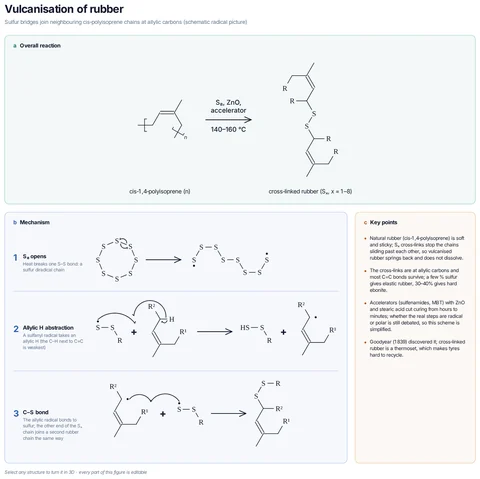
Schematic radical picture of sulfur vulcanisation of natural rubber: heat opens the S₈ ring, a sulfanyl radical takes an allylic hydrogen from cis-1,4-polyisoprene and the allylic radical bonds to sulfur; the other end of the sulfur chain does the same on a second chain, so Sₓ bridges cross-link the chains.
Mechanism step by step
Sulfur bridges join neighbouring cis-polyisoprene chains at allylic carbons (schematic radical picture)
- S₈ opens – Heat breaks one S–S bond: a sulfur diradical chain
- Allylic H abstraction – A sulfanyl radical takes an allylic H (the C–H next to C=C is weakest)
- C–S bond – The allylic radical bonds to sulfur; the other end of the Sₓ chain joins a second rubber chain the same way
Key points
- Natural rubber (cis-1,4-polyisoprene) is soft and sticky; Sₓ cross-links stop the chains sliding past each other, so vulcanised rubber springs back and does not dissolve.
- The cross-links are at allylic carbons and most C=C bonds survive; a few % sulfur gives elastic rubber, 30–40% gives hard ebonite.
- Accelerators (sulfenamides, MBT) with ZnO and stearic acid cut curing from hours to minutes; whether the real steps are radical or polar is still debated, so this scheme is simplified.
- Goodyear (1839) discovered it; cross-linked rubber is a thermoset, which makes tyres hard to recycle.
Drawn with 80 atoms, 11 arrows, 11 shapes – every one editable in MolDraw.
Sources
How to use this template
- Press Edit in MolDraw. The template opens on the canvas of the free MolDraw editor.
- Change anything: move structures, edit atoms and labels, recolour highlights or delete what you do not need.
- Add your own structures, arrows and text next to it, or combine several templates on one page.
- Export the drawing as PNG, SVG or PDF for slides, worksheets, theses and papers.
Frequently asked questions
Is the Vulcanisation of rubber template free?
You can preview the Vulcanisation of rubber template here and open and edit it in MolDraw for free. Downloading or exporting it is part of MolDraw Pro, together with the other premium templates.
Can I edit the Vulcanisation of rubber template?
Yes. It opens as an ordinary MolDraw drawing, so every structure, arrow, label and colour can be changed, and you can add your own content around it.
Is the chemistry checked?
Every structure is checked with RDKit and every curly arrow passes MolDraw’s electron-flow audit. The sources used are listed on this page.
Do the polymer templates show repeat units?
Yes. Each polymer is drawn with its repeat unit in brackets with n, next to the monomers it comes from.