MolDraw › Templates › Polymers › Bakelite: phenol–formaldehyde resin
PolymersPremium
Bakelite: phenol–formaldehyde resin template
Premium template. Preview and edit it free in MolDraw; downloading and exporting it is part of MolDraw Pro.
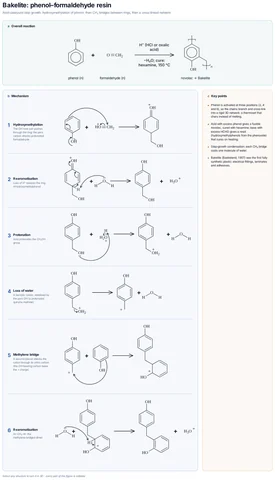
Protonated formaldehyde attacks phenol at the para (or ortho) position, rearomatisation gives a hydroxymethylphenol, loss of water gives a benzylic cation and a second phenol bonds to it: a methylene bridge. Repeated at the 2, 4 and 6 positions this builds the cross-linked Bakelite network.
Mechanism step by step
Acid-catalysed step growth: hydroxymethylation of phenol, then CH₂ bridges between rings, then a cross-linked network
- Hydroxymethylation – The OH lone pair pushes through the ring: the para carbon attacks protonated formaldehyde
- Rearomatisation – Loss of H⁺ restores the ring: 4-hydroxymethylphenol
- Protonation – Acid protonates the CH₂OH group
- Loss of water – A benzylic cation, stabilised by the para OH (a protonated quinone methide)
- Methylene bridge – A second phenol attacks the cation through its ortho carbon (the OH-bearing carbon takes the + charge)
- Rearomatisation – Ar–CH₂–Ar: the methylene-bridged dimer
Key points
- Phenol is activated at three positions (2, 4 and 6), so the chains branch and cross-link into a rigid 3D network: a thermoset that chars instead of melting.
- Acid with excess phenol gives a fusible novolac, cured with hexamine; base with excess HCHO gives a resol (hydroxymethylphenols from the phenoxide) that cures on heating.
- Step-growth condensation: each CH₂ bridge costs one molecule of water.
- Bakelite (Baekeland, 1907) was the first fully synthetic plastic: electrical fittings, laminates and adhesives.
Drawn with 160 atoms, 21 arrows, 14 shapes – every one editable in MolDraw.
Sources
How to use this template
- Press Edit in MolDraw. The template opens on the canvas of the free MolDraw editor.
- Change anything: move structures, edit atoms and labels, recolour highlights or delete what you do not need.
- Add your own structures, arrows and text next to it, or combine several templates on one page.
- Export the drawing as PNG, SVG or PDF for slides, worksheets, theses and papers.
Frequently asked questions
Is the Bakelite: phenol–formaldehyde resin template free?
You can preview the Bakelite: phenol–formaldehyde resin template here and open and edit it in MolDraw for free. Downloading or exporting it is part of MolDraw Pro, together with the other premium templates.
Can I edit the Bakelite: phenol–formaldehyde resin template?
Yes. It opens as an ordinary MolDraw drawing, so every structure, arrow, label and colour can be changed, and you can add your own content around it.
Is the chemistry checked?
Every structure is checked with RDKit and every curly arrow passes MolDraw’s electron-flow audit. The sources used are listed on this page.
Do the polymer templates show repeat units?
Yes. Each polymer is drawn with its repeat unit in brackets with n, next to the monomers it comes from.