MolDraw › Templates › Polymers › Cationic polymerisation
PolymersFree
Cationic polymerisation template
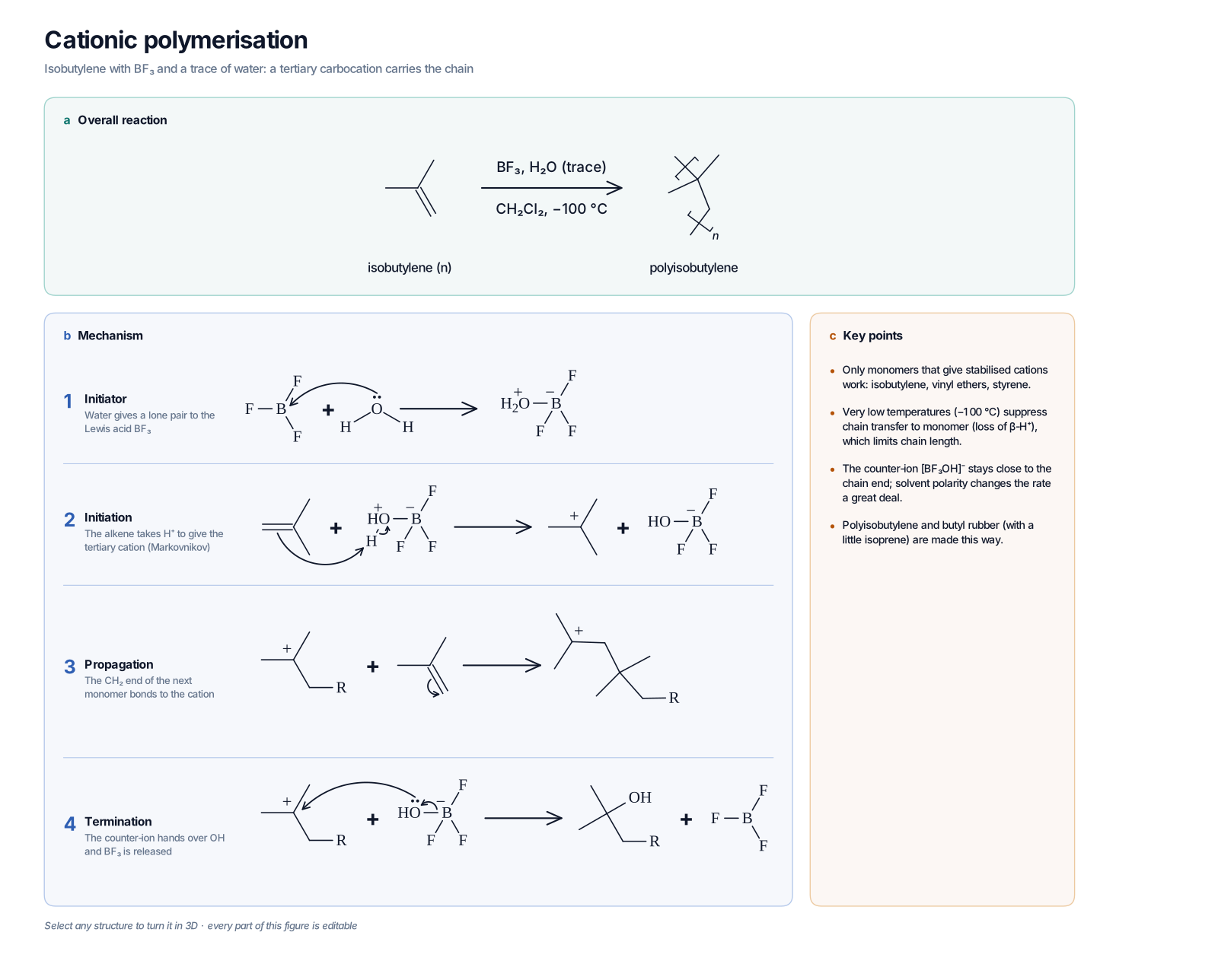
Free template. Download it, or open it in MolDraw to change it first.
BF₃ and H₂O form the protic initiator, which protonates isobutylene to the tert-butyl cation; monomer adds to the cation end, and the chain stops when the counter-ion gives up OH.
Mechanism step by step
Isobutylene with BF₃ and a trace of water: a tertiary carbocation carries the chain
- Initiator – Water gives a lone pair to the Lewis acid BF₃
- Initiation – The alkene takes H⁺ to give the tertiary cation (Markovnikov)
- Propagation – The CH₂ end of the next monomer bonds to the cation
- Termination – The counter-ion hands over OH and BF₃ is released
Key points
- Only monomers that give stabilised cations work: isobutylene, vinyl ethers, styrene.
- Very low temperatures (−100 °C) suppress chain transfer to monomer (loss of β-H⁺), which limits chain length.
- The counter-ion [BF₃OH]⁻ stays close to the chain end; solvent polarity changes the rate a great deal.
- Polyisobutylene and butyl rubber (with a little isoprene) are made this way.
Drawn with 77 atoms, 11 arrows, 12 shapes – every one editable in MolDraw.
Sources
How to use this template
- Press Edit in MolDraw. The template opens on the canvas of the free MolDraw editor.
- Change anything: move structures, edit atoms and labels, recolour highlights or delete what you do not need.
- Add your own structures, arrows and text next to it, or combine several templates on one page.
- Export the drawing as PNG, SVG or PDF for slides, worksheets, theses and papers.
Frequently asked questions
Is the Cationic polymerisation template free?
Yes. The Cationic polymerisation template is one of the free MolDraw templates: open it in the editor or download it from this page as SVG or PNG and use it in your slides, worksheets and notes.
Can I edit the Cationic polymerisation template?
Yes. It opens as an ordinary MolDraw drawing, so every structure, arrow, label and colour can be changed, and you can add your own content around it.
Is the chemistry checked?
Every structure is checked with RDKit and every curly arrow passes MolDraw’s electron-flow audit. The sources used are listed on this page.
Do the polymer templates show repeat units?
Yes. Each polymer is drawn with its repeat unit in brackets with n, next to the monomers it comes from.