MolDraw › Templates › Polymers › Polyurethane formation
PolymersPremium
Polyurethane formation template
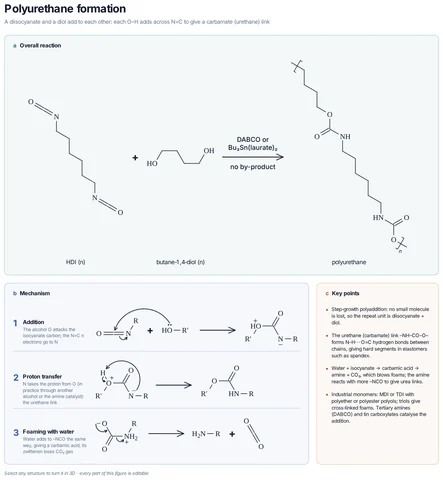
Premium template. Preview and edit it free in MolDraw; downloading and exporting it is part of MolDraw Pro.
The alcohol oxygen of butane-1,4-diol attacks the central carbon of hexamethylene diisocyanate, the N=C π electrons move onto nitrogen and a proton transfer gives the urethane –NH–CO–O– link; with water the isocyanate gives a carbamic acid that loses CO₂, the blowing reaction of polyurethane foams.
Mechanism step by step
A diisocyanate and a diol add to each other: each O–H adds across N=C to give a carbamate (urethane) link
- Addition – The alcohol O attacks the isocyanate carbon; the N=C π electrons go to N
- Proton transfer – N takes the proton from O (in practice through another alcohol or the amine catalyst): the urethane link
- Foaming with water – Water adds to –NCO the same way, giving a carbamic acid; its zwitterion loses CO₂ gas
Key points
- Step-growth polyaddition: no small molecule is lost, so the repeat unit is diisocyanate + diol.
- The urethane (carbamate) link –NH–CO–O– forms N–H···O=C hydrogen bonds between chains, giving hard segments in elastomers such as spandex.
- Water + isocyanate → carbamic acid → amine + CO₂, which blows foams; the amine reacts with more –NCO to give urea links.
- Industrial monomers: MDI or TDI with polyether or polyester polyols; triols give cross-linked foams. Tertiary amines (DABCO) and tin carboxylates catalyse the addition.
Drawn with 73 atoms, 10 arrows, 11 shapes – every one editable in MolDraw.
Sources
How to use this template
- Press Edit in MolDraw. The template opens on the canvas of the free MolDraw editor.
- Change anything: move structures, edit atoms and labels, recolour highlights or delete what you do not need.
- Add your own structures, arrows and text next to it, or combine several templates on one page.
- Export the drawing as PNG, SVG or PDF for slides, worksheets, theses and papers.
Frequently asked questions
Is the Polyurethane formation template free?
You can preview the Polyurethane formation template here and open and edit it in MolDraw for free. Downloading or exporting it is part of MolDraw Pro, together with the other premium templates.
Can I edit the Polyurethane formation template?
Yes. It opens as an ordinary MolDraw drawing, so every structure, arrow, label and colour can be changed, and you can add your own content around it.
Is the chemistry checked?
Every structure is checked with RDKit and every curly arrow passes MolDraw’s electron-flow audit. The sources used are listed on this page.
Do the polymer templates show repeat units?
Yes. Each polymer is drawn with its repeat unit in brackets with n, next to the monomers it comes from.