MolDraw › Templates › Pharma › Drug-likeness beyond the rule of five
PharmaPremium
Drug-likeness beyond the rule of five template
Premium template. Preview and edit it free in MolDraw; downloading and exporting it is part of MolDraw Pro.
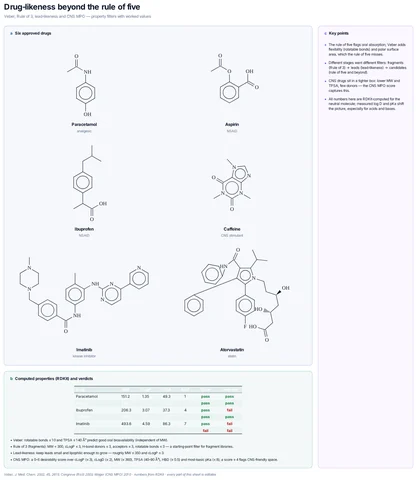
Veber (rotatable bonds ≤ 10, TPSA ≤ 140), the Rule of 3 for fragments, lead-likeness (MW ≤ 350, cLogP ≤ 3) and the CNS MPO bands, with RDKit-computed MW, cLogP, TPSA and rotatable bonds for six common approved drugs and the Veber / lead-like verdicts.
What the template shows
- Veber, Rule of 3, lead-likeness and CNS MPO — property filters with worked values
- Six approved drugs
- CNS stimulant
- kinase inhibitor
- Computed properties (RDKit) and verdicts
- Drug MW cLogP TPSA RotB Veber Lead-like Paracetamol 151.2 1.35 49.3 1 pass pass Aspirin 180.2 1.31 63.6 2 pass pass Ibuprofen 206.3 3.07 37.3 4 pass fail Caffeine 194.2 -1.03 61.8 0 pass pass Imatinib 493.6 4.59 86.3 7 pass fail Atorvastatin 558.7 6.31 111.8 12 fail fail
- Veber: rotatable bonds ≤ 10 and TPSA ≤ 140 Ų predict good oral bioavailability (independent of MW).
- Rule of 3 (fragments): MW < 300, cLogP ≤ 3, H-bond donors ≤ 3, acceptors ≤ 3, rotatable bonds ≤ 3 — a starting-point filter for fragment libraries.
- Lead-likeness: keep leads small and lipophilic enough to grow — roughly MW ≤ 350 and cLogP ≤ 3.
- CNS MPO: a 0–6 desirability score over cLogP (≤ 3), cLogD (≤ 2), MW (≤ 360), TPSA (40–90 Ų), HBD (≤ 0.5) and most-basic pKa (≤ 8); a score ≥ 4 flags CNS-friendly space.
- The rule of five flags oral absorption; Veber adds flexibility (rotatable bonds) and polar surface area, which the rule of five misses.
- Different stages want different filters: fragments (Rule of 3) → leads (lead-likeness) → candidates (rule of five and beyond).
- CNS drugs sit in a tighter box: lower MW and TPSA, few donors — the CNS MPO score captures this.
- All numbers here are RDKit-computed for the neutral molecule; measured log D and pKa shift the picture, especially for acids and bases.
- Veber, J. Med. Chem. 2002, 45, 2615; Congreve (Ro3) 2003; Wager (CNS MPO) 2010 · numbers from RDKit · every part of this sheet is editable
Drawn with 131 atoms, 3 shapes – every one editable in MolDraw.
Sources
- Veber et al., J. Med. Chem. 2002, 45, 2615 Original paper
- Wager et al., ACS Chem. Neurosci. 2010, 1, 435 Original paper
How to use this template
- Press Edit in MolDraw. The template opens on the canvas of the free MolDraw editor.
- Change anything: move structures, edit atoms and labels, recolour highlights or delete what you do not need.
- Add your own structures, arrows and text next to it, or combine several templates on one page.
- Export the drawing as PNG, SVG or PDF for slides, worksheets, theses and papers.
Frequently asked questions
Is the Drug-likeness beyond the rule of five template free?
You can preview the Drug-likeness beyond the rule of five template here and open and edit it in MolDraw for free. Downloading or exporting it is part of MolDraw Pro, together with the other premium templates.
Can I edit the Drug-likeness beyond the rule of five template?
Yes. It opens as an ordinary MolDraw drawing, so every structure, arrow, label and colour can be changed, and you can add your own content around it.
Is the chemistry checked?
Every structure is checked with RDKit and every curly arrow passes MolDraw’s electron-flow audit. The sources used are listed on this page.
Are the IC₅₀ values in the SAR table real?
No. They are illustrative example values so the table can be filled in with your own data; the structures and R-group positions are checked with RDKit.