MolDraw › Templates › Name reactions › Mitsunobu reaction
Name reactionsPremium
Mitsunobu reaction template
Premium template. Preview and edit it free in MolDraw; downloading and exporting it is part of MolDraw Pro.
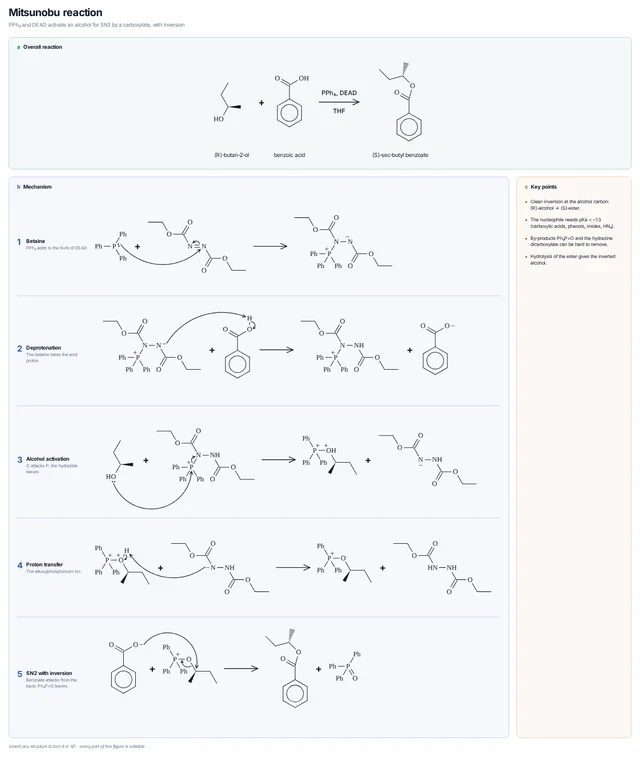
PPh₃ adds to DEAD; the betaine deprotonates benzoic acid, the alcohol attacks phosphorus and benzoate displaces Ph₃P=O to give the inverted ester.
Mechanism step by step
PPh₃ and DEAD activate an alcohol for SN2 by a carboxylate, with inversion
- Betaine – PPh₃ adds to the N=N of DEAD
- Deprotonation – The betaine takes the acid proton
- Alcohol activation – O attacks P; the hydrazide leaves
- Proton transfer – The alkoxyphosphonium ion
- SN2 with inversion – Benzoate attacks from the back; Ph₃P=O leaves
Key points
- Clean inversion at the alcohol carbon: (R)-alcohol → (S)-ester.
- The nucleophile needs pKa < ~13 (carboxylic acids, phenols, imides, HN₃).
- By-products Ph₃P=O and the hydrazine dicarboxylate can be hard to remove.
- Hydrolysis of the ester gives the inverted alcohol.
Drawn with 231 atoms, 16 arrows, 7 shapes – every one editable in MolDraw.
Sources
How to use this template
- Press Edit in MolDraw. The template opens on the canvas of the free MolDraw editor.
- Change anything: move structures, edit atoms and labels, recolour highlights or delete what you do not need.
- Add your own structures, arrows and text next to it, or combine several templates on one page.
- Export the drawing as PNG, SVG or PDF for slides, worksheets, theses and papers.
Frequently asked questions
Is the Mitsunobu reaction template free?
You can preview the Mitsunobu reaction template here and open and edit it in MolDraw for free. Downloading or exporting it is part of MolDraw Pro, together with the other premium templates.
Can I edit the Mitsunobu reaction template?
Yes. It opens as an ordinary MolDraw drawing, so every structure, arrow, label and colour can be changed, and you can add your own content around it.
Is the chemistry checked?
Every structure is checked with RDKit and every curly arrow passes MolDraw’s electron-flow audit. The sources used are listed on this page.
Which name reactions are included?
Over seventy, covering the reactions most often asked in school-leaving exams (A-level, IB, CBSE, JEE and NEET) and first-year university courses, including condensations, rearrangements, oxidations, reductions and aromatic substitutions.