MolDraw › Templates › Medicinal chemistry › NSAIDs and cyclooxygenase
Medicinal chemistryPremium
NSAIDs and cyclooxygenase template
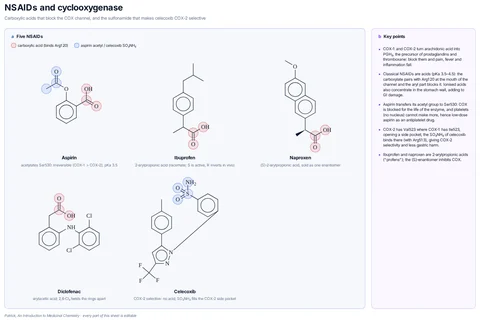
Premium template. Preview and edit it free in MolDraw; downloading and exporting it is part of MolDraw Pro.
Aspirin, ibuprofen, naproxen, diclofenac and celecoxib with the acidic group (or celecoxib’s sulfonamide) circled, notes on how each binds COX-1 and COX-2, and aspirin’s irreversible acetylation of Ser530.
What the template shows
- Carboxylic acids that block the COX channel, and the sulfonamide that makes celecoxib COX-2 selective
- Five NSAIDs
- carboxylic acid (binds Arg120)
- aspirin acetyl / celecoxib SO₂NH₂
- acetylates Ser530: irreversible (COX-1 > COX-2); pKa 3.5
- 2-arylpropionic acid (racemate; S is active, R inverts in vivo)
- (S)-2-arylpropionic acid, sold as one enantiomer
- arylacetic acid; 2,6-Cl₂ twists the rings apart
- COX-2 selective: no acid; SO₂NH₂ fills the COX-2 side pocket
- COX-1 and COX-2 turn arachidonic acid into PGH₂, the precursor of prostaglandins and thromboxane: block them and pain, fever and inflammation fall.
- Classical NSAIDs are acids (pKa 3.5–4.5): the carboxylate pairs with Arg120 at the mouth of the channel and the aryl part blocks it. Ionised acids also concentrate in the stomach wall, adding to GI damage.
- Aspirin transfers its acetyl group to Ser530: COX is blocked for the life of the enzyme, and platelets (no nucleus) cannot make more, hence low-dose aspirin as an antiplatelet drug.
- COX-2 has Val523 where COX-1 has Ile523, opening a side pocket; the SO₂NH₂ of celecoxib binds there (with Arg513), giving COX-2 selectivity and less gastric harm.
- Ibuprofen and naproxen are 2-arylpropionic acids (“profens”); the (S)-enantiomer inhibits COX.
- Patrick, An Introduction to Medicinal Chemistry · every part of this sheet is editable
Drawn with 90 atoms, 23 shapes – every one editable in MolDraw.
Sources
How to use this template
- Press Edit in MolDraw. The template opens on the canvas of the free MolDraw editor.
- Change anything: move structures, edit atoms and labels, recolour highlights or delete what you do not need.
- Add your own structures, arrows and text next to it, or combine several templates on one page.
- Export the drawing as PNG, SVG or PDF for slides, worksheets, theses and papers.
Frequently asked questions
Is the NSAIDs and cyclooxygenase template free?
You can preview the NSAIDs and cyclooxygenase template here and open and edit it in MolDraw for free. Downloading or exporting it is part of MolDraw Pro, together with the other premium templates.
Can I edit the NSAIDs and cyclooxygenase template?
Yes. It opens as an ordinary MolDraw drawing, so every structure, arrow, label and colour can be changed, and you can add your own content around it.
Is the chemistry checked?
Every structure is checked with RDKit and every curly arrow passes MolDraw’s electron-flow audit. The sources used are listed on this page.
Are the drug structures accurate?
Every structure is checked with RDKit, including its stereocentres, and the sheets follow the medicinal chemistry textbooks listed on each template page.