MolDraw › Templates › Medicinal chemistry › Lipinski rule of five
Lipinski rule of five template
Free template. Download it, or open it in MolDraw to change it first.
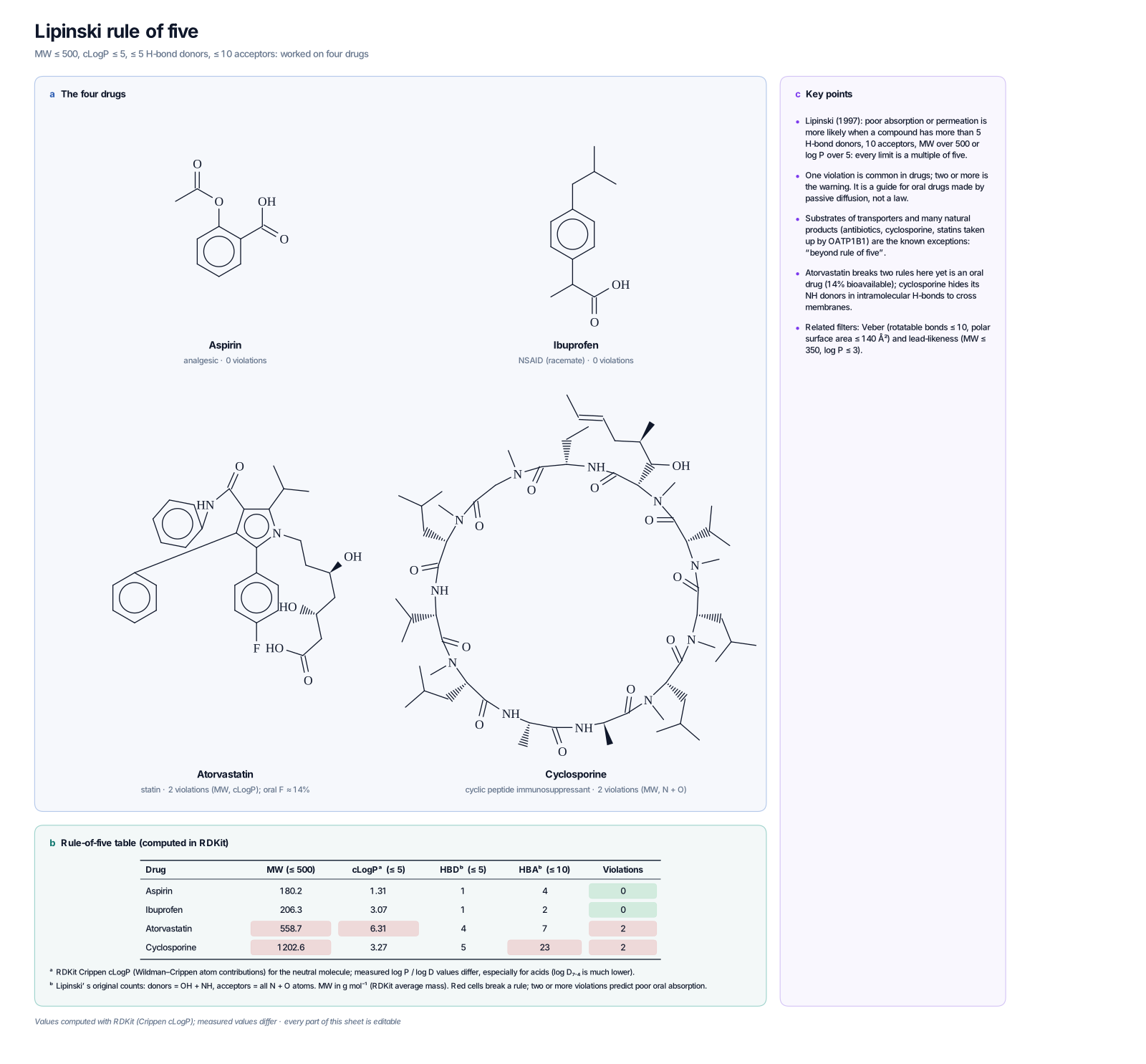
Aspirin, ibuprofen, atorvastatin and cyclosporine with a table of MW, RDKit Crippen cLogP, H-bond donors (OH + NH) and acceptors (N + O) and the number of rule-of-five violations, all computed in RDKit.
What the template shows
- MW ≤ 500, cLogP ≤ 5, ≤ 5 H-bond donors, ≤ 10 acceptors: worked on four drugs
- The four drugs
- analgesic · 0 violations
- NSAID (racemate) · 0 violations
- statin · 2 violations (MW, cLogP); oral F ≈ 14%
- cyclic peptide immunosuppressant · 2 violations (MW, N + O)
- Rule-of-five table (computed in RDKit)
- ᵃ RDKit Crippen cLogP (Wildman–Crippen atom contributions) for the neutral molecule; measured log P / log D values differ, especially for acids (log D₇.₄ is much lower).
- ᵇ Lipinski’s original counts: donors = OH + NH, acceptors = all N + O atoms. MW in g mol⁻¹ (RDKit average mass). Red cells break a rule; two or more violations predict poor oral absorption.
- Lipinski (1997): poor absorption or permeation is more likely when a compound has more than 5 H-bond donors, 10 acceptors, MW over 500 or log P over 5: every limit is a multiple of five.
- One violation is common in drugs; two or more is the warning. It is a guide for oral drugs made by passive diffusion, not a law.
- Substrates of transporters and many natural products (antibiotics, cyclosporine, statins taken up by OATP1B1) are the known exceptions: “beyond rule of five”.
- Atorvastatin breaks two rules here yet is an oral drug (14% bioavailable); cyclosporine hides its NH donors in intramolecular H-bonds to cross membranes.
- Related filters: Veber (rotatable bonds ≤ 10, polar surface area ≤ 140 Ų) and lead-likeness (MW ≤ 350, log P ≤ 3).
- Values computed with RDKit (Crippen cLogP); measured values differ · every part of this sheet is editable
Drawn with 154 atoms, 14 shapes – every one editable in MolDraw.
Sources
How to use this template
- Press Edit in MolDraw. The template opens on the canvas of the free MolDraw editor.
- Change anything: move structures, edit atoms and labels, recolour highlights or delete what you do not need.
- Add your own structures, arrows and text next to it, or combine several templates on one page.
- Export the drawing as PNG, SVG or PDF for slides, worksheets, theses and papers.
Frequently asked questions
Is the Lipinski rule of five template free?
Yes. The Lipinski rule of five template is one of the free MolDraw templates: open it in the editor or download it from this page as SVG or PNG and use it in your slides, worksheets and notes.
Can I edit the Lipinski rule of five template?
Yes. It opens as an ordinary MolDraw drawing, so every structure, arrow, label and colour can be changed, and you can add your own content around it.
Is the chemistry checked?
Every structure is checked with RDKit and every curly arrow passes MolDraw’s electron-flow audit. The sources used are listed on this page.
Are the drug structures accurate?
Every structure is checked with RDKit, including its stereocentres, and the sheets follow the medicinal chemistry textbooks listed on each template page.