MolDraw › Templates › Medicinal chemistry › β-Lactam antibiotics
β-Lactam antibiotics template
Free template. Download it, or open it in MolDraw to change it first.
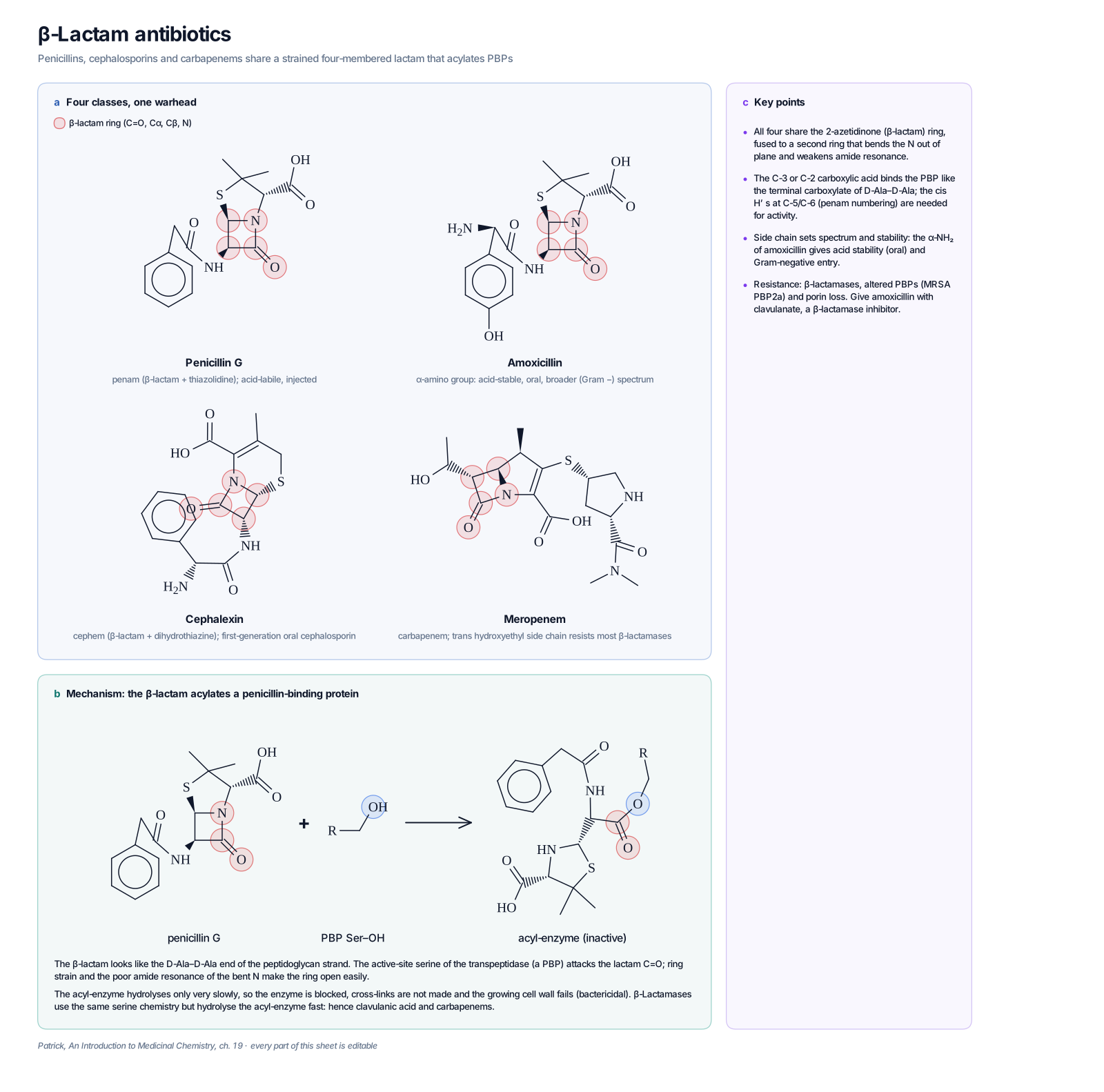
Penicillin G, amoxicillin, cephalexin and meropenem with the β-lactam ring circled, and how it works: the strained amide acylates the active-site serine of penicillin-binding proteins (transpeptidases) and stops cell-wall cross-linking.
What the template shows
- Penicillins, cephalosporins and carbapenems share a strained four-membered lactam that acylates PBPs
- Four classes, one warhead
- β-lactam ring (C=O, Cα, Cβ, N)
- penam (β-lactam + thiazolidine); acid-labile, injected
- α-amino group: acid-stable, oral, broader (Gram −) spectrum
- cephem (β-lactam + dihydrothiazine); first-generation oral cephalosporin
- carbapenem; trans hydroxyethyl side chain resists most β-lactamases
- Mechanism: the β-lactam acylates a penicillin-binding protein
- PBP Ser–OH
- acyl-enzyme (inactive)
- The β-lactam looks like the D-Ala–D-Ala end of the peptidoglycan strand. The active-site serine of the transpeptidase (a PBP) attacks the lactam C=O; ring strain and the poor amide resonance of the bent N make the ring open easily.
- The acyl-enzyme hydrolyses only very slowly, so the enzyme is blocked, cross-links are not made and the growing cell wall fails (bactericidal). β-Lactamases use the same serine chemistry but hydrolyse the acyl-enzyme fast: hence clavulanic acid and carbapenems.
- All four share the 2-azetidinone (β-lactam) ring, fused to a second ring that bends the N out of plane and weakens amide resonance.
- The C-3 or C-2 carboxylic acid binds the PBP like the terminal carboxylate of D-Ala–D-Ala; the cis H’s at C-5/C-6 (penam numbering) are needed for activity.
- Side chain sets spectrum and stability: the α-NH₂ of amoxicillin gives acid stability (oral) and Gram-negative entry.
- Resistance: β-lactamases, altered PBPs (MRSA PBP2a) and porin loss. Give amoxicillin with clavulanate, a β-lactamase inhibitor.
- Patrick, An Introduction to Medicinal Chemistry, ch. 19 · every part of this sheet is editable
Drawn with 150 atoms, 1 arrow, 31 shapes – every one editable in MolDraw.
Sources
How to use this template
- Press Edit in MolDraw. The template opens on the canvas of the free MolDraw editor.
- Change anything: move structures, edit atoms and labels, recolour highlights or delete what you do not need.
- Add your own structures, arrows and text next to it, or combine several templates on one page.
- Export the drawing as PNG, SVG or PDF for slides, worksheets, theses and papers.
Frequently asked questions
Is the β-Lactam antibiotics template free?
Yes. The β-Lactam antibiotics template is one of the free MolDraw templates: open it in the editor or download it from this page as SVG or PNG and use it in your slides, worksheets and notes.
Can I edit the β-Lactam antibiotics template?
Yes. It opens as an ordinary MolDraw drawing, so every structure, arrow, label and colour can be changed, and you can add your own content around it.
Is the chemistry checked?
Every structure is checked with RDKit and every curly arrow passes MolDraw’s electron-flow audit. The sources used are listed on this page.
Are the drug structures accurate?
Every structure is checked with RDKit, including its stereocentres, and the sheets follow the medicinal chemistry textbooks listed on each template page.