MolDraw › Templates › Lab safety › SOP: LiAlH₄ quench (Fieser)
Lab safetyFree
SOP: LiAlH₄ quench (Fieser) template
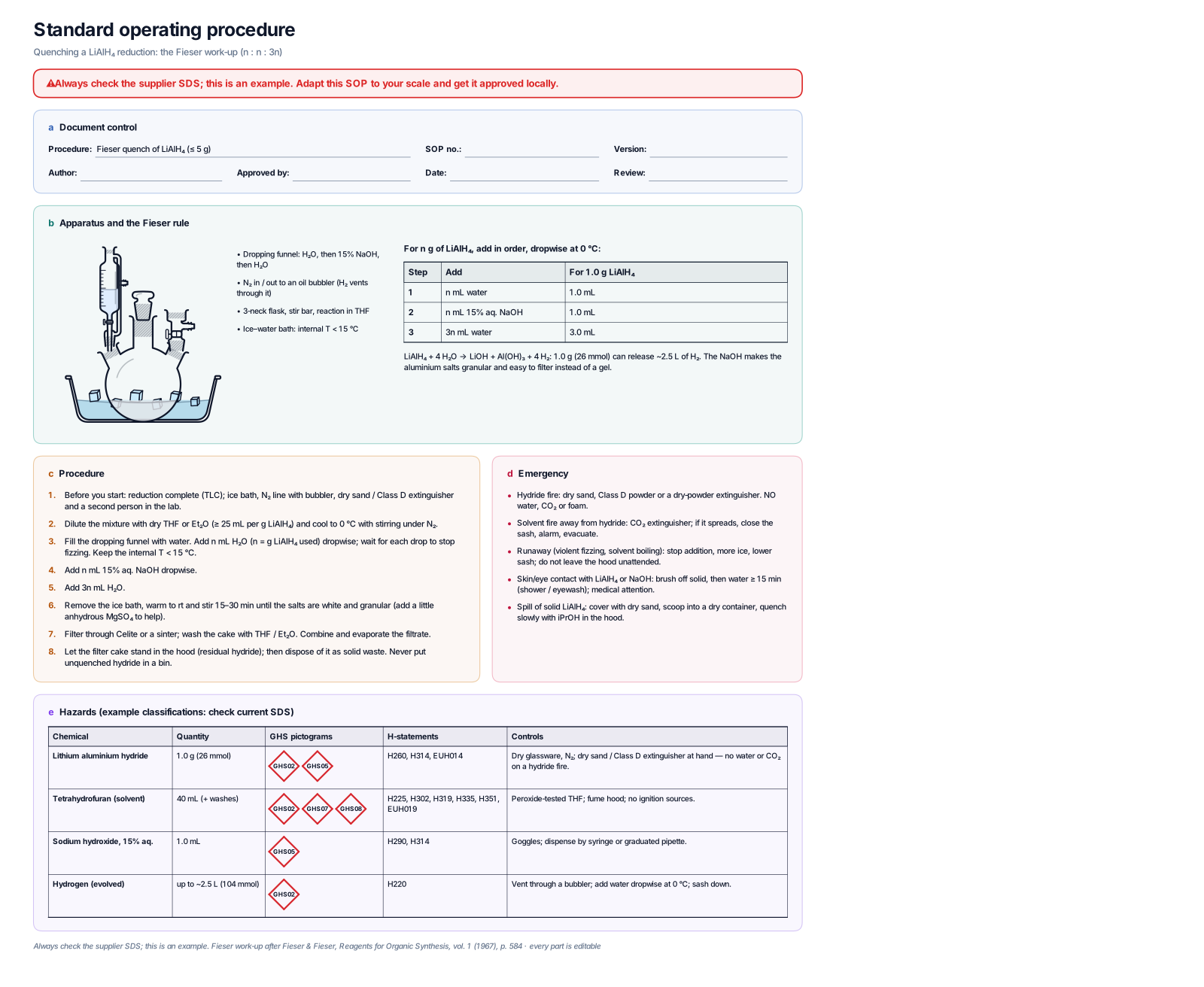
Free template. Download it, or open it in MolDraw to change it first.
Standard operating procedure for quenching a lithium aluminium hydride reduction by the Fieser work-up (n mL H₂O, n mL 15% NaOH, 3n mL H₂O per n g LiAlH₄): document control, apparatus, the n:n:3n rule worked for 1.0 g, step list, hazard table and emergency actions.
What the template shows
- Standard operating procedure
- Quenching a LiAlH₄ reduction: the Fieser work-up (n : n : 3n)
- ⚠ Always check the supplier SDS; this is an example. Adapt this SOP to your scale and get it approved locally.
- Document control
- Fieser quench of LiAlH₄ (≤ 5 g)
- Apparatus and the Fieser rule
- Dropping funnel: H₂O, then 15% NaOH, then H₂O
- N₂ in / out to an oil bubbler (H₂ vents through it)
- 3-neck flask, stir bar, reaction in THF
- Ice–water bath: internal T < 15 °C
- For n g of LiAlH₄, add in order, dropwise at 0 °C:
- For 1.0 g LiAlH₄
- LiAlH₄ + 4 H₂O → LiOH + Al(OH)₃ + 4 H₂: 1.0 g (26 mmol) can release ~2.5 L of H₂. The NaOH makes the aluminium salts granular and easy to filter instead of a gel.
- Before you start: reduction complete (TLC); ice bath, N₂ line with bubbler, dry sand / Class D extinguisher and a second person in the lab.
- Dilute the mixture with dry THF or Et₂O (≥ 25 mL per g LiAlH₄) and cool to 0 °C with stirring under N₂.
- Fill the dropping funnel with water. Add n mL H₂O (n = g LiAlH₄ used) dropwise; wait for each drop to stop fizzing. Keep the internal T < 15 °C.
- Add n mL 15% aq. NaOH dropwise.
- Remove the ice bath, warm to rt and stir 15–30 min until the salts are white and granular (add a little anhydrous MgSO₄ to help).
- Filter through Celite or a sinter; wash the cake with THF / Et₂O. Combine and evaporate the filtrate.
- Let the filter cake stand in the hood (residual hydride); then dispose of it as solid waste. Never put unquenched hydride in a bin.
- Hydride fire: dry sand, Class D powder or a dry-powder extinguisher. NO water, CO₂ or foam.
- Solvent fire away from hydride: CO₂ extinguisher; if it spreads, close the sash, alarm, evacuate.
- Runaway (violent fizzing, solvent boiling): stop addition, more ice, lower sash; do not leave the hood unattended.
- Skin/eye contact with LiAlH₄ or NaOH: brush off solid, then water ≥ 15 min (shower / eyewash); medical attention.
Drawn with 69 shapes – every one editable in MolDraw.
Sources
How to use this template
- Press Edit in MolDraw. The template opens on the canvas of the free MolDraw editor.
- Change anything: move structures, edit atoms and labels, recolour highlights or delete what you do not need.
- Add your own structures, arrows and text next to it, or combine several templates on one page.
- Export the drawing as PNG, SVG or PDF for slides, worksheets, theses and papers.
Frequently asked questions
Is the SOP: LiAlH₄ quench (Fieser) template free?
Yes. The SOP: LiAlH₄ quench (Fieser) template is one of the free MolDraw templates: open it in the editor or download it from this page as SVG or PNG and use it in your slides, worksheets and notes.
Can I edit the SOP: LiAlH₄ quench (Fieser) template?
Yes. It opens as an ordinary MolDraw drawing, so every structure, arrow, label and colour can be changed, and you can add your own content around it.
Is the chemistry checked?
Every structure is checked with RDKit and every curly arrow passes MolDraw’s electron-flow audit. The sources used are listed on this page.
Do the lab safety templates follow GHS?
Yes. Pictograms and hazard classes follow the UN Globally Harmonized System; check them against your institution’s own forms before use.