MolDraw › Templates › Lab safety › Risk assessment (COSHH) form
Lab safetyFree
Risk assessment (COSHH) form template
Free template. Download it, or open it in MolDraw to change it first.
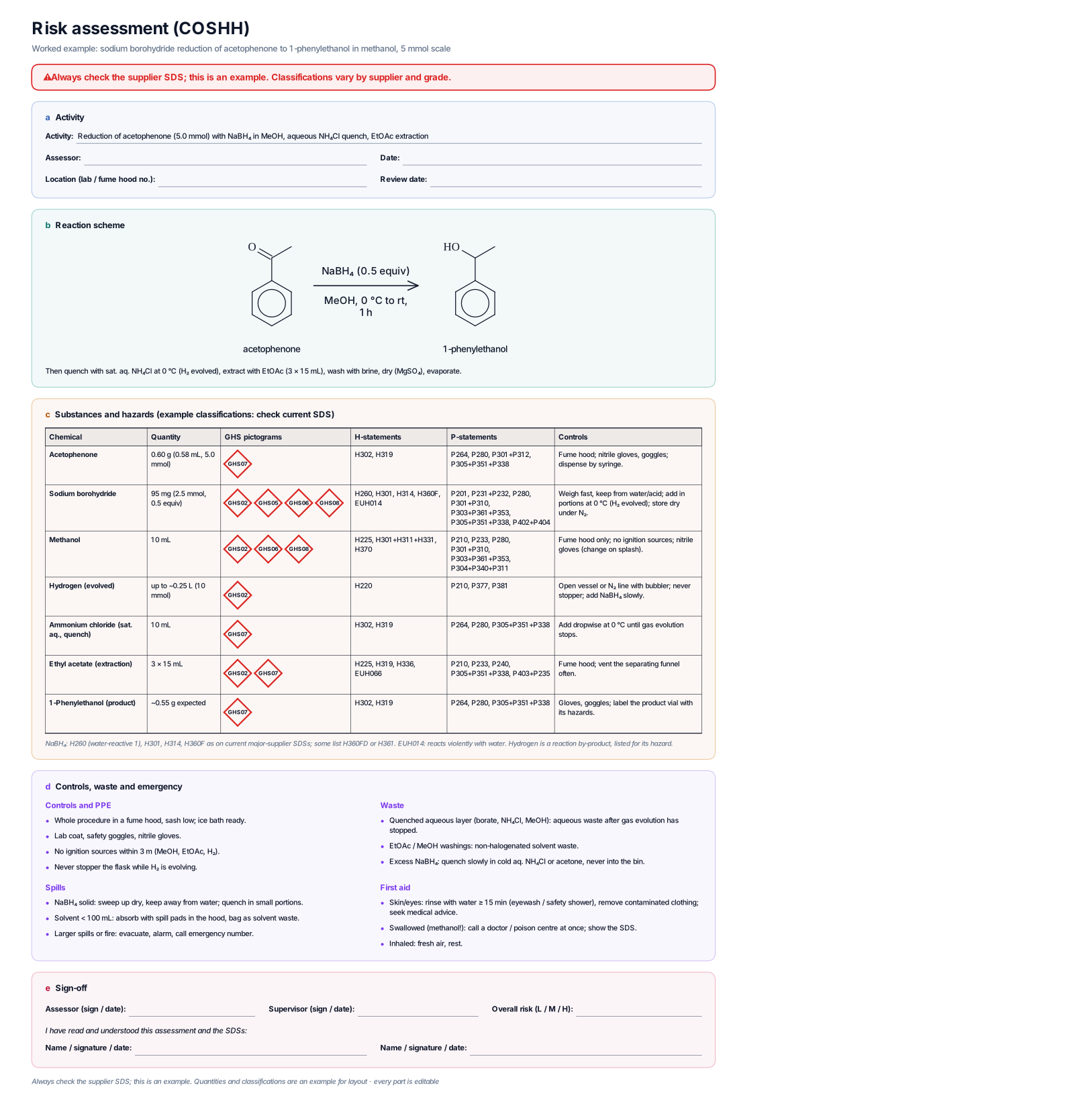
A COSHH-style risk assessment worked for the NaBH₄ reduction of acetophenone in methanol: header fields, the reaction scheme, a per-chemical table with GHS pictograms, H- and P-statements and controls, then PPE, waste, spills, first aid and sign-off.
What the template shows
- Risk assessment (COSHH)
- Worked example: sodium borohydride reduction of acetophenone to 1-phenylethanol in methanol, 5 mmol scale
- ⚠ Always check the supplier SDS; this is an example. Classifications vary by supplier and grade.
- Reduction of acetophenone (5.0 mmol) with NaBH₄ in MeOH, aqueous NH₄Cl quench, EtOAc extraction
- Location (lab / fume hood no.):
- Review date:
- Reaction scheme
- Then quench with sat. aq. NH₄Cl at 0 °C (H₂ evolved), extract with EtOAc (3 × 15 mL), wash with brine, dry (MgSO₄), evaporate.
- Substances and hazards (example classifications: check current SDS)
- GHS pictograms
- Fume hood; nitrile gloves, goggles; dispense by syringe.
- Sodium borohydride
- Weigh fast, keep from water/acid; add in portions at 0 °C (H₂ evolved); store dry under N₂.
- Fume hood only; no ignition sources; nitrile gloves (change on splash).
- Hydrogen (evolved)
- Open vessel or N₂ line with bubbler; never stopper; add NaBH₄ slowly.
- Ammonium chloride (sat. aq., quench)
- Add dropwise at 0 °C until gas evolution stops.
- Ethyl acetate (extraction)
- Fume hood; vent the separating funnel often.
- 1-Phenylethanol (product)
- Gloves, goggles; label the product vial with its hazards.
- NaBH₄: H260 (water-reactive 1), H301, H314, H360F as on current major-supplier SDSs; some list H360FD or H361. EUH014: reacts violently with water. Hydrogen is a reaction by-product, listed for its hazard.
- Controls, waste and emergency
Drawn with 18 atoms, 1 arrow, 85 shapes – every one editable in MolDraw.
Sources
How to use this template
- Press Edit in MolDraw. The template opens on the canvas of the free MolDraw editor.
- Change anything: move structures, edit atoms and labels, recolour highlights or delete what you do not need.
- Add your own structures, arrows and text next to it, or combine several templates on one page.
- Export the drawing as PNG, SVG or PDF for slides, worksheets, theses and papers.
Frequently asked questions
Is the Risk assessment (COSHH) form template free?
Yes. The Risk assessment (COSHH) form template is one of the free MolDraw templates: open it in the editor or download it from this page as SVG or PNG and use it in your slides, worksheets and notes.
Can I edit the Risk assessment (COSHH) form template?
Yes. It opens as an ordinary MolDraw drawing, so every structure, arrow, label and colour can be changed, and you can add your own content around it.
Is the chemistry checked?
Every structure is checked with RDKit and every curly arrow passes MolDraw’s electron-flow audit. The sources used are listed on this page.
Do the lab safety templates follow GHS?
Yes. Pictograms and hazard classes follow the UN Globally Harmonized System; check them against your institution’s own forms before use.