MolDraw › Templates › Name reactions › Kolbe–Schmitt reaction
Name reactionsPremium
Kolbe–Schmitt reaction template
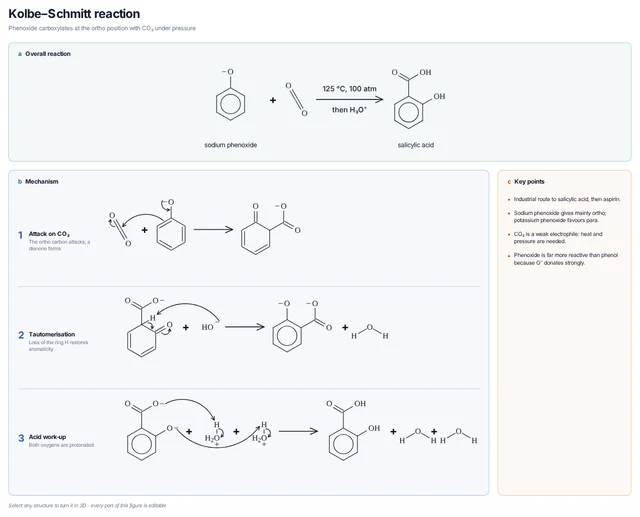
Premium template. Preview and edit it free in MolDraw; downloading and exporting it is part of MolDraw Pro.
Phenoxide attacks CO₂ through its ring carbon, the dienone tautomerises and acid work-up gives salicylic acid.
Mechanism step by step
Phenoxide carboxylates at the ortho position with CO₂ under pressure
- Attack on CO₂ – The ortho carbon attacks; a dienone forms
- Tautomerisation – Loss of the ring H restores aromaticity
- Acid work-up – Both oxygens are protonated
Key points
- Industrial route to salicylic acid, then aspirin.
- Sodium phenoxide gives mainly ortho; potassium phenoxide favours para.
- CO₂ is a weak electrophile: heat and pressure are needed.
- Phenoxide is far more reactive than phenol because O⁻ donates strongly.
Drawn with 89 atoms, 14 arrows, 5 shapes – every one editable in MolDraw.
Sources
How to use this template
- Press Edit in MolDraw. The template opens on the canvas of the free MolDraw editor.
- Change anything: move structures, edit atoms and labels, recolour highlights or delete what you do not need.
- Add your own structures, arrows and text next to it, or combine several templates on one page.
- Export the drawing as PNG, SVG or PDF for slides, worksheets, theses and papers.
Frequently asked questions
Is the Kolbe–Schmitt reaction template free?
You can preview the Kolbe–Schmitt reaction template here and open and edit it in MolDraw for free. Downloading or exporting it is part of MolDraw Pro, together with the other premium templates.
Can I edit the Kolbe–Schmitt reaction template?
Yes. It opens as an ordinary MolDraw drawing, so every structure, arrow, label and colour can be changed, and you can add your own content around it.
Is the chemistry checked?
Every structure is checked with RDKit and every curly arrow passes MolDraw’s electron-flow audit. The sources used are listed on this page.
Which name reactions are included?
Over seventy, covering the reactions most often asked in school-leaving exams (A-level, IB, CBSE, JEE and NEET) and first-year university courses, including condensations, rearrangements, oxidations, reductions and aromatic substitutions.