MolDraw › Templates › Name reactions › Favorskii rearrangement
Name reactionsPremium
Favorskii rearrangement template
Premium template. Preview and edit it free in MolDraw; downloading and exporting it is part of MolDraw Pro.
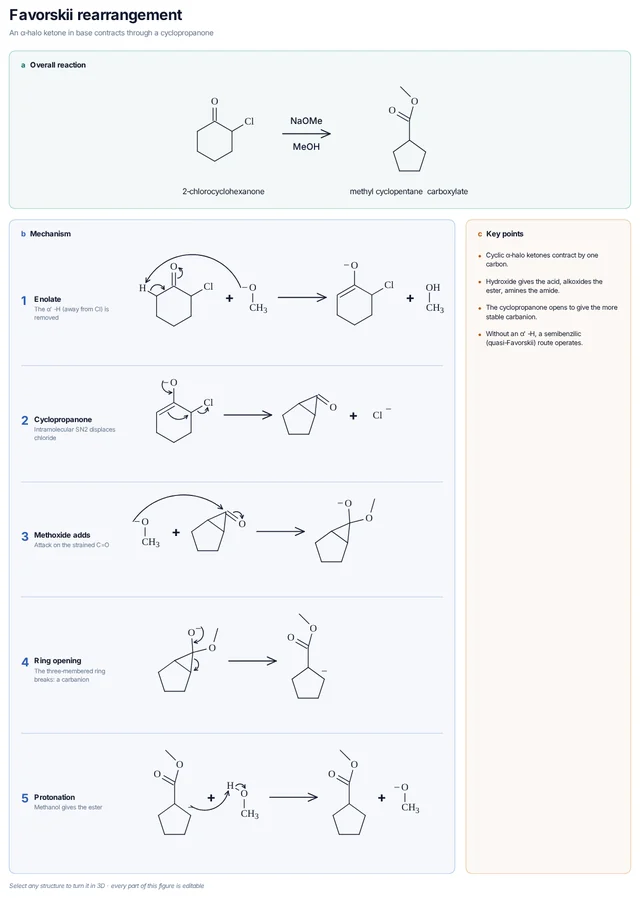
2-Chlorocyclohexanone forms an enolate on the other α-carbon, closes to a cyclopropanone, and methoxide opens it to methyl cyclopentanecarboxylate.
Mechanism step by step
An α-halo ketone in base contracts through a cyclopropanone
- Enolate – The α′-H (away from Cl) is removed
- Cyclopropanone – Intramolecular SN2 displaces chloride
- Methoxide adds – Attack on the strained C=O
- Ring opening – The three-membered ring breaks: a carbanion
- Protonation – Methanol gives the ester
Key points
- Cyclic α-halo ketones contract by one carbon.
- Hydroxide gives the acid, alkoxides the ester, amines the amide.
- The cyclopropanone opens to give the more stable carbanion.
- Without an α′-H, a semibenzilic (quasi-Favorskii) route operates.
Drawn with 113 atoms, 18 arrows, 7 shapes – every one editable in MolDraw.
Sources
How to use this template
- Press Edit in MolDraw. The template opens on the canvas of the free MolDraw editor.
- Change anything: move structures, edit atoms and labels, recolour highlights or delete what you do not need.
- Add your own structures, arrows and text next to it, or combine several templates on one page.
- Export the drawing as PNG, SVG or PDF for slides, worksheets, theses and papers.
Frequently asked questions
Is the Favorskii rearrangement template free?
You can preview the Favorskii rearrangement template here and open and edit it in MolDraw for free. Downloading or exporting it is part of MolDraw Pro, together with the other premium templates.
Can I edit the Favorskii rearrangement template?
Yes. It opens as an ordinary MolDraw drawing, so every structure, arrow, label and colour can be changed, and you can add your own content around it.
Is the chemistry checked?
Every structure is checked with RDKit and every curly arrow passes MolDraw’s electron-flow audit. The sources used are listed on this page.
Which name reactions are included?
Over seventy, covering the reactions most often asked in school-leaving exams (A-level, IB, CBSE, JEE and NEET) and first-year university courses, including condensations, rearrangements, oxidations, reductions and aromatic substitutions.