MolDraw › Templates › Name reactions › Carbylamine reaction
Name reactionsPremium
Carbylamine reaction template
Premium template. Preview and edit it free in MolDraw; downloading and exporting it is part of MolDraw Pro.
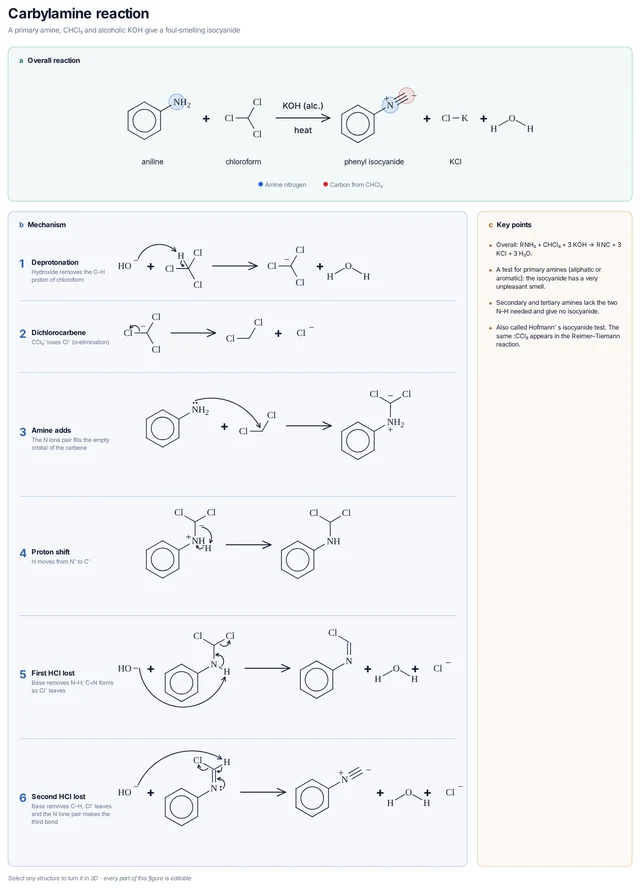
Base turns chloroform into dichlorocarbene; aniline adds to it, two molecules of HCl are lost and phenyl isocyanide forms. Only primary amines (two N–H) can do this.
Mechanism step by step
A primary amine, CHCl₃ and alcoholic KOH give a foul-smelling isocyanide
- Deprotonation – Hydroxide removes the C–H proton of chloroform
- Dichlorocarbene – CCl₃⁻ loses Cl⁻ (α-elimination)
- Amine adds – The N lone pair fills the empty orbital of the carbene
- Proton shift – H moves from N⁺ to C⁻
- First HCl lost – Base removes N–H; C=N forms as Cl⁻ leaves
- Second HCl lost – Base removes C–H, Cl⁻ leaves and the N lone pair makes the third bond
Key points
- Overall: RNH₂ + CHCl₃ + 3 KOH → RNC + 3 KCl + 3 H₂O.
- A test for primary amines (aliphatic or aromatic): the isocyanide has a very unpleasant smell.
- Secondary and tertiary amines lack the two N–H needed and give no isocyanide.
- Also called Hofmann’s isocyanide test. The same :CCl₂ appears in the Reimer–Tiemann reaction.
Drawn with 126 atoms, 20 arrows, 11 shapes – every one editable in MolDraw.
Sources
How to use this template
- Press Edit in MolDraw. The template opens on the canvas of the free MolDraw editor.
- Change anything: move structures, edit atoms and labels, recolour highlights or delete what you do not need.
- Add your own structures, arrows and text next to it, or combine several templates on one page.
- Export the drawing as PNG, SVG or PDF for slides, worksheets, theses and papers.
Frequently asked questions
Is the Carbylamine reaction template free?
You can preview the Carbylamine reaction template here and open and edit it in MolDraw for free. Downloading or exporting it is part of MolDraw Pro, together with the other premium templates.
Can I edit the Carbylamine reaction template?
Yes. It opens as an ordinary MolDraw drawing, so every structure, arrow, label and colour can be changed, and you can add your own content around it.
Is the chemistry checked?
Every structure is checked with RDKit and every curly arrow passes MolDraw’s electron-flow audit. The sources used are listed on this page.
Which name reactions are included?
Over seventy, covering the reactions most often asked in school-leaving exams (A-level, IB, CBSE, JEE and NEET) and first-year university courses, including condensations, rearrangements, oxidations, reductions and aromatic substitutions.