MolDraw › Templates › Mechanisms › Brady's test: 2,4-DNP hydrazone
MechanismsPremium
Brady's test: 2,4-DNP hydrazone template
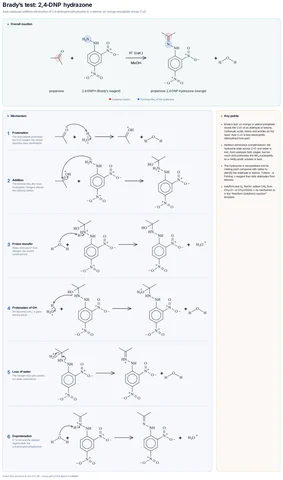
Premium template. Preview and edit it free in MolDraw; downloading and exporting it is part of MolDraw Pro.
Brady's reagent (2,4-dinitrophenylhydrazine in acid) with propanone: protonation of C=O, attack by the terminal NH₂, proton transfers, loss of water and deprotonation give the orange propanone 2,4-dinitrophenylhydrazone. For A-level and NCERT Class 12; the iodoform test is in the Haloform (iodoform) reaction template.
Mechanism step by step
Acid-catalysed addition–elimination of 2,4-dinitrophenylhydrazine to a ketone: an orange precipitate shows C=O
- Protonation – The acid catalyst protonates the C=O oxygen: the carbon becomes more electrophilic
- Addition – The terminal NH₂ (the more nucleophilic nitrogen) attacks the carbonyl carbon
- Proton transfer – Water removes H⁺ from nitrogen: the neutral carbinolamine
- Protonation of OH – OH becomes OH₂⁺, a good leaving group
- Loss of water – The nitrogen lone pair pushes out water (elimination)
- Deprotonation – H⁺ is lost and the catalyst regenerated: the 2,4-dinitrophenylhydrazone
Key points
- Brady's test: an orange or yellow precipitate shows the C=O of an aldehyde or ketone. Carboxylic acids, esters and amides do not react: their C=O is less electrophilic (delocalised lone pair).
- Addition–elimination (condensation): the hydrazine adds across C=O and water is lost. Acid catalyses both stages, but too much acid protonates the NH₂ nucleophile, so a mildly acidic solution is best.
- The hydrazone is recrystallised and its melting point compared with tables to identify the aldehyde or ketone. Tollens’ or Fehling’s reagent then tells aldehydes from ketones.
- Iodoform test (I₂, NaOH: yellow CHI₃ from CH₃CO– or CH₃CH(OH)–): its mechanism is in the "Haloform (iodoform) reaction" template.
Drawn with 234 atoms, 19 arrows, 12 shapes – every one editable in MolDraw.
Sources
How to use this template
- Press Edit in MolDraw. The template opens on the canvas of the free MolDraw editor.
- Change anything: move structures, edit atoms and labels, recolour highlights or delete what you do not need.
- Add your own structures, arrows and text next to it, or combine several templates on one page.
- Export the drawing as PNG, SVG or PDF for slides, worksheets, theses and papers.
Frequently asked questions
Is the Brady's test: 2,4-DNP hydrazone template free?
You can preview the Brady's test: 2,4-DNP hydrazone template here and open and edit it in MolDraw for free. Downloading or exporting it is part of MolDraw Pro, together with the other premium templates.
Can I edit the Brady's test: 2,4-DNP hydrazone template?
Yes. It opens as an ordinary MolDraw drawing, so every structure, arrow, label and colour can be changed, and you can add your own content around it.
Is the chemistry checked?
Every structure is checked with RDKit and every curly arrow passes MolDraw’s electron-flow audit. The sources used are listed on this page.
What is a curly-arrow mechanism template?
A ready-made drawing of a reaction mechanism in which curved arrows show where electron pairs move in each step. You can open it in MolDraw, change the substrate and reuse it.