MolDraw › Templates › Name reactions › Arndt–Eistert homologation and Wolff rearrangement
Name reactionsPremium
Arndt–Eistert homologation and Wolff rearrangement template
Premium template. Preview and edit it free in MolDraw; downloading and exporting it is part of MolDraw Pro.
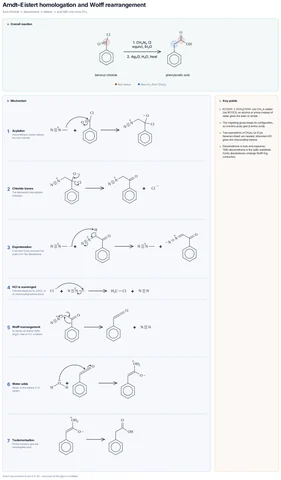
Diazomethane acylates on carbon; a second equivalent removes the proton (and ends up as CH₃Cl and N₂), giving the α-diazoketone. Silver(I), heat or light then triggers the Wolff rearrangement: N₂ leaves as the phenyl group moves to the neighbouring carbon, giving a ketene that water traps as phenylacetic acid.
Mechanism step by step
Acid chloride → diazoketone → ketene → acid with one more CH₂
- Acylation – Diazomethane carbon attacks the acid chloride
- Chloride leaves – The tetrahedral intermediate collapses
- Deprotonation – A second CH₂N₂ removes the acidic α-H: the diazoketone
- HCl is scavenged – Chloride displaces N₂ (SN2), so no chloromethyl ketone forms
- Wolff rearrangement – N₂ leaves as phenyl shifts (Ag₂O, heat or hν): a ketene
- Water adds – Attack on the ketene C=O carbon
- Tautomerisation – Proton transfers give the homologated acid
Key points
- RCOOH → RCH₂COOH: one CH₂ is added (via RCOCl); an alcohol or amine instead of water gives the ester or amide.
- The migrating group keeps its configuration, so α-amino acids give β-amino acids.
- Two equivalents of CH₂N₂ (or Et₃N, Newman–Beal) are needed; otherwise HCl gives the chloromethyl ketone.
- Diazomethane is toxic and explosive; TMS-diazomethane is the safer substitute. Cyclic diazoketones undergo Wolff ring contraction.
Drawn with 166 atoms, 22 arrows, 12 shapes – every one editable in MolDraw.
Sources
- Kürti & Czakó, Strategic Applications of Named Reactions in Organic Synthesis, Elsevier 2005, Arndt–Eistert homologation; Wolff rearrangement Textbook
- Clayden, Greeves & Warren, Organic Chemistry, 2nd ed., OUP 2012, ch. 38 Textbook
- Smith, March's Advanced Organic Chemistry, 8th ed., Wiley 2020, ch. 18 Textbook
How to use this template
- Press Edit in MolDraw. The template opens on the canvas of the free MolDraw editor.
- Change anything: move structures, edit atoms and labels, recolour highlights or delete what you do not need.
- Add your own structures, arrows and text next to it, or combine several templates on one page.
- Export the drawing as PNG, SVG or PDF for slides, worksheets, theses and papers.
Frequently asked questions
Is the Arndt–Eistert homologation and Wolff rearrangement template free?
You can preview the Arndt–Eistert homologation and Wolff rearrangement template here and open and edit it in MolDraw for free. Downloading or exporting it is part of MolDraw Pro, together with the other premium templates.
Can I edit the Arndt–Eistert homologation and Wolff rearrangement template?
Yes. It opens as an ordinary MolDraw drawing, so every structure, arrow, label and colour can be changed, and you can add your own content around it.
Is the chemistry checked?
Every structure is checked with RDKit and every curly arrow passes MolDraw’s electron-flow audit. The sources used are listed on this page.
Which name reactions are included?
Over seventy, covering the reactions most often asked in school-leaving exams (A-level, IB, CBSE, JEE and NEET) and first-year university courses, including condensations, rearrangements, oxidations, reductions and aromatic substitutions.