MolDraw › Templates › Mechanisms › Alkylation of acetylide ions
MechanismsPremium
Alkylation of acetylide ions template
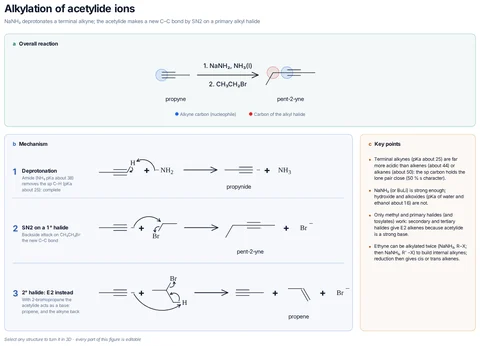
Premium template. Preview and edit it free in MolDraw; downloading and exporting it is part of MolDraw Pro.
Propyne (pKa about 25) is deprotonated by amide ion; the acetylide attacks bromoethane by SN2 to give pent-2-yne. With a secondary or tertiary halide the strongly basic acetylide removes a β-H instead (E2).
Mechanism step by step
NaNH₂ deprotonates a terminal alkyne; the acetylide makes a new C–C bond by SN2 on a primary alkyl halide
- Deprotonation – Amide (NH₃ pKa about 38) removes the sp C–H (pKa about 25): complete
- SN2 on a 1° halide – Backside attack on CH₃CH₂Br: the new C–C bond
- 2° halide: E2 instead – With 2-bromopropane the acetylide acts as a base: propene, and the alkyne back
Key points
- Terminal alkynes (pKa about 25) are far more acidic than alkenes (about 44) or alkanes (about 50): the sp carbon holds the lone pair close (50 % s character).
- NaNH₂ (or BuLi) is strong enough; hydroxide and alkoxides (pKa of water and ethanol about 16) are not.
- Only methyl and primary halides (and tosylates) work: secondary and tertiary halides give E2 alkenes because acetylide is a strong base.
- Ethyne can be alkylated twice (NaNH₂, R–X; then NaNH₂, R′–X) to build internal alkynes; reduction then gives cis or trans alkenes.
Drawn with 44 atoms, 11 arrows, 8 shapes – every one editable in MolDraw.
Sources
How to use this template
- Press Edit in MolDraw. The template opens on the canvas of the free MolDraw editor.
- Change anything: move structures, edit atoms and labels, recolour highlights or delete what you do not need.
- Add your own structures, arrows and text next to it, or combine several templates on one page.
- Export the drawing as PNG, SVG or PDF for slides, worksheets, theses and papers.
Frequently asked questions
Is the Alkylation of acetylide ions template free?
You can preview the Alkylation of acetylide ions template here and open and edit it in MolDraw for free. Downloading or exporting it is part of MolDraw Pro, together with the other premium templates.
Can I edit the Alkylation of acetylide ions template?
Yes. It opens as an ordinary MolDraw drawing, so every structure, arrow, label and colour can be changed, and you can add your own content around it.
Is the chemistry checked?
Every structure is checked with RDKit and every curly arrow passes MolDraw’s electron-flow audit. The sources used are listed on this page.
What is a curly-arrow mechanism template?
A ready-made drawing of a reaction mechanism in which curved arrows show where electron pairs move in each step. You can open it in MolDraw, change the substrate and reuse it.