Reaction Scheme
aryl halide + boronic acid -> biarylPd catalyst, base, often aqueous organic solvent.
Primary reaction SMILES: B(O)(O)c1ccccc1.Brc1ccccc1>>c1ccc(-c2ccccc2)cc1
Suzuki coupling, also called Suzuki-Miyaura coupling, forms carbon-carbon bonds between organoboron reagents and aryl or vinyl halides under palladium catalysis.
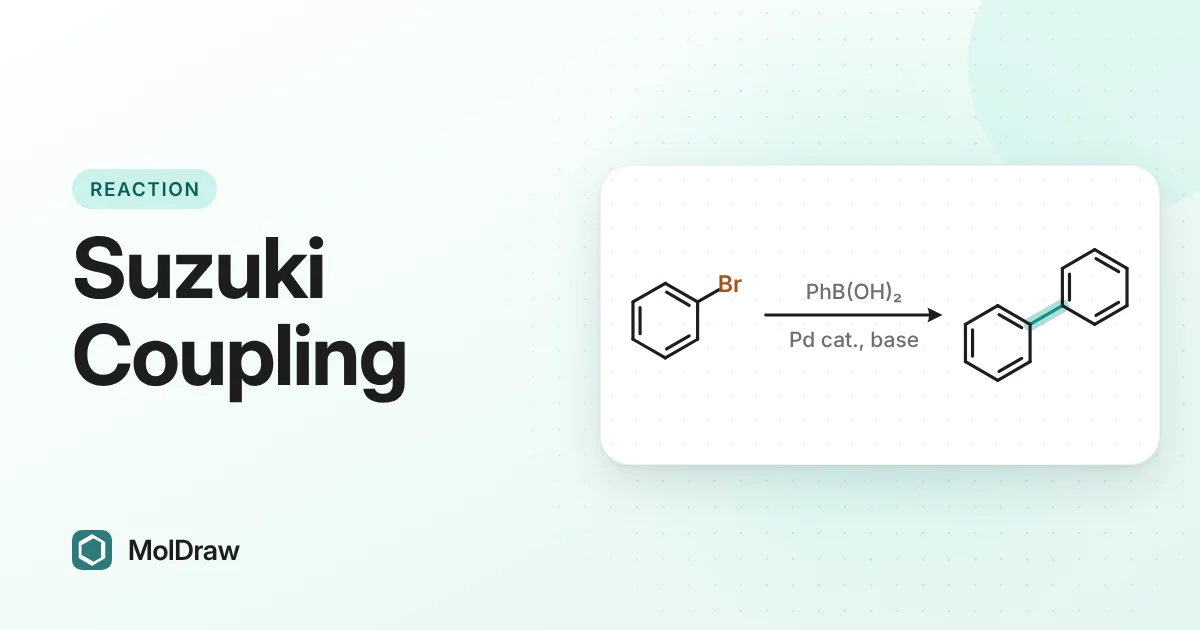
Primary reaction SMILES: B(O)(O)c1ccccc1.Brc1ccccc1>>c1ccc(-c2ccccc2)cc1
Forms biphenyl under Pd/base conditions.
Common in medicinal chemistry library synthesis.
Sketch the halide, boronic acid, catalyst, base, and coupled product for reports or retrosynthesis notes.
Suzuki–Miyaura coupling joins an organoboron compound (usually an aryl boronic acid or boronate ester) with an aryl or vinyl halide using a palladium catalyst and a base. The cycle has three steps: oxidative addition of the halide to Pd(0), transmetalation in which the organic group moves from boron to palladium (assisted by the base), and reductive elimination that forms the new C–C bond and regenerates Pd(0).
Why is a base needed? It activates the boron species (forming a boronate) so transmetalation can occur. Example: bromobenzene + phenylboronic acid gives biphenyl. In MolDraw, draw both partners, a straight arrow with "Pd(PPh3)4, K2CO3" above it, and highlight the new C–C bond with a colour.