Reaction Scheme
aryl halide + alkene -> substituted alkenePd catalyst, base, heat; often gives E-alkene products.
Primary reaction SMILES: Brc1ccccc1.C=CC(=O)OC>>COC(=O)C=Cc1ccccc1
The Heck reaction forms substituted alkenes by palladium-catalyzed coupling of aryl or vinyl halides with alkenes.
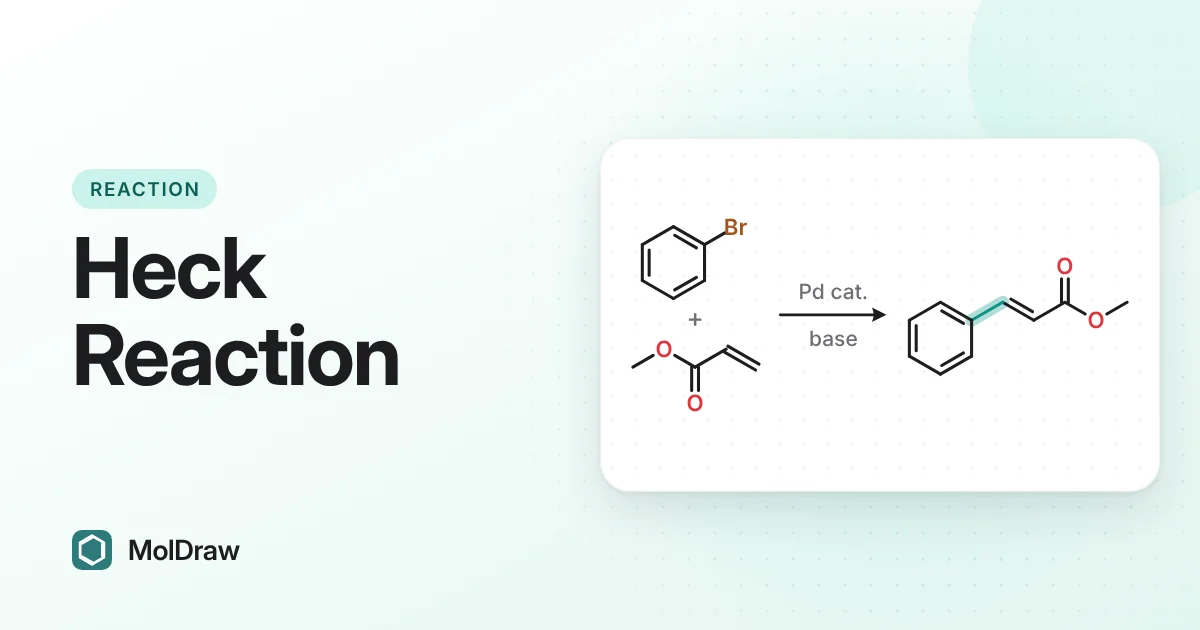
Primary reaction SMILES: Brc1ccccc1.C=CC(=O)OC>>COC(=O)C=Cc1ccccc1
Forms cinnamate-type ester products.
Forms stilbene derivatives under Pd/base conditions.
Use MolDraw to communicate regioselectivity, alkene geometry, catalysts, and product structures.
The Heck (Mizoroki–Heck) reaction follows a Pd(0)/Pd(II) catalytic cycle. Pd(0) undergoes oxidative addition into the aryl–halide bond. The alkene coordinates and inserts into the Pd–aryl bond (migratory insertion, syn addition). β-Hydride elimination then releases the substituted alkene, and the base removes HX from the palladium hydride to regenerate Pd(0).
How is it different from Suzuki coupling? Heck couples an aryl halide with an alkene C–H, with no organometallic partner, while Suzuki coupling uses a boronic acid. How do I show the catalyst? Write "Pd(OAc)2 (cat.), PPh3, Et3N, heat" above and below the arrow, or draw the catalytic cycle as a loop of arrows for teaching.