MolDraw › 3D molecule models › Vitamin D3 structure
Vitamin D3 structure and 3D model (C27H44O)
Vitamin D3 (cholecalciferol) is a secosteroid: a steroid whose B ring has been broken open by UV light. It has a conjugated triene linking a cyclohexanol ring to a two-ring system with a hydrocarbon tail.
Drag to rotate · pinch or scroll to zoom. 3D coordinates: computed with RDKit (ETKDG conformer, force-field optimised).
Vitamin D3 at a glance
| Formula | C27H44O |
|---|---|
| Molar mass | 384.65 g/mol |
| IUPAC name | (1S,3Z)-3-[(2E)-2-[(1R,3aS,7aR)-7a-methyl-1-[(2R)-6-methylheptan-2-yl]-2,3,3a,5,6,7-hexahydro-1H-inden-4-ylidene]ethylidene]-4-methylidenecyclohexan-1-ol |
| Atoms / bonds | 72 / 74 |
| H-bond donors / acceptors | 1 / 1 |
| logP (estimated) | 7.6 |
| SMILES | C[C@H](CCCC(C)C)[C@H]1CC[C@@H]\2[C@@]1(CCC/C2=C\C=C/3\C[C@H](CCC3=C)O)C |
| InChIKey | QYSXJUFSXHHAJI-YRZJJWOYSA-N |
| PubChem | 5280795 |
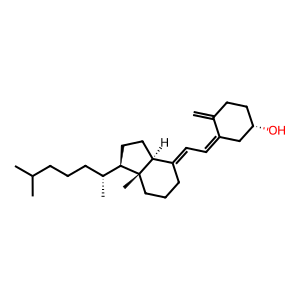
What the 3D model of Vitamin D3 shows
The model contains 72 atoms (28 heavy atoms and 44 hydrogens) joined by 74 bonds; in ball-and-stick mode every stick is one bond, and double or aromatic bonds are drawn as multiple sticks. Switch to space-filling to see the molecule as its electron cloud, scaled to van der Waals radii: this is the shape other molecules actually "feel". It can donate 1 and accept 1 hydrogen bonds, and its estimated logP of 7.6 means it is fat-loving (lipophilic). Its topological polar surface area is 20 Ų.
Shape and bond angles
| Atom(s) | Geometry / hybridisation | Angles & lengths |
|---|---|---|
| triene carbons | Trigonal planar, sp²; conjugated | ≈ 120° |
| ring and side-chain carbons | Tetrahedral, sp³ | ≈ 109.5° |
| C=CH₂ (exocyclic methylene) | Trigonal planar, sp² | ≈ 120° |
Is Vitamin D3 polar?
No, mostly non-polar. It has only one OH group on a 27-carbon skeleton, so it dissolves in oils and is stored in body fat.
Elemental composition of C27H44O
| Element | Atoms | Mass (g/mol) | Mass % |
|---|---|---|---|
| Carbon (C) | 27 | 324.297 | 84.31% |
| Hydrogen (H) | 44 | 44.352 | 11.53% |
| Oxygen (O) | 1 | 15.999 | 4.16% |
Calculated from IUPAC standard atomic weights. Check any formula with the molar mass calculator.
Uses of Vitamin D3
- Helps the body absorb calcium for healthy bones
- Added to supplements and fortified foods
- Prevents rickets in children
Interesting facts
- Skin makes vitamin D3 when UVB light breaks a ring in 7-dehydrocholesterol.
- The body converts it in the liver and then the kidneys into the active hormone calcitriol.
- Vitamin D2 (ergocalciferol) is the plant and fungal version, with an extra double bond and methyl group in the side chain.
Drawing structures for your notes? MolDraw is a free online chemical structure editor for molecules, reactions and lab diagrams.
Open MolDraw editorFrequently asked questions
What is the structure of Vitamin D3?
Vitamin D3 (cholecalciferol) is a secosteroid: a steroid whose B ring has been broken open by UV light. It has a conjugated triene linking a cyclohexanol ring to a two-ring system with a hydrocarbon tail. Its SMILES is C[C@H](CCCC(C)C)[C@H]1CC[C@@H]\2[C@@]1(CCC/C2=C\C=C/3\C[C@H](CCC3=C)O)C.
What is a secosteroid?
A steroid in which one of the rings has been cut open. In vitamin D3 the B ring is broken between C9 and C10.
Is vitamin D a hormone or a vitamin?
Both, in a way. The skin can make it with sunlight, and its active form calcitriol works as a hormone.
What is the chemical formula and molar mass of Vitamin D3?
Vitamin D3 is C27H44O with a molar mass of 384.65 g/mol. It contains 72 atoms: 27 carbon, 44 hydrogen, 1 oxygen.
What is the IUPAC name of Vitamin D3?
The IUPAC name is (1S,3Z)-3-[(2E)-2-[(1R,3aS,7aR)-7a-methyl-1-[(2R)-6-methylheptan-2-yl]-2,3,3a,5,6,7-hexahydro-1H-inden-4-ylidene]ethylidene]-4-methylidenecyclohexan-1-ol.
How do I draw Vitamin D3?
Open the MolDraw editor, paste the SMILES C[C@H](CCCC(C)C)[C@H]1CC[C@@H]\2[C@@]1(CCC/C2=C\C=C/3\C[C@H](CCC3=C)O)C or type "Vitamin D3" in name search, and the structure is drawn for you. You can then export it as PNG, SVG, MOL or CDXML.