MolDraw › 3D molecule models › Folic acid structure
Folic acid structure and 3D model (C19H19N7O6)
Folic acid is built from three parts: a pteridine ring system, a para-aminobenzoic acid unit and L-glutamic acid. Its two COOH groups come from the glutamate.
Drag to rotate · pinch or scroll to zoom. 3D coordinates: computed with RDKit (ETKDG conformer, force-field optimised).
Folic acid at a glance
| Formula | C19H19N7O6 |
|---|---|
| Molar mass | 441.40 g/mol |
| IUPAC name | (2S)-2-[[4-[(2-amino-4-oxo-3H-pteridin-6-yl)methylamino]benzoyl]amino]pentanedioic acid |
| Atoms / bonds | 51 / 53 |
| H-bond donors / acceptors | 6 / 9 |
| logP (estimated) | -0.0 |
| SMILES | C1=CC(=CC=C1C(=O)N[C@@H](CCC(=O)O)C(=O)O)NCC2=CN=C3C(=N2)C(=O)NC(=N3)N |
| InChIKey | OVBPIULPVIDEAO-LBPRGKRZSA-N |
| PubChem | 135398658 |
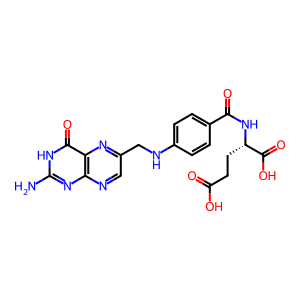
What the 3D model of Folic acid shows
The model contains 51 atoms (32 heavy atoms and 19 hydrogens) joined by 53 bonds; in ball-and-stick mode every stick is one bond, and double or aromatic bonds are drawn as multiple sticks. Switch to space-filling to see the molecule as its electron cloud, scaled to van der Waals radii: this is the shape other molecules actually "feel". It can donate 6 and accept 9 hydrogen bonds, and its estimated logP of -0.0 means it is very water-loving (hydrophilic). Its topological polar surface area is 213 Ų.
Shape and bond angles
| Atom(s) | Geometry / hybridisation | Angles & lengths |
|---|---|---|
| pteridine and benzene ring atoms | Trigonal planar, sp²; aromatic | 120° |
| amide and acid C=O carbons | Trigonal planar, sp² | ≈ 120° |
| glutamate α-carbon and CH₂ groups | Tetrahedral, sp³ | ≈ 109.5° |
Is Folic acid polar?
Yes. It has many N–H, O–H and C=O groups, but the flat rings stack strongly in the solid, so the free acid dissolves poorly. Its salts dissolve much better.
Elemental composition of C19H19N7O6
| Element | Atoms | Mass (g/mol) | Mass % |
|---|---|---|---|
| Carbon (C) | 19 | 228.209 | 51.70% |
| Hydrogen (H) | 19 | 19.152 | 4.34% |
| Nitrogen (N) | 7 | 98.049 | 22.21% |
| Oxygen (O) | 6 | 95.994 | 21.75% |
Calculated from IUPAC standard atomic weights. Check any formula with the molar mass calculator.
Uses of folic acid
- Added to flour and supplements to prevent neural tube defects
- Needed to make DNA and red blood cells
- Basis for drugs such as methotrexate that block folate use
Interesting facts
- The name comes from the Latin folium, leaf, because it was first found in spinach.
- Folic acid is the synthetic form; the natural forms in food are called folates.
- Its glutamate part has the L configuration, the same as in proteins.
Drawing structures for your notes? MolDraw is a free online chemical structure editor for molecules, reactions and lab diagrams.
Open MolDraw editorFrequently asked questions
What is the structure of Folic acid?
Folic acid is built from three parts: a pteridine ring system, a para-aminobenzoic acid unit and L-glutamic acid. Its two COOH groups come from the glutamate. Its SMILES is C1=CC(=CC=C1C(=O)N[C@@H](CCC(=O)O)C(=O)O)NCC2=CN=C3C(=N2)C(=O)NC(=N3)N.
What is the difference between folic acid and folate?
Folic acid is the stable synthetic form used in supplements. Folates are the reduced natural forms found in foods like leafy greens.
Why is folic acid yellow?
Its pteridine ring system absorbs light in the blue to violet part of the spectrum.
What is the chemical formula and molar mass of Folic acid?
Folic acid is C19H19N7O6 with a molar mass of 441.40 g/mol. It contains 51 atoms: 19 carbon, 19 hydrogen, 7 nitrogen, 6 oxygen.
What is the IUPAC name of Folic acid?
The IUPAC name is (2S)-2-[[4-[(2-amino-4-oxo-3H-pteridin-6-yl)methylamino]benzoyl]amino]pentanedioic acid.
How do I draw Folic acid?
Open the MolDraw editor, paste the SMILES C1=CC(=CC=C1C(=O)N[C@@H](CCC(=O)O)C(=O)O)NCC2=CN=C3C(=N2)C(=O)NC(=N3)N or type "Folic acid" in name search, and the structure is drawn for you. You can then export it as PNG, SVG, MOL or CDXML.