Bond Polarity and Dipole Moments Explained, with a Free Checker
Short answer: A bond is polar when its two atoms differ in electronegativity. With Pauling values, ΔEN below 0.4 is nonpolar covalent, 0.4 to 1.7 is polar covalent and above 1.7 is usually ionic. The more electronegative atom is δ−. A molecule is polar when its bond dipoles do not cancel, which depends on its VSEPR shape: H₂O (bent) is polar with 1.85 D, CO₂ (linear) is nonpolar. The free MolDraw bond polarity and dipole checker works out both.
Bond polarity and electronegativity
Electronegativity (χ) is the pull an atom has on the electrons in a bond. On the Pauling scale fluorine is highest at 3.98, then oxygen 3.44, chlorine 3.16 and nitrogen 3.04. Carbon is 2.55 and hydrogen 2.20.
In a bond between two different atoms the electrons spend more time near the more electronegative atom. It gains a partial negative charge (δ−) and the other atom a partial positive charge (δ+). This charge separation is a bond dipole.
| ΔEN less than 0.4 | Nonpolar covalent. Examples: Cl–Cl (0), C–H (0.35). |
|---|---|
| ΔEN 0.4 to 1.7 | Polar covalent. Examples: C–O (0.89), H–Cl (0.96), O–H (1.24). |
| ΔEN 1.7 to 2.0 | Borderline. Most school books say ionic above 1.7, some say above 2.0. H–F (1.78) is a covalent molecule. |
| ΔEN above 2.0 | Ionic. Examples: Na–Cl (2.23), K–F (3.16). |
Percent ionic character can be estimated with Pauling’s formula: % ionic = (1 − e^(−ΔEN²/4)) × 100. A ΔEN of 1.7 gives about 51% ionic, which is where the 1.7 cut-off comes from.
When is a molecule polar?
Bond dipoles are vectors. Add them using the 3D shape of the molecule:
- Draw the Lewis structure and find the shape with VSEPR.
- Draw a dipole arrow on every polar bond, pointing to the δ− atom.
- Add the arrows. If they cancel, the molecule is nonpolar. If not, it is polar.
A simple test: a molecule is nonpolar when the central atom has no lone pairs and all outer atoms are identical (CO₂, BF₃, CCl₄, PCl₅, SF₆). Two shapes with lone pairs are still symmetric and nonpolar: linear AX₂E₃ (XeF₂) and square planar AX₄E₂ (XeF₄). Lone pairs in other shapes (NH₃, H₂O, SF₄, ClF₃) or different outer atoms (CHCl₃, CH₂Cl₂) give a net dipole.
How to use the bond polarity and dipole checker
- Open the bond polarity and dipole checker.
- In Bond: two elements, choose Element A and Element B, or press an example such as H–Cl, C–O or Na–Cl. The result shows ΔEN, the bond type on a colour scale, which atom is δ− and the % ionic character with the working. Swap A and B reverses the pair.
- Switch to Molecule: polar or nonpolar?. Type a formula such as
XeF4or a SMILES string such asCl/C=C\Cland press Check polarity, or press an example. - Read the shape, electron geometry, bond angle, the vector sum of the bond dipoles and, where known, the measured dipole moment in debye.
- The drawing shows δ+ and δ− on each atom, a purple arrow on each polar bond and a teal net dipole arrow when the molecule is polar. Dashed bonds point away from you.
- The Reasoning list explains each step, so you can copy the logic into an answer.
Worked examples
1. H–Cl bond
ΔEN = 3.16 − 2.20 = 0.96, so the bond is polar covalent with Cl δ− and H δ+. % ionic = (1 − e^(−0.2304)) × 100 = 20.6%. HCl has a dipole moment of 1.11 D.
2. Water, H₂O
O has 2 bonded atoms and 2 lone pairs: AX₂E₂, bent, 104.5°. Each O–H bond has ΔEN = 1.24 with O δ−. The two dipoles point partly the same way, so they add up. Water is polar, 1.85 D.
3. CCl₄ and CHCl₃
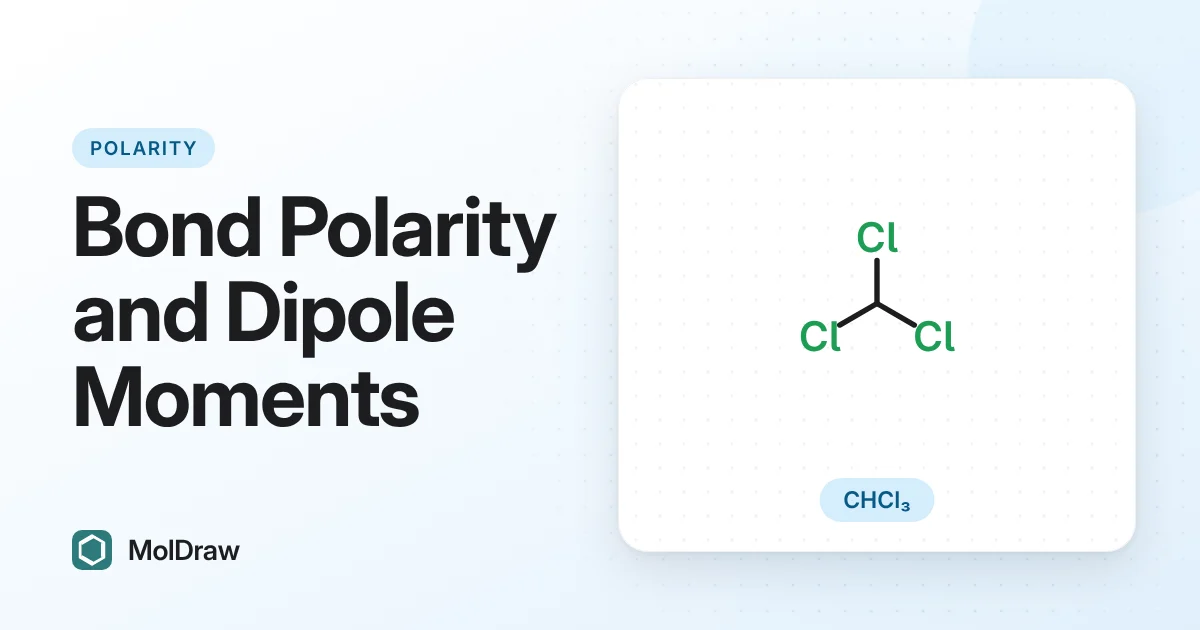
Both are tetrahedral. In CCl₄ the four C–Cl dipoles (ΔEN 0.61) cancel: nonpolar, 0 D. In CHCl₃ one Cl is replaced by H, so the dipoles no longer cancel: polar, 1.04 D.
4. SF₄ and XeF₄
SF₄ is AX₄E, seesaw shaped: the S–F dipoles do not cancel, so it is polar (0.63 D). XeF₄ is AX₄E₂, square planar with the two lone pairs opposite each other: the Xe–F dipoles cancel, so it is nonpolar.
5. cis- and trans-1,2-dichloroethene
Both are flat. In the cis isomer both C–Cl dipoles point to the same side: polar, 1.90 D. In the trans isomer they point in opposite directions and cancel: nonpolar, 0 D. This difference is why the cis isomer boils higher (60 °C) than the trans isomer (48 °C).
Summary table
| H₂O | Bent (AX₂E₂): polar, 1.85 D |
|---|---|
| NH₃ | Trigonal pyramidal (AX₃E): polar, 1.47 D |
| CO₂ | Linear (AX₂): nonpolar, 0 D |
| BF₃ | Trigonal planar (AX₃): nonpolar |
| CCl₄ | Tetrahedral, identical atoms: nonpolar |
| CHCl₃, CH₂Cl₂ | Tetrahedral, mixed atoms: polar, 1.04 D and 1.60 D |
| SO₂ | Bent (AX₂E): polar, 1.63 D |
| SF₄ | Seesaw (AX₄E): polar, 0.63 D |
| XeF₄ | Square planar (AX₄E₂): nonpolar |
| PCl₅ | Trigonal bipyramidal (AX₅): nonpolar |
Common mistakes
- Assuming polar bonds always give a polar molecule. Symmetry can cancel them.
- Judging the shape from a flat drawing. CH₂Cl₂ drawn as a flat cross looks symmetric, but it is tetrahedral and polar.
- Forgetting the lone pairs on the central atom, which change the shape.
- Pointing the dipole arrow toward the δ+ atom.
- Treating 0.4 and 1.7 as sharp borders. Bond character changes smoothly with ΔEN.
- Calling every compound with ΔEN above 1.7 ionic. H–F is a covalent molecule; bonds between two non-metals stay covalent.
Exam tips (JEE, NEET, AP, A-level)
- Always state the shape first, then whether the dipoles cancel.
- JEE and NEET often ask for the order of dipole moments, for example NH₃ (1.47 D) > NF₃ (0.24 D): in NH₃ the lone pair and the bond dipoles point the same way, in NF₃ they oppose.
- AP Chemistry links polarity to intermolecular forces: polar molecules have dipole–dipole forces and usually higher boiling points.
- A-level answers on cis/trans isomers should mention that the trans isomer is nonpolar because the C–Cl dipoles cancel.
- Quote ΔEN to two decimal places with the Pauling values given in your data booklet.
Questions and answers
What electronegativity difference makes a bond polar?
With Pauling values, a difference of 0.4 or more makes a bond polar covalent. Below 0.4 the bond is treated as nonpolar. Above about 1.7 the bond is usually called ionic, although some textbooks use 2.0.
What is a dipole moment?
A dipole moment measures how far apart the positive and negative charge centres of a molecule are. It equals charge times distance and is given in debye (D). Water has 1.85 D; CO2 has 0 D.
Which way does the dipole arrow point?
In chemistry the arrow points toward the more electronegative atom, the δ− end, and has a small cross at the δ+ end. Physics uses the opposite direction for the dipole vector.
Can a molecule with polar bonds be nonpolar?
Yes. If the bond dipoles are arranged symmetrically they cancel. CO2 (linear), BF3 (trigonal planar), CCl4 (tetrahedral), PCl5 and SF6 all have polar bonds but no net dipole.
Why is NH3 polar but BF3 nonpolar?
NH3 has a lone pair on N, which makes it trigonal pyramidal, so the N–H dipoles do not cancel. BF3 has no lone pair on B and is trigonal planar, so its three B–F dipoles cancel.
Why is SO2 polar but CO2 nonpolar?
SO2 has a lone pair on sulfur and is bent (about 119°), so the S=O dipoles add up to 1.63 D. CO2 has no lone pair on carbon and is linear, so its two C=O dipoles cancel.
What is the % ionic character of HCl?
Using Pauling’s formula with ΔEN = 0.96: % ionic = (1 − e^(−0.96²/4)) × 100 = (1 − e^(−0.23)) × 100 = 20.6%. From its measured dipole moment, HCl is about 18% ionic, so the estimate is close.