Aromaticity and Hückel’s 4n + 2 Rule Explained, with a Free Checker
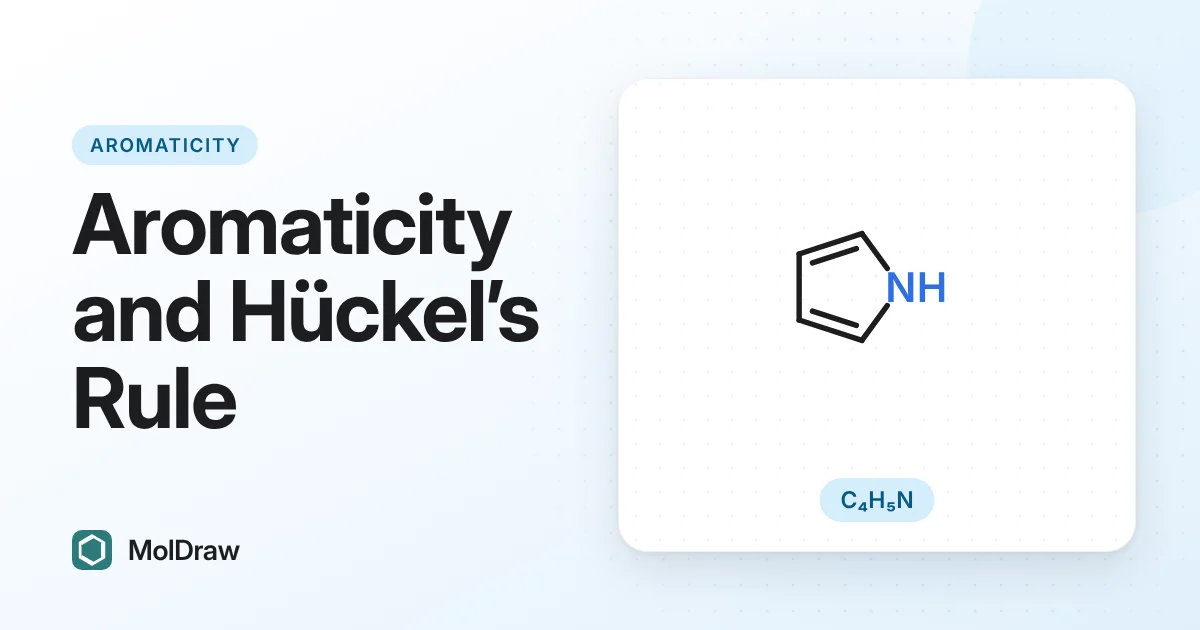
Short answer: A ring is aromatic if it is cyclic, planar, fully conjugated and has 4n + 2 π electrons (2, 6, 10, 14, 18). It is antiaromatic if it passes the first three tests but has 4n π electrons (4, 8, 12). If it fails any of the first three tests it is non-aromatic. Benzene (6) is aromatic, cyclobutadiene (4) is antiaromatic and cyclohexane is non-aromatic. The free MolDraw aromaticity checker applies these tests to any ring and explains each π electron.
What aromaticity is
Aromatic compounds are rings with a closed loop of delocalised π electrons that makes them much more stable than expected. Benzene is about 150 kJ/mol more stable than a ring of three isolated C=C bonds. Aromatic rings resist addition reactions and prefer substitution.
Hückel’s rule (Erich Hückel, 1931) predicts which rings are aromatic. A ring must pass four tests:
- Cyclic: the π system forms a closed ring.
- Fully conjugated: every ring atom has a p orbital. One sp³ atom breaks the loop.
- Planar: the ring can lie flat so the p orbitals overlap.
- 4n + 2 π electrons: n = 0, 1, 2 … gives 2, 6, 10, 14, 18.
A flat, fully conjugated ring with 4n π electrons is antiaromatic and is less stable than an open-chain analogue.
How to count π electrons
| Atom in a ring C=C or C=N | 1 π electron. Example: each carbon of benzene, the N of pyridine. |
|---|---|
| N, O or S with a lone pair and no double bond | 2 π electrons from one lone pair. Example: pyrrole N–H, furan O, thiophene S. |
| Carbanion C⁻ | 2 π electrons. Example: cyclopentadienyl anion. |
| Carbocation C⁺ or three-bonded B | 0 π electrons, but an empty p orbital keeps the ring conjugated. Example: tropylium. |
| sp³ carbon (CH₂) | No p orbital. The ring is non-aromatic. Example: cyclopentadiene. |
The key distinction is where a heteroatom lone pair sits. In pyridine the nitrogen is already in a C=N bond and gives 1 π electron; its lone pair points out of the ring in an sp² orbital and is not counted. In pyrrole the nitrogen has no double bond, so its lone pair occupies the p orbital and gives 2. In furan, oxygen has two lone pairs: one is in the π system, the other lies in the ring plane.
How to use the aromaticity checker
- Open the aromaticity checker.
- Draw a ring in the editor, or paste a SMILES string into the box and press Check aromaticity. Use
[nH]for a pyrrole-type nitrogen and brackets for ring ions, such as[CH-]1C=CC=C1. - Or press an example: Benzene, Cyclobutadiene, Cyclooctatetraene, Pyridine, Pyrrole, Furan, Thiophene, Imidazole, Cyclopentadienyl anion, Tropylium cation, Cyclopropenyl cation, Naphthalene, Azulene, [18]Annulene or Cyclopentadiene.
- The drawing shades each ring green (aromatic), red (antiaromatic) or grey (non-aromatic) and writes the π electrons each atom gives. A × marks an atom with no p orbital.
- Each ring card lists the four tests with Yes or No, the π electron sum, the value of n and the verdict. Open π electrons from each atom to see the reason for every atom.
- Fused rings get an extra card for the whole fused ring system.
Worked examples
1. Benzene, C₆H₆
Six sp² carbons in three C=C bonds: 6 × 1 = 6 π electrons. 6 = 4(1) + 2, so n = 1. Cyclic, flat, fully conjugated: aromatic.
2. Pyrrole, C₄H₄NH
Four carbons in two C=C bonds give 4. The N–H nitrogen has no double bond, so its lone pair is in the p orbital and gives 2. Total 6 = 4(1) + 2: aromatic. Imidazole has one pyrrole-type N (2) and one pyridine-type N (1), also 6.
3. Cyclopentadiene and its ions
Cyclopentadiene, C₅H₆, has an sp³ CH₂: non-aromatic. Removing H⁺ gives the cyclopentadienyl anion with 4 + 2 = 6 π electrons: aromatic. This makes cyclopentadiene unusually acidic, pKa about 16. Removing H⁻ gives the cation with 4 π electrons: antiaromatic.
4. Cyclobutadiene and cyclooctatetraene
Cyclobutadiene has 4 = 4(1) π electrons in a flat ring: antiaromatic. Cyclooctatetraene has 8 = 4(2) but puckers into a tub: non-aromatic. Add two electrons and the cyclooctatetraene dianion (10 π electrons) becomes flat and aromatic.
5. Naphthalene and azulene
Both are C₁₀H₈ with 10 π electrons over a fused system. 10 = 4(2) + 2: aromatic. In azulene, each ring alone has an odd count (5 and 7) because the shared bond is counted twice, so judge the fused system as a whole.
6. [18]Annulene
An 18-membered ring with nine C=C bonds: 18 = 4(4) + 2. The ring is large enough to be nearly flat, so it is aromatic. [10]Annulene also fits 4n + 2 but cannot be flat, so it is non-aromatic.
Summary table
| Benzene | 6 π electrons, n = 1: aromatic |
|---|---|
| Pyridine | 6 (lone pair not counted): aromatic |
| Pyrrole, furan, thiophene | 6 (one lone pair counted): aromatic |
| Cyclopropenyl cation | 2, n = 0: aromatic |
| Cyclopentadienyl anion | 6: aromatic |
| Tropylium cation | 6: aromatic |
| Naphthalene, azulene | 10, n = 2: aromatic |
| [18]Annulene | 18, n = 4: aromatic |
| Cyclobutadiene | 4, 4n: antiaromatic |
| Cyclopentadienyl cation | 4, 4n: antiaromatic |
| Cyclooctatetraene | 8, tub-shaped: non-aromatic |
| Cyclopentadiene | sp³ CH₂: non-aromatic |
Common mistakes
- Counting the pyridine lone pair, which gives 8 instead of 6.
- Counting both lone pairs of furan or thiophene.
- Calling cyclooctatetraene antiaromatic. It is non-aromatic because it is not flat.
- Missing an sp³ ring atom, as in cyclopentadiene or cycloheptatriene.
- Treating n as the number of rings or double bonds. It is only the whole number that makes 4n + 2 fit.
- Applying the rule ring by ring in azulene instead of to the whole fused system.
Exam tips (JEE, NEET, AP, A-level)
- Run the four tests in order. If test 2 fails (an sp³ atom), stop: the ring is non-aromatic.
- JEE and NEET often ask which ion is aromatic: C₃H₃⁺, C₅H₅⁻ and C₇H₇⁺ are aromatic; C₃H₃⁻, C₅H₅⁺ and C₇H₇⁻ are antiaromatic.
- Stability and acidity questions: a reaction that creates an aromatic ring is favoured, which explains the acidity of cyclopentadiene and the stability of the tropylium ion.
- Basicity questions: pyridine is a base because its lone pair is not in the π system; pyrrole is a very weak base because its lone pair is.
- AP and A-level answers should name the π electron count and the value of n, for example "6 π electrons, 4n + 2 with n = 1".
Questions and answers
What are the four rules for aromaticity?
An aromatic ring is cyclic, planar and fully conjugated (every ring atom has a p orbital), and it has 4n + 2 π electrons, where n is 0 or a positive whole number. All four must hold.
What does n mean in 4n + 2?
n is just a whole number (0, 1, 2, 3 …) that makes the count fit. It is not the number of rings or atoms. Benzene has 6 π electrons, so 4n + 2 = 6 gives n = 1.
Is pyridine or pyrrole more basic, and why?
Pyridine is much more basic. Its lone pair lies in the ring plane and is not part of the aromatic sextet, so it is free to take a proton. Pyrrole’s lone pair is part of its 6 π electrons, and protonating it would destroy the aromaticity.
Why is cyclobutadiene antiaromatic?
It is cyclic, flat and fully conjugated, but it has 4 π electrons, which is 4n with n = 1. Rings with 4n π electrons are destabilised, so cyclobutadiene is very reactive and exists only at very low temperature.
Why is cyclooctatetraene not antiaromatic?
It has 8 π electrons, but the eight-membered ring is large enough to bend into a tub shape. The p orbitals no longer overlap all the way round, so the molecule is non-aromatic.
Is tropylium aromatic?
Yes. The cycloheptatrienyl cation, C7H7+, has three C=C bonds (6 π electrons) and one carbocation with an empty p orbital (0). 6 = 4n + 2 with n = 1, so it is aromatic and unusually stable for a carbocation.
Is azulene aromatic?
Yes. Azulene is a fused 5- and 7-membered ring system with 10 π electrons around its perimeter. 10 = 4n + 2 with n = 2. It is a blue aromatic hydrocarbon with a dipole moment of about 1 D.