Curly Arrows and Arrow Pushing: The Rules, the Patterns and How to Practise
Short answer: A curly arrow shows a pair of electrons moving. It starts at the electrons: a lone pair, a π bond or a σ bond. It ends where they go: on an atom, as a new lone pair, or between two atoms, as a new bond. A fish-hook arrow moves one electron. To practise, open the free arrow-pushing mechanism practice, tap where each arrow starts and ends, and press Check answer.
What arrow pushing is
Arrow pushing is the way chemists show how a reaction happens, one step at a time. Each curly arrow moves electrons. Bonds form where electron pairs arrive between atoms, and bonds break where pairs leave.
A nucleophile is an electron-rich species that gives a pair of electrons, such as HO⁻, NH₃, CN⁻ or a C=C π bond. An electrophile is an electron-poor species that accepts a pair, such as a carbocation, the carbon of C=O, H⁺ or NO₂⁺. Arrows always run from the nucleophile to the electrophile.
The rules
- Arrows move electrons, not atoms. A full arrow (two-sided head) moves two electrons. A fish-hook (one-sided head) moves one.
- The tail sits on electrons. Start at a lone pair, a π bond or a σ bond. Never start at a positive charge, an empty orbital or a bare H atom.
- The head shows where the electrons go. Ending on an atom makes a lone pair. Ending between two atoms makes a bond.
- Keep octets. C, N and O can hold at most eight electrons. If a pair arrives at an atom that is already full, another arrow must move a pair away from it in the same step.
- Charges follow the arrows. An atom that uses its lone pair to make a bond becomes one unit more positive. An atom that gains a lone pair becomes one unit more negative.
- Total charge is conserved. Add up the charges before and after. They must match.
Formal charge = valence electrons − non-bonding electrons − number of bonds. Use it to check every atom after you draw the arrows.
Full arrows and fish-hooks
| Full curly arrow | Moves an electron pair. Used for polar reactions: acids and bases, nucleophiles and electrophiles, SN1, SN2, E1, E2, additions and eliminations. |
|---|---|
| Fish-hook arrow | Moves one electron. Used for radical reactions. Breaking a bond evenly (homolysis) needs two fish-hooks, one to each atom. |
| Reaction arrow (→) | Separates starting materials from products. Not a curly arrow. |
| Resonance arrow (↔) | Joins two drawings of the same species. No reaction takes place. |
Common arrow patterns
Almost every mechanism is built from a few patterns.
| Proton transfer | Base lone pair → H; H–A bond → A. Example: HO⁻ + HCl → H₂O + Cl⁻. |
|---|---|
| Nucleophilic attack | Lone pair or π bond → electrophilic atom. Example: water + (CH₃)₃C⁺. |
| Loss of a leaving group | C–X bond → X. Example: (CH₃)₃C–Br → (CH₃)₃C⁺ + Br⁻. |
| SN2 | Nucleophile → C and C–X → X, at the same time. |
| Addition to C=O | Nucleophile → C and C=O π → O. |
| E2 | Base → β-H, C–H → C–C (new π bond), C–X → X. |
| Carbocation shift | C–H or C–C bond → the neighbouring C⁺. |
| Pericyclic | Arrows in a closed loop, as in the Diels–Alder reaction. |
| Radical | Fish-hooks, one electron per arrow. |
How to use the practice tool
- Open the arrow-pushing mechanism practice.
- Choose a Level (Intro, Intermediate or Advanced) and a Reaction type, or leave both on all.
- Read the equation and the line that says how many arrows to draw.
- Tap the start of an arrow: a pair of dots (lone pair), a bond, or a single dot (unpaired electron). Then tap the atom or bond where the electrons go.
- For radical steps, press Fish-hook (1 e⁻) before drawing.
- Press Check answer. Each wrong arrow gets its own message. Remove it with ×, or use Undo or Clear.
- Press Hint if you are stuck, or Show answer to see the correct arrows in orange, the product and why. Then press Next step.
Arrows can be drawn in any order. The tool also accepts equivalent drawings, such as a lone-pair arrow that ends on the bond it forms rather than on the atom. Your progress is saved in your browser; Reset progress clears it.
Worked examples
1. SN2: hydroxide and bromomethane
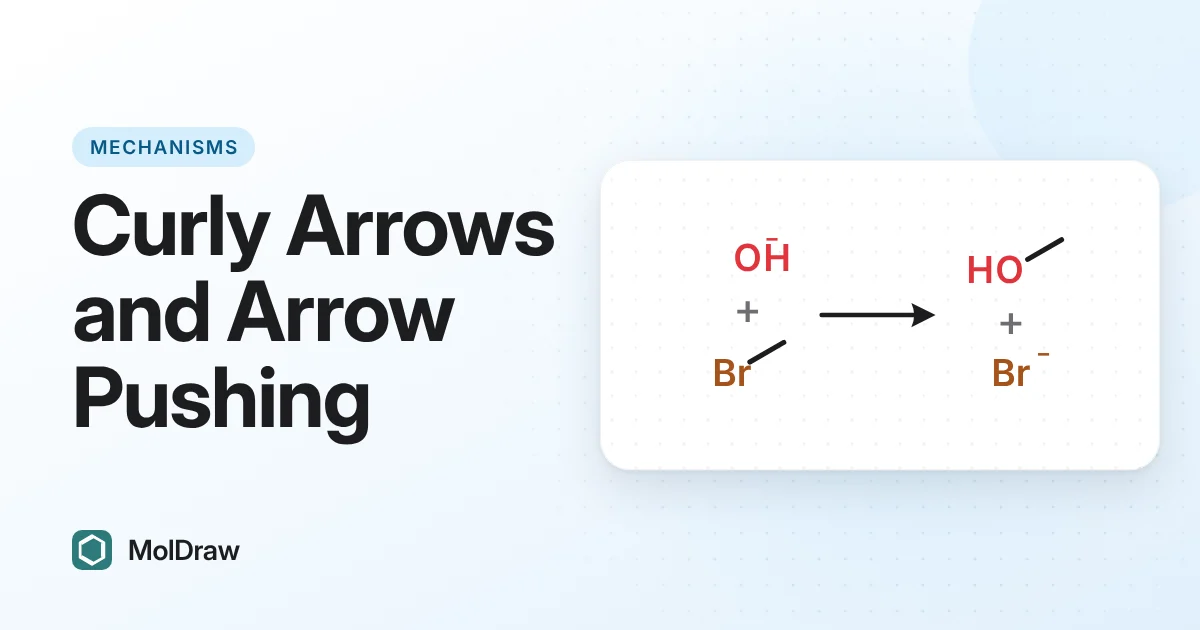
HO⁻ + CH₃Br → CH₃OH + Br⁻. Arrow 1 goes from a lone pair on O⁻ to the carbon. Arrow 2 goes from the C–Br bond to bromine. Oxygen goes from −1 to 0, and bromine from 0 to −1. One arrow alone would give carbon five bonds, so both are needed.
2. E2: hydroxide and bromoethane
Arrow 1: O⁻ lone pair to a hydrogen on the carbon next to C–Br. Arrow 2: that C–H bond into the C–C bond, which becomes the π bond. Arrow 3: the C–Br bond to bromine. The product is ethene, water and bromide. The second arrow ends on the bond, not on the carbon atom.
3. Aldol addition
The enolate CH₂=CH–O⁻ attacks acetaldehyde. Arrow 1: the O⁻ lone pair re-forms C=O. Arrow 2: the C=C π bond attacks the aldehyde carbon, making the new C–C bond. Arrow 3: the aldehyde C=O π bond moves to its oxygen, giving an alkoxide.
4. Radical chlorination of methane
Cl• + CH₄ → HCl + •CH₃ uses three fish-hooks. One electron from Cl• and one from the C–H bond pair up as the H–Cl bond. The other C–H electron stays on carbon as the methyl radical.
5. 1,2-hydride shift
A secondary carbocation next to a C–H becomes tertiary. One arrow goes from the C–H bond to the positive carbon. The hydrogen moves with its two electrons, as hydride. If the arrow ended on the C–C bond instead, it would describe an elimination.
Summary table
| Step | Arrows · charge change |
|---|---|
| Proton transfer | 2 · base gains +1, acid’s A gains −1 |
| SN1 ionisation | 1 · C becomes +, leaving group − |
| SN2 | 2 · nucleophile +1, leaving group −1 |
| Addition to C=O | 2 · O becomes − |
| E2 | 3 · leaving group −1 |
| Enolate formation | 3 · O becomes − |
| Electrophilic aromatic substitution | 2 to attack, 2 to lose H⁺ |
| Diels–Alder | 3 in a ring · no charges |
| Radical abstraction | 3 fish-hooks · no charges |
Common mistakes
- Backwards arrows. Drawing from the electrophile to the nucleophile, or from H⁺ to the base.
- Starting at a + charge. A carbocation has no electrons to give.
- Too many bonds. Attacking a full carbon without pushing a pair away gives a five-bond carbon.
- Breaking the wrong bond of C=O. In additions, only the π bond moves to oxygen.
- Vague arrow heads. An arrow that stops halfway does not say whether a bond or a lone pair forms.
- Full arrows in radical steps, or fish-hooks in polar steps.
- Forgetting to update charges. Recount every atom that an arrow touched.
Exam tips
- Draw all lone pairs on the atoms that react. Examiners look for the tail on a lone pair.
- Start each arrow exactly on the lone pair or the bond, and end it exactly on the atom or bond.
- Write the charges on every intermediate. Missing charges often cost a mark.
- For SN2, show attack from the side opposite the leaving group.
- For E2, draw the H and the leaving group anti-periplanar.
- Check the stability of any carbocation you make, and look for a hydride or methyl shift.
- Learn the patterns, not single reactions. Most exam mechanisms combine three or four of them.
Questions and answers
What does a curly arrow mean in chemistry?
A curly arrow shows a pair of electrons moving during a reaction step. The tail is where the electrons are now, and the head is where they end up. Atoms do not follow the arrow; only electrons do.
Can a curly arrow start from a positive charge?
No. A positive charge means an atom is short of electrons, so it has none to give. Arrows point toward positive centres, such as a carbocation or the δ+ carbon of C=O, never away from them.
When do I use a fish-hook arrow?
Use a fish-hook, with a one-sided head, when a single electron moves. This happens in radical reactions: homolysis of Cl₂ or Br₂ in light, hydrogen abstraction by a halogen radical, and radical addition to alkenes. Breaking one bond evenly needs two fish-hooks.
Why does the arrow go from the nucleophile to the electrophile?
The nucleophile is electron-rich and provides the electron pair that forms the new bond. The electrophile is electron-poor and accepts it. Since arrows follow electrons, they always run from nucleophile to electrophile, and from a bond to the leaving group.
How many arrows does each mechanism step need?
As many as the electron pairs that move. Loss of a leaving group needs one. SN2 and addition to C=O need two. E2 and enolate formation need three. The Diels–Alder reaction needs three arrows in a ring. A Michael addition from an enolate needs four.
How do I check my arrows are right?
Apply each arrow and redraw the product. Every atom should keep a sensible octet, the formal charges should follow from the arrows, and the total charge must not change. The free MolDraw arrow-pushing practice does this check for you on 35 real steps.
What is the difference between a curly arrow and a resonance arrow?
A curly arrow moves electrons within or between structures. A double-headed straight arrow (↔) links resonance structures, which are two drawings of the same molecule, not a reaction. The curly arrows drawn on a resonance form show how to get from one drawing to the next.