MolDraw › Templates › Reaction setups › Electrolysis of brine
Reaction setupsPremium
Electrolysis of brine template
Premium template. Preview and edit it free in MolDraw; downloading and exporting it is part of MolDraw Pro.
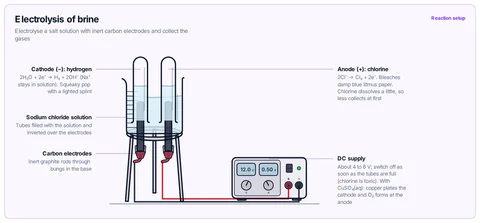
Sodium chloride solution in a cell with carbon electrodes sealed through the base, an inverted test tube over each electrode, wired to a low-voltage DC supply; copper(II) sulfate solution works the same way. GCSE / high school (CBSE class 10).
What the template shows
- Electrolyse a salt solution with inert carbon electrodes and collect the gases
- Cathode (−): hydrogen
- 2H₂O + 2e⁻ → H₂ + 2OH⁻ (Na⁺ stays in solution). Squeaky pop with a lighted splint
- Sodium chloride solution
- Tubes filled with the solution and inverted over the electrodes
- Carbon electrodes
- Inert graphite rods through bungs in the base
- Anode (+): chlorine
- 2Cl⁻ → Cl₂ + 2e⁻. Bleaches damp blue litmus paper. Chlorine dissolves a little, so less collects at first
- About 4 to 6 V; switch off as soon as the tubes are full (chlorine is toxic). With CuSO₄(aq): copper plates the cathode and O₂ forms at the anode
- Reaction setup
Drawn with 20 shapes – every one editable in MolDraw.
Sources
How to use this template
- Press Edit in MolDraw. The template opens on the canvas of the free MolDraw editor.
- Change anything: move structures, edit atoms and labels, recolour highlights or delete what you do not need.
- Add your own structures, arrows and text next to it, or combine several templates on one page.
- Export the drawing as PNG, SVG or PDF for slides, worksheets, theses and papers.
Frequently asked questions
Is the Electrolysis of brine template free?
You can preview the Electrolysis of brine template here and open and edit it in MolDraw for free. Downloading or exporting it is part of MolDraw Pro, together with the other premium templates.
Can I edit the Electrolysis of brine template?
Yes. It opens as an ordinary MolDraw drawing, so every structure, arrow, label and colour can be changed, and you can add your own content around it.
Is the chemistry checked?
Every structure is checked with RDKit and every curly arrow passes MolDraw’s electron-flow audit. The sources used are listed on this page.
Can I edit the glassware?
Yes. Every piece of glassware is a MolDraw apparatus object: move, resize, recolour the liquid or swap a piece and the joints stay connected.