MolDraw › Templates › Reaction setups › Cyclic voltammetry
Reaction setupsPremium
Cyclic voltammetry template
Premium template. Preview and edit it free in MolDraw; downloading and exporting it is part of MolDraw Pro.
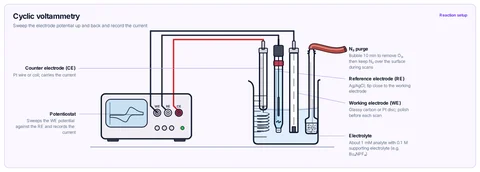
Potentiostat wired to working, Ag/AgCl reference and Pt counter electrodes in a degassed electrolyte, with an N₂ purge line.
What the template shows
- Sweep the electrode potential up and back and record the current
- Counter electrode (CE)
- Pt wire or coil; carries the current
- Sweeps the WE potential against the RE and records the current
- Bubble 10 min to remove O₂, then keep N₂ over the surface during scans
- Reference electrode (RE)
- Ag/AgCl; tip close to the working electrode
- Working electrode (WE)
- Glassy carbon or Pt disc; polish before each scan
- About 1 mM analyte with 0.1 M supporting electrolyte (e.g. Bu₄NPF₆)
- Reaction setup
Drawn with 26 shapes – every one editable in MolDraw.
Sources
How to use this template
- Press Edit in MolDraw. The template opens on the canvas of the free MolDraw editor.
- Change anything: move structures, edit atoms and labels, recolour highlights or delete what you do not need.
- Add your own structures, arrows and text next to it, or combine several templates on one page.
- Export the drawing as PNG, SVG or PDF for slides, worksheets, theses and papers.
Frequently asked questions
Is the Cyclic voltammetry template free?
You can preview the Cyclic voltammetry template here and open and edit it in MolDraw for free. Downloading or exporting it is part of MolDraw Pro, together with the other premium templates.
Can I edit the Cyclic voltammetry template?
Yes. It opens as an ordinary MolDraw drawing, so every structure, arrow, label and colour can be changed, and you can add your own content around it.
Is the chemistry checked?
Every structure is checked with RDKit and every curly arrow passes MolDraw’s electron-flow audit. The sources used are listed on this page.
Can I edit the glassware?
Yes. Every piece of glassware is a MolDraw apparatus object: move, resize, recolour the liquid or swap a piece and the joints stay connected.