MolDraw › Templates › Pericyclic reactions › Woodward–Hoffmann rules
Pericyclic reactionsPremium
Woodward–Hoffmann rules template
Premium template. Preview and edit it free in MolDraw; downloading and exporting it is part of MolDraw Pro.
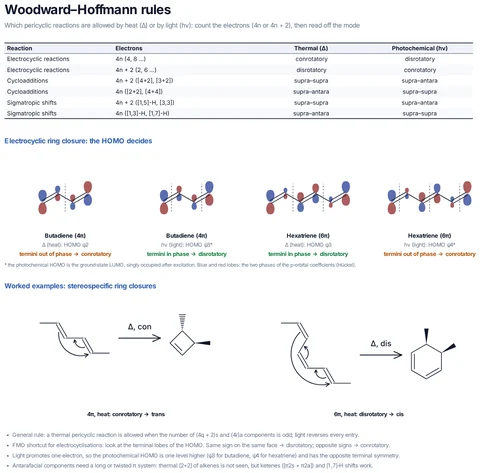
Summary sheet: allowed modes for electrocyclic reactions (con/dis), cycloadditions and sigmatropic shifts (supra/antara), thermal and photochemical, with the Hückel HOMOs of butadiene and hexatriene that explain them.
What the template shows
- Which pericyclic reactions are allowed by heat (Δ) or by light (hν): count the electrons (4n or 4n + 2), then read off the mode
- Reaction Electrons Thermal (Δ) Photochemical (hν) Electrocyclic reactions 4n (4, 8 …) conrotatory disrotatory Electrocyclic reactions 4n + 2 (2, 6 …) disrotatory conrotatory Cycloadditions 4n + 2 ([4+2], [3+2]) supra–supra supra–antara Cycloadditions 4n ([2+2], [4+4]) supra–antara supra–supra Sigmatropic shifts 4n + 2 ([1,5]-H, [3,3]) supra–supra supra–antara Sigmatropic shifts 4n ([1,3]-H, [1,7]-H) supra–antara supra–supra
- Electrocyclic ring closure: the HOMO decides
- Δ (heat): HOMO ψ2
- termini out of phase → conrotatory
- hν (light): HOMO ψ3*
- termini in phase → disrotatory
- Δ (heat): HOMO ψ3
- hν (light): HOMO ψ4*
- * the photochemical HOMO is the ground-state LUMO, singly occupied after excitation. Blue and red lobes: the two phases of the p-orbital coefficients (Hückel).
- Worked examples: stereospecific ring closures
- 4π, heat: conrotatory → trans
- 6π, heat: disrotatory → cis
- General rule: a thermal pericyclic reaction is allowed when the number of (4q + 2)s and (4r)a components is odd; light reverses every entry.
- FMO shortcut for electrocyclisations: look at the terminal lobes of the HOMO. Same sign on the same face → disrotatory; opposite signs → conrotatory.
- Light promotes one electron, so the photochemical HOMO is one level higher (ψ3 for butadiene, ψ4 for hexatriene) and has the opposite terminal symmetry.
- Antarafacial components need a long or twisted π system: thermal [2+2] of alkenes is not seen, but ketenes ([π2s + π2a]) and [1,7]-H shifts work.
Drawn with 48 atoms, 7 arrows – every one editable in MolDraw.
Sources
How to use this template
- Press Edit in MolDraw. The template opens on the canvas of the free MolDraw editor.
- Change anything: move structures, edit atoms and labels, recolour highlights or delete what you do not need.
- Add your own structures, arrows and text next to it, or combine several templates on one page.
- Export the drawing as PNG, SVG or PDF for slides, worksheets, theses and papers.
Frequently asked questions
Is the Woodward–Hoffmann rules template free?
You can preview the Woodward–Hoffmann rules template here and open and edit it in MolDraw for free. Downloading or exporting it is part of MolDraw Pro, together with the other premium templates.
Can I edit the Woodward–Hoffmann rules template?
Yes. It opens as an ordinary MolDraw drawing, so every structure, arrow, label and colour can be changed, and you can add your own content around it.
Is the chemistry checked?
Every structure is checked with RDKit and every curly arrow passes MolDraw’s electron-flow audit. The sources used are listed on this page.
Do the pericyclic templates show orbital symmetry?
They show the curly arrows, the stereochemical outcome and the Woodward–Hoffmann rule that predicts it (conrotatory or disrotatory, endo or exo).