MolDraw › Templates › Pericyclic reactions › Diels–Alder regiochemistry
Diels–Alder regiochemistry template
Free template. Download it, or open it in MolDraw to change it first.
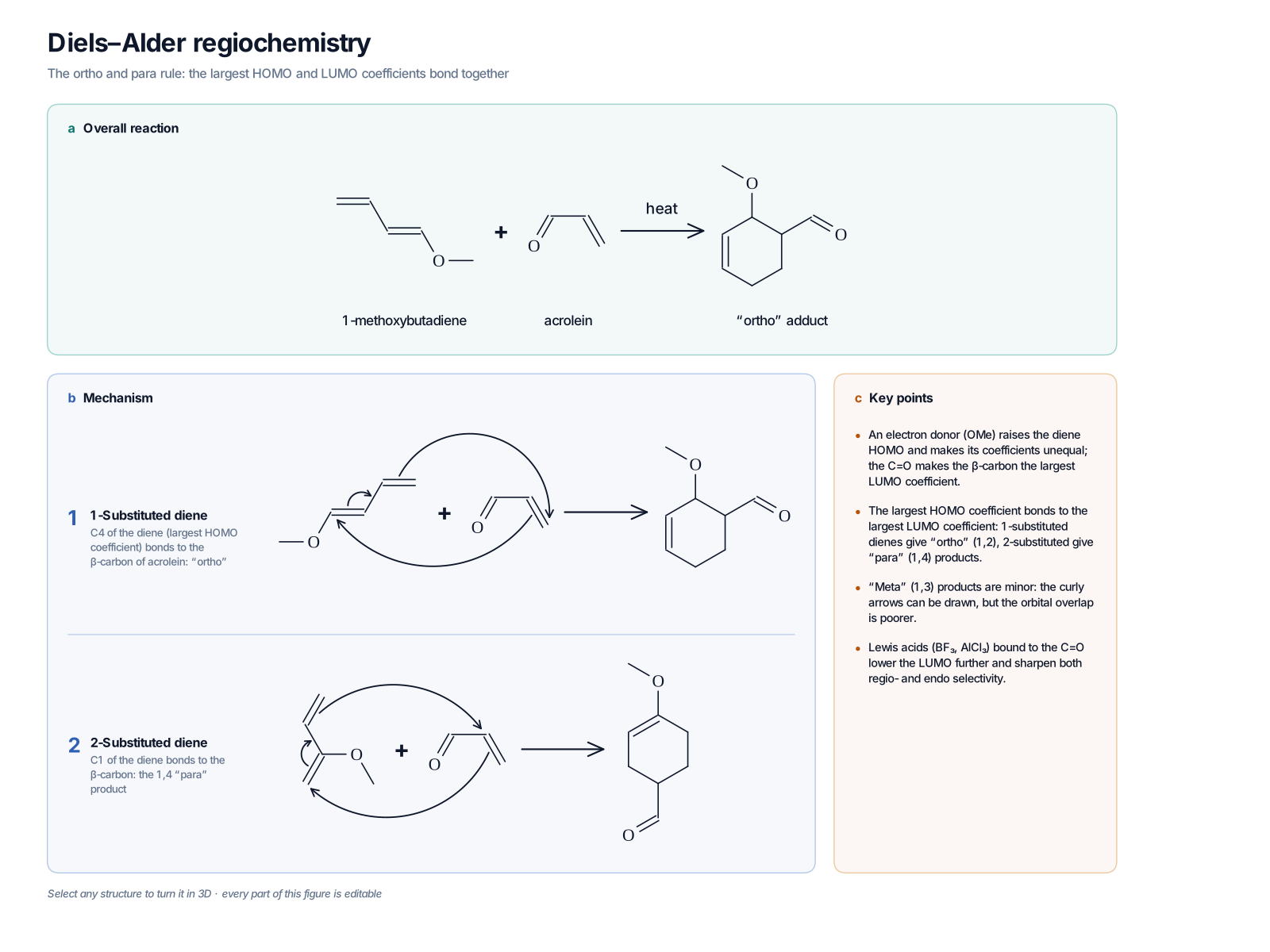
1-Methoxybutadiene and acrolein give the 1,2 (“ortho”) adduct; 2-methoxybutadiene gives the 1,4 (“para”) adduct, as the biggest orbital coefficients line up.
Mechanism step by step
The ortho and para rule: the largest HOMO and LUMO coefficients bond together
- 1-Substituted diene – C4 of the diene (largest HOMO coefficient) bonds to the β-carbon of acrolein: “ortho”
- 2-Substituted diene – C1 of the diene bonds to the β-carbon: the 1,4 “para” product
Key points
- An electron donor (OMe) raises the diene HOMO and makes its coefficients unequal; the C=O makes the β-carbon the largest LUMO coefficient.
- The largest HOMO coefficient bonds to the largest LUMO coefficient: 1-substituted dienes give “ortho” (1,2), 2-substituted give “para” (1,4) products.
- “Meta” (1,3) products are minor: the curly arrows can be drawn, but the orbital overlap is poorer.
- Lewis acids (BF₃, AlCl₃) bound to the C=O lower the LUMO further and sharpen both regio- and endo selectivity.
Drawn with 60 atoms, 9 arrows, 4 shapes – every one editable in MolDraw.
Sources
How to use this template
- Press Edit in MolDraw. The template opens on the canvas of the free MolDraw editor.
- Change anything: move structures, edit atoms and labels, recolour highlights or delete what you do not need.
- Add your own structures, arrows and text next to it, or combine several templates on one page.
- Export the drawing as PNG, SVG or PDF for slides, worksheets, theses and papers.
Frequently asked questions
Is the Diels–Alder regiochemistry template free?
Yes. The Diels–Alder regiochemistry template is one of the free MolDraw templates: open it in the editor or download it from this page as SVG or PNG and use it in your slides, worksheets and notes.
Can I edit the Diels–Alder regiochemistry template?
Yes. It opens as an ordinary MolDraw drawing, so every structure, arrow, label and colour can be changed, and you can add your own content around it.
Is the chemistry checked?
Every structure is checked with RDKit and every curly arrow passes MolDraw’s electron-flow audit. The sources used are listed on this page.
Do the pericyclic templates show orbital symmetry?
They show the curly arrows, the stereochemical outcome and the Woodward–Hoffmann rule that predicts it (conrotatory or disrotatory, endo or exo).