MolDraw › Templates › Pericyclic reactions › Photochemical [2+2] and Paternò–Büchi
Pericyclic reactionsPremium
Photochemical [2+2] and Paternò–Büchi template
Premium template. Preview and edit it free in MolDraw; downloading and exporting it is part of MolDraw Pro.
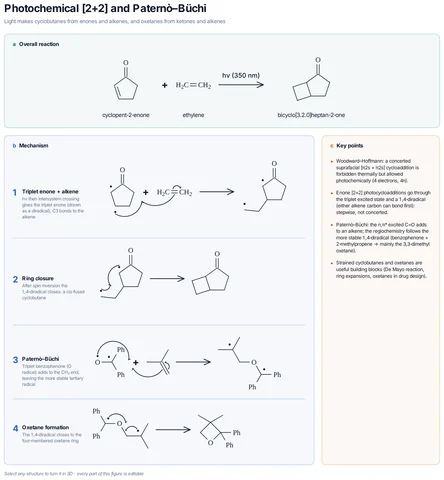
Triplet cyclopent-2-enone adds to ethylene through a 1,4-diradical to give bicyclo[3.2.0]heptan-2-one; triplet benzophenone adds to 2-methylpropene through the more stable diradical to give 3,3-dimethyl-2,2-diphenyloxetane.
Mechanism step by step
Light makes cyclobutanes from enones and alkenes, and oxetanes from ketones and alkenes
- Triplet enone + alkene – hν then intersystem crossing gives the triplet enone (drawn as a diradical); C3 bonds to the alkene
- Ring closure – After spin inversion the 1,4-diradical closes: a cis-fused cyclobutane
- Paternò–Büchi – Triplet benzophenone (O radical) adds to the CH₂ end, leaving the more stable tertiary radical
- Oxetane formation – The 1,4-diradical closes to the four-membered oxetane ring
Key points
- Woodward–Hoffmann: a concerted suprafacial [π2s + π2s] cycloaddition is forbidden thermally but allowed photochemically (4 electrons, 4n).
- Enone [2+2] photocycloadditions go through the triplet excited state and a 1,4-diradical (either alkene carbon can bond first): stepwise, not concerted.
- Paternò–Büchi: the n,π* excited C=O adds to an alkene; the regiochemistry follows the more stable 1,4-diradical (benzophenone + 2-methylpropene → mainly the 3,3-dimethyl oxetane).
- Strained cyclobutanes and oxetanes are useful building blocks (De Mayo reaction, ring expansions, oxetanes in drug design).
Drawn with 80 atoms, 15 arrows, 6 shapes – every one editable in MolDraw.
Sources
How to use this template
- Press Edit in MolDraw. The template opens on the canvas of the free MolDraw editor.
- Change anything: move structures, edit atoms and labels, recolour highlights or delete what you do not need.
- Add your own structures, arrows and text next to it, or combine several templates on one page.
- Export the drawing as PNG, SVG or PDF for slides, worksheets, theses and papers.
Frequently asked questions
Is the Photochemical [2+2] and Paternò–Büchi template free?
You can preview the Photochemical [2+2] and Paternò–Büchi template here and open and edit it in MolDraw for free. Downloading or exporting it is part of MolDraw Pro, together with the other premium templates.
Can I edit the Photochemical [2+2] and Paternò–Büchi template?
Yes. It opens as an ordinary MolDraw drawing, so every structure, arrow, label and colour can be changed, and you can add your own content around it.
Is the chemistry checked?
Every structure is checked with RDKit and every curly arrow passes MolDraw’s electron-flow audit. The sources used are listed on this page.
Do the pericyclic templates show orbital symmetry?
They show the curly arrows, the stereochemical outcome and the Woodward–Hoffmann rule that predicts it (conrotatory or disrotatory, endo or exo).