MolDraw › 3D molecule models › Tryptophan structure
Tryptophan structure and 3D model (C11H12N2O2)
L-tryptophan is an amino acid whose side chain is an indole ring: a benzene ring fused to a pyrrole. It is the largest of the 20 standard amino acids.
Drag to rotate · pinch or scroll to zoom. 3D coordinates: computed with RDKit (ETKDG conformer, force-field optimised).
Tryptophan at a glance
| Formula | C11H12N2O2 |
|---|---|
| Molar mass | 204.23 g/mol |
| IUPAC name | (2S)-2-amino-3-(1H-indol-3-yl)propanoic acid |
| Atoms / bonds | 27 / 28 |
| H-bond donors / acceptors | 3 / 2 |
| logP (estimated) | 1.1 |
| SMILES | C1=CC=C2C(=C1)C(=CN2)C[C@@H](C(=O)O)N |
| InChIKey | QIVBCDIJIAJPQS-VIFPVBQESA-N |
| PubChem | 6305 |
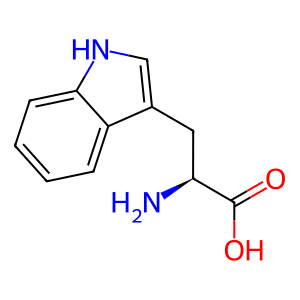
What the 3D model of Tryptophan shows
The model contains 27 atoms (15 heavy atoms and 12 hydrogens) joined by 28 bonds; in ball-and-stick mode every stick is one bond, and double or aromatic bonds are drawn as multiple sticks. Switch to space-filling to see the molecule as its electron cloud, scaled to van der Waals radii: this is the shape other molecules actually "feel". It can donate 3 and accept 2 hydrogen bonds, and its estimated logP of 1.1 means it is fairly balanced between water and fat. Its topological polar surface area is 79 Ų.
Shape and bond angles
| Atom(s) | Geometry / hybridisation | Angles & lengths |
|---|---|---|
| indole ring atoms | Trigonal planar, sp²; aromatic | ≈ 108–120° |
| α-carbon | Tetrahedral, sp³; stereocentre (S) | ≈ 109.5° |
| carboxyl carbon | Trigonal planar, sp² | ≈ 120° |
Is Tryptophan polar?
Partly. The amino and acid groups are charged in water (zwitterion), but the large indole ring is hydrophobic, so it is one of the less soluble amino acids.
Elemental composition of C11H12N2O2
| Element | Atoms | Mass (g/mol) | Mass % |
|---|---|---|---|
| Carbon (C) | 11 | 132.121 | 64.69% |
| Hydrogen (H) | 12 | 12.096 | 5.92% |
| Nitrogen (N) | 2 | 28.014 | 13.72% |
| Oxygen (O) | 2 | 31.998 | 15.67% |
Calculated from IUPAC standard atomic weights. Check any formula with the molar mass calculator.
Uses of tryptophan
- Essential amino acid that must come from food
- Precursor of serotonin, melatonin and niacin
- Its fluorescence is used to study protein folding
Interesting facts
- Tryptophan absorbs UV light at about 280 nm, which is why proteins can be measured at that wavelength.
- It is one of the least common amino acids in most proteins.
- The idea that turkey makes you sleepy because of tryptophan is mostly a myth; turkey has about as much as other meats.
Drawing structures for your notes? MolDraw is a free online chemical structure editor for molecules, reactions and lab diagrams.
Open MolDraw editorFrequently asked questions
What is the structure of Tryptophan?
L-tryptophan is an amino acid whose side chain is an indole ring: a benzene ring fused to a pyrrole. It is the largest of the 20 standard amino acids. Its SMILES is C1=CC=C2C(=C1)C(=CN2)C[C@@H](C(=O)O)N.
Is tryptophan an essential amino acid?
Yes. Humans cannot make it, so it must come from protein in the diet.
What does the L in L-tryptophan mean?
It is the natural mirror-image form found in proteins. By CIP rules its α-carbon is (S).
What is the chemical formula and molar mass of Tryptophan?
Tryptophan is C11H12N2O2 with a molar mass of 204.23 g/mol. It contains 27 atoms: 11 carbon, 12 hydrogen, 2 nitrogen, 2 oxygen.
What is the IUPAC name of Tryptophan?
The IUPAC name is (2S)-2-amino-3-(1H-indol-3-yl)propanoic acid.
How do I draw Tryptophan?
Open the MolDraw editor, paste the SMILES C1=CC=C2C(=C1)C(=CN2)C[C@@H](C(=O)O)N or type "Tryptophan" in name search, and the structure is drawn for you. You can then export it as PNG, SVG, MOL or CDXML.