MolDraw › 3D molecule models › Thymine structure
Thymine structure and 3D model (C5H6N2O2)
Thymine is a pyrimidine base with two C=O groups and a methyl group at C5. It is found in DNA, where it pairs with adenine.
Drag to rotate · pinch or scroll to zoom. 3D coordinates: computed with RDKit (ETKDG conformer, force-field optimised).
Thymine at a glance
| Formula | C5H6N2O2 |
|---|---|
| Molar mass | 126.11 g/mol |
| IUPAC name | 5-methyl-1H-pyrimidine-2,4-dione |
| Atoms / bonds | 15 / 15 |
| H-bond donors / acceptors | 2 / 2 |
| logP (estimated) | -0.6 |
| SMILES | CC1=CNC(=O)NC1=O |
| InChIKey | RWQNBRDOKXIBIV-UHFFFAOYSA-N |
| PubChem | 1135 |
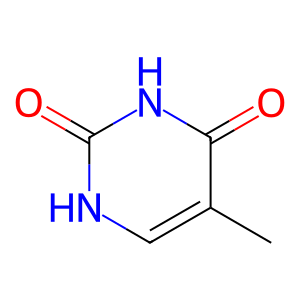
What the 3D model of Thymine shows
The model contains 15 atoms (9 heavy atoms and 6 hydrogens) joined by 15 bonds; in ball-and-stick mode every stick is one bond, and double or aromatic bonds are drawn as multiple sticks. Switch to space-filling to see the molecule as its electron cloud, scaled to van der Waals radii: this is the shape other molecules actually "feel". It can donate 2 and accept 2 hydrogen bonds, and its estimated logP of -0.6 means it is very water-loving (hydrophilic). Its topological polar surface area is 66 Ų.
Shape and bond angles
| Atom(s) | Geometry / hybridisation | Angles & lengths |
|---|---|---|
| ring atoms | Trigonal planar, sp²; planar ring | ≈ 120° |
| C=O carbons | Trigonal planar, sp² | ≈ 120° |
| methyl carbon | Tetrahedral, sp³ | ≈ 109.5° |
Is Thymine polar?
Yes. Two N–H donors and two C=O acceptors make it polar, but the solid is strongly hydrogen-bonded so it dissolves only slowly in cold water.
Elemental composition of C5H6N2O2
| Element | Atoms | Mass (g/mol) | Mass % |
|---|---|---|---|
| Carbon (C) | 5 | 60.055 | 47.62% |
| Hydrogen (H) | 6 | 6.048 | 4.80% |
| Nitrogen (N) | 2 | 28.014 | 22.21% |
| Oxygen (O) | 2 | 31.998 | 25.37% |
Calculated from IUPAC standard atomic weights. Check any formula with the molar mass calculator.
Uses of thymine
- One of the four bases in DNA
- Thymidine analogues are used as antiviral drugs
- Used to study UV damage to DNA
Interesting facts
- Thymine is also called 5-methyluracil; RNA uses uracil instead.
- UV light can join two neighbouring thymines into a thymine dimer, which damages DNA.
- It was first isolated from calf thymus glands, which gave it its name.
Drawing structures for your notes? MolDraw is a free online chemical structure editor for molecules, reactions and lab diagrams.
Open MolDraw editorFrequently asked questions
What is the structure of Thymine?
Thymine is a pyrimidine base with two C=O groups and a methyl group at C5. It is found in DNA, where it pairs with adenine. Its SMILES is CC1=CNC(=O)NC1=O.
What is the difference between thymine and uracil?
Thymine has a methyl group at C5; uracil has a hydrogen there. DNA uses thymine and RNA uses uracil.
Is thymine in RNA?
Normally no. RNA uses uracil, although many transfer RNAs contain one modified nucleoside (ribothymidine) that carries thymine.
What is the chemical formula and molar mass of Thymine?
Thymine is C5H6N2O2 with a molar mass of 126.11 g/mol. It contains 15 atoms: 5 carbon, 6 hydrogen, 2 nitrogen, 2 oxygen.
What is the IUPAC name of Thymine?
The IUPAC name is 5-methyl-1H-pyrimidine-2,4-dione.
How do I draw Thymine?
Open the MolDraw editor, paste the SMILES CC1=CNC(=O)NC1=O or type "Thymine" in name search, and the structure is drawn for you. You can then export it as PNG, SVG, MOL or CDXML.