How to Count Stereoisomers: the 2ⁿ Rule, Meso Compounds, Enantiomers and Diastereomers
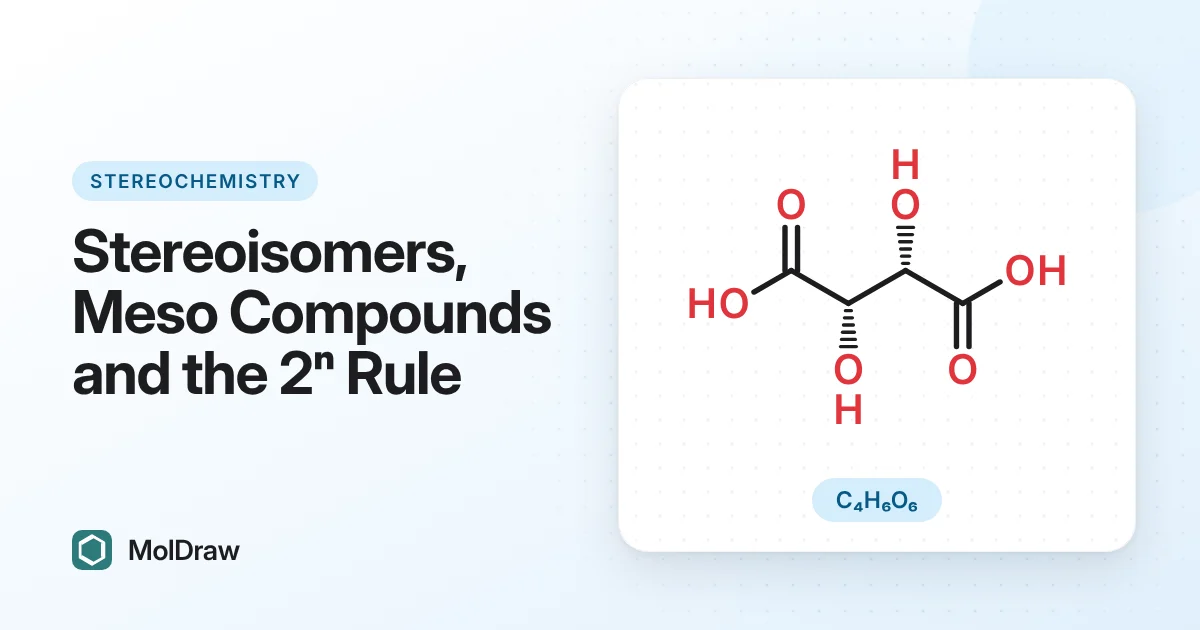
Short answer: Count the stereocentres and the stereogenic (E/Z) double bonds, n. The maximum number of stereoisomers is 2ⁿ. If the molecule has two identical halves, some arrangements are meso (achiral, with an internal mirror plane) and are counted once, so the real number is lower. Tartaric acid: n = 2, 2² = 4, but only 3 stereoisomers. Open-chain glucose: n = 4, 16. Mirror-image pairs are enantiomers; every other pair is diastereomers. The free stereoisomer enumerator lists and draws them all.
Key definitions
- Stereoisomers have the same atoms joined in the same order but arranged differently in space.
- A stereocentre (chiral centre) is usually a carbon with four different groups. It is labelled R or S.
- A stereogenic double bond has two different groups on each carbon. It is labelled E or Z.
- Enantiomers are non-superimposable mirror images. Every stereocentre is inverted.
- Diastereomers are stereoisomers that are not mirror images. Cis/trans isomers are diastereomers.
- A meso compound has stereocentres but is achiral, because it has an internal mirror plane.
The 2ⁿ rule, and when it fails
Each stereo element has two choices, so n elements give at most 2ⁿ stereoisomers. The rule gives the exact answer only when the molecule has no symmetry. When two halves of the molecule are the same, check for:
- Meso forms: (2R,3S) in a symmetric molecule is the same as (2S,3R), and is its own mirror image.
- Identical arrangements: in hexa-2,4-diene, (2E,4Z) is the same as (2Z,4E), so 3 isomers instead of 4.
- Pseudo-asymmetric centres: in pentane-2,3,4-triol, C3 is a stereocentre only when C2 and C4 have opposite configurations. It is labelled r or s. The total is 4, not 8.
A shortcut for symmetric chains with n stereocentres: if n is even, the count is 2ⁿ⁻¹ + 2^(n/2 − 1); if n is odd, it is 2ⁿ⁻¹. For tartaric acid (n = 2): 2 + 1 = 3.
How to use the stereoisomer enumerator
- Open the stereoisomer enumerator.
- Draw the molecule in the editor, or paste a SMILES into the box and press Enter. You can also press an example such as Tartaric acid, Glucose (open chain) or Hexa-2,4-diene. Press Find stereoisomers to run it again.
- Read the count: the number of stereocentres and E/Z bonds, the 2ⁿ limit and the real number.
- Look at the groups: Enantiomer pairs (mirror images), Meso compounds and Achiral stereoisomers (cis/trans, E/Z). Each drawing carries its R/S and E/Z labels.
- Use the table How each pair is related to see which pairs are enantiomers and which are diastereomers.
- If your SMILES fixes some centres with @ or @@, the isomers that fit are marked your input. Press Open in MolDraw under any structure to edit it.
The tool tries every arrangement and compares them by a stereo-aware canonical code, so it never counts the same molecule twice.
Worked examples
1. Butan-2-ol: 2
C2 carries H, OH, CH₃ and CH₂CH₃. One stereocentre, 2¹ = 2: (R) and (S), a pair of enantiomers.
2. 2,3-Dibromobutane: 3
Two stereocentres with the same groups. (2R,3R) and (2S,3S) are enantiomers. (2R,3S) has a mirror plane: meso. Total 3.
3. 2,3-Dibromopentane: 4
The two ends differ (CH₃ and CH₂CH₃), so no meso form is possible. 2² = 4: two pairs of enantiomers.
4. Open-chain glucose: 16
C2, C3, C4 and C5 are stereocentres, and the ends (CHO and CH₂OH) differ. 2⁴ = 16 aldohexoses: 8 D and 8 L. D-glucose is (2R,3S,4R,5R).
5. 1,2-Dimethylcyclohexane: 3
cis has a mirror plane (meso, (1R,2S)). trans is chiral: (1R,2R) and (1S,2S). By contrast, 1,4-dimethylcyclohexane has only cis and trans, and neither is chiral.
Summary table
| Molecule | n | 2ⁿ | Stereoisomers |
|---|---|---|---|
| Butan-2-ol | 1 | 2 | 2 (1 pair) |
| Tartaric acid | 2 | 4 | 3 (1 pair + meso) |
| Butane-2,3-diol | 2 | 4 | 3 (1 pair + meso) |
| 2,3-Dibromopentane | 2 | 4 | 4 (2 pairs) |
| Threonine | 2 | 4 | 4 (2 pairs) |
| Hexa-2,4-diene | 2 | 4 | 3 (EE, ZZ, EZ) |
| Pentane-2,3,4-triol | 3 | 8 | 4 (2 meso + 1 pair) |
| Carvone | 1 | 2 | 2 (R and S) |
| Glucose (open chain) | 4 | 16 | 16 (8 pairs) |
Common mistakes
- Giving 2ⁿ for a symmetric molecule without checking for meso forms.
- Forgetting that E/Z double bonds count in n.
- Counting a C=C inside a small ring, or a CH₂ or C(CH₃)₂ carbon, as stereogenic.
- Calling (2R,3S) and (2S,3R) two compounds when the molecule is symmetric.
- Thinking all diastereomers have stereocentres. cis- and trans-but-2-ene are diastereomers too.
- Counting an amine nitrogen as a stereocentre. It inverts too quickly.
Exam tips
- JEE and NEET: "total number of stereoisomers" questions often hide a meso form or an E/Z bond. Write out the R/S combinations and cross out duplicates.
- AP and A-level: optical isomers need a chiral centre; a meso compound is optically inactive even though it has chiral centres.
- University organic: use point groups to judge chirality: a molecule with a mirror plane (σ) or a centre of inversion (i) is achiral. The point group finder shows these elements in 3D.
- Enantiomers have identical melting points and NMR spectra; diastereomers do not. That is how diastereomers can be separated by crystallisation or chromatography.
Questions and answers
How do you calculate the number of stereoisomers?
Count stereocentres and stereogenic double bonds (n). The maximum is 2^n. If the molecule has two identical halves, remove meso forms and identical arrangements to get the real number.
How many stereoisomers does tartaric acid have?
Three: the (2R,3R) and (2S,3S) enantiomers and the meso (2R,3S) form. The 2^n rule gives 4, but (2R,3S) and (2S,3R) are the same molecule.
What is a meso compound?
A molecule with two or more stereocentres that is achiral because it has an internal mirror plane. It is identical to its mirror image and is optically inactive.
What is the difference between enantiomers and diastereomers?
Enantiomers are mirror images that cannot be superimposed: every stereocentre is inverted. Diastereomers are stereoisomers that are not mirror images, such as (2R,3R) and (2R,3S).
How many stereoisomers does glucose have?
The open-chain form has four stereocentres and no symmetry, so 2^4 = 16. These are the eight D- and eight L-aldohexoses.
Do E/Z double bonds count when using 2^n?
Yes. A double bond with two different groups on each carbon has E and Z forms, so it counts as one stereo element, just like a stereocentre.
Can a molecule be chiral without a stereocentre?
Yes. Some allenes and biaryls are chiral because of a chiral axis, not a stereocentre. Penta-2,3-diene is a chiral allene.