Fischer Projections Explained: Rules, R/S, D/L and a Free Converter
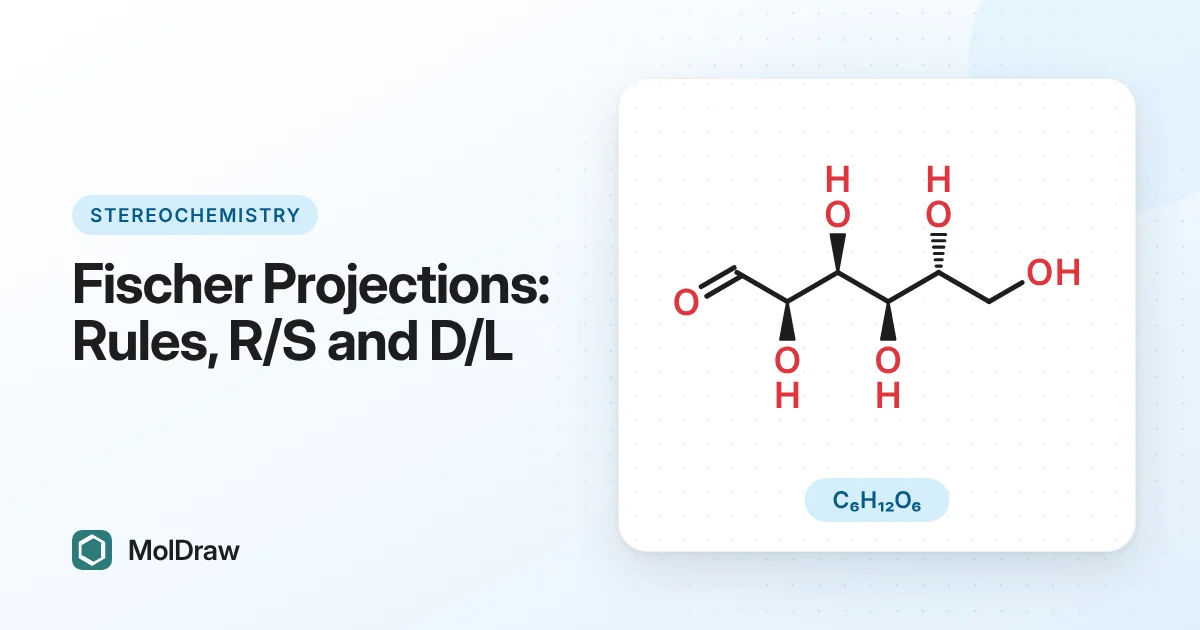
Short answer: In a Fischer projection every crossing point is a carbon, horizontal bonds point toward you and vertical bonds point away. To get R or S, rank the groups by CIP rules and trace 1 → 2 → 3: if the lowest group is vertical, clockwise is R; if it is horizontal, reverse the answer. D/L comes from the OH on the stereocentre furthest from the C=O (sugars) or the NH₂ on the α-carbon (amino acids): right is D, left is L. D-glyceraldehyde is (R) and D-glucose is (2R,3S,4R,5R). The free Fischer projection converter does all of this and draws the wedge-dash structure.
What a Fischer projection shows
A Fischer projection is a flat way to draw a molecule with several stereocentres in a chain. It was designed by Emil Fischer for sugars.
- The carbon chain runs from top to bottom, with the most oxidised carbon (CHO or COOH) at the top.
- Each crossing point is a stereocentre carbon.
- Horizontal bonds come toward you (like wedges). Vertical bonds go away from you (like dashes).
The four rules for moving a Fischer projection
| Move | Result |
|---|---|
| Rotate 180° in the page | Same molecule |
| Rotate 90° | Enantiomer (for one stereocentre) |
| Swap two groups on one carbon | That centre is inverted (R ⇄ S) |
| Swap twice on the same carbon | Same molecule again |
How to assign R or S from a Fischer projection
- Rank the four groups on the carbon by CIP rules: higher atomic number first. Count C=O as C with two O atoms.
- Trace 1 → 2 → 3 on the page.
- If group 4 (usually H) is on a vertical bond, it already points away from you: clockwise = R, anticlockwise = S.
- If group 4 is on a horizontal bond, it points toward you: reverse the answer.
Example, D-glyceraldehyde: OH (1) is right, CHO (2) is top, CH₂OH (3) is bottom, H (4) is left. 1 → 2 → 3 goes anticlockwise, which reads as S. H is horizontal, so the true answer is R.
D and L
D/L compares a molecule with glyceraldehyde. Draw the chain with the most oxidised carbon at the top.
- Sugars: look at the OH on the stereocentre furthest from the C=O. Right = D, left = L. In glucose this is C5.
- Amino acids: put COOH at the top and the side chain at the bottom. NH₂ on the left = L, on the right = D. Natural amino acids are L.
D/L is not R/S. D-glyceraldehyde is R, L-alanine is S, but L-cysteine is R because the CH₂SH group (S atom) outranks COOH. D/L also says nothing about the sign of optical rotation: D-fructose is laevorotatory.
How to use the Fischer projection converter
- Open the Fischer projection converter.
- Paste a SMILES with
@or@@into From SMILES and press Convert, or press an example such as D-Glucose or L-Alanine. - To build your own, pick the top and bottom groups and the left and right group of each row. Use Add row and Remove row for up to five stereocentres.
- Read the Fischer projection next to the Wedge-dash structure (zigzag). Each centre card shows the CIP priorities, where each group sits and why the centre is R or S.
- Press Rotate 180°, Rotate 90°, Mirror image or ⇄ on a row to test the rules.
- Copy the SMILES or press Open in MolDraw to edit and export the structure.
Fischer projection to wedge-dash (zigzag)
A Fischer projection shows each carbon eclipsed, with the chain curving away behind the page. A zigzag drawing shows the chain staggered and flat. To convert by hand:
- Assign R or S to every centre in the Fischer projection.
- Draw the zigzag chain with C1 on the left.
- At each centre, put the substituent on a wedge or a dash so that the centre has the same R or S label.
A quick check: two groups on the same side of a Fischer projection on neighbouring carbons end up on opposite sides (one wedge, one dash) in the zigzag. That is why meso-tartaric acid looks "anti" in its zigzag drawing.
Worked examples
1. L-Alanine
COOH top, CH₃ bottom, NH₂ left, H right. NH₂ (1) > COOH (2) > CH₃ (3) > H (4). 1 → 2 → 3 is clockwise; H is horizontal, so reverse: (S). NH₂ is on the left, so L.
2. D-Erythrose and D-threose
Both have CHO at the top and the C3 OH on the right (D). Erythrose has the C2 OH on the right too: (2R,3R). Threose has it on the left: (2S,3R). They are diastereomers.
3. Tartaric acid
With both OH groups on the same side, a horizontal mirror plane cuts between C2 and C3: meso, (2R,3S). With the OH groups on opposite sides you get the chiral (R,R) and (S,S) forms.
4. L-Threonine
COOH top, CH₃ bottom. C2: NH₂ left (L). C3: OH right. The tool gives (2S,3R), the natural amino acid.
Summary table
| Molecule | Fischer pattern (top to bottom) | Configuration |
|---|---|---|
| D-glyceraldehyde | CHO; OH right; CH₂OH | (R), D |
| L-alanine | COOH; NH₂ left; CH₃ | (S), L |
| D-erythrose | CHO; OH right, right; CH₂OH | (2R,3R) |
| D-threose | CHO; OH left, right; CH₂OH | (2S,3R) |
| D-glucose | CHO; OH right, left, right, right; CH₂OH | (2R,3S,4R,5R) |
| meso-tartaric acid | COOH; OH right, right; COOH | (2R,3S), achiral |
Common mistakes
- Turning a Fischer projection by 90°. This gives the enantiomer.
- Forgetting to reverse the answer when H is horizontal.
- Reading D/L at C2 of a sugar. Use the stereocentre furthest from the C=O.
- Assuming D means R or (+). D/L, R/S and +/− are three different things.
- Copying the Fischer sides straight onto a zigzag. Check each centre's R/S instead.
Exam tips
- JEE and NEET: practise R/S on glucose, fructose and amino acids drawn as Fischer projections, and spot meso forms by a horizontal mirror line.
- AP and A-level: know that horizontal bonds point toward the viewer and that natural amino acids are L.
- University organic and biochemistry: relate Fischer projections to Haworth projections: groups on the right in the Fischer projection point down in the Haworth ring.
- When in doubt, swap groups so that H is vertical, read the answer, then count the swaps: an odd number reverses it.
Questions and answers
What do horizontal and vertical lines mean in a Fischer projection?
Horizontal lines are bonds that point toward the viewer. Vertical lines are bonds that point away from the viewer. Each crossing point is a carbon atom.
How do you find R and S from a Fischer projection?
Rank the groups by CIP rules and trace 1 → 2 → 3. If the lowest-priority group is on a vertical line, clockwise is R. If it is on a horizontal line, reverse the result.
Can you rotate a Fischer projection?
Only by 180° in the plane of the page. A 90° rotation, or flipping the drawing over, gives a different stereoisomer.
How do you tell if a sugar is D or L?
Draw it with the C=O at the top and look at the OH on the stereocentre furthest from it. OH on the right means D, OH on the left means L.
Is a D sugar always R?
No. D and L compare the molecule with glyceraldehyde, while R and S come from CIP priorities at each centre. D-glucose is (2R,3S,4R,5R), so it has an S centre.
How do I spot a meso compound in a Fischer projection?
Look for a horizontal mirror line that makes the top half the mirror image of the bottom half. meso-Tartaric acid, with both OH groups on the right, is an example.