Chair Conformations and Newman Projections: A Step-by-Step Guide with a Free Drawing Tool
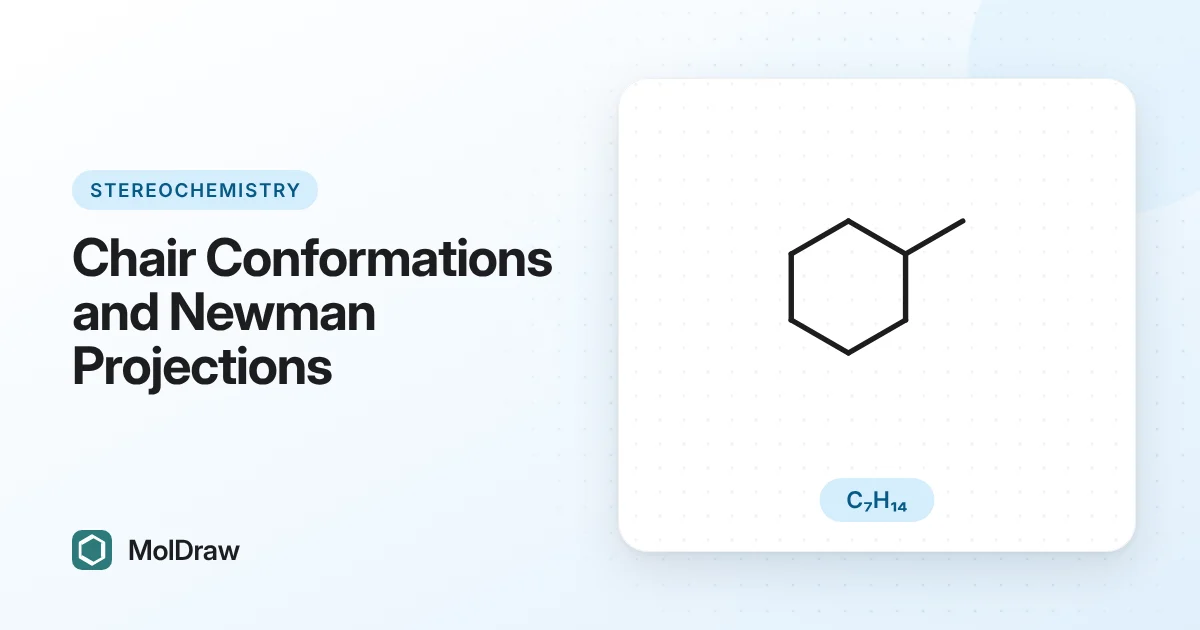
Short answer: In a cyclohexane chair every carbon has one axial bond (straight up or down) and one equatorial bond (pointing out from the ring). A ring flip swaps them. Large groups prefer equatorial: an axial methyl costs 7.3 kJ/mol (its A-value), so methylcyclohexane is 95% equatorial at 25 °C. In a Newman projection, staggered conformations are lowest in energy; butane anti is 0, gauche 3.8, eclipsed 16 and fully eclipsed 19 kJ/mol. The free chair and Newman drawer draws both chairs, sums the strain and plots the torsional energy.
The chair conformation
Cyclohexane is not flat. A flat hexagon would have 120° angles and eclipsed C–H bonds. The ring folds into a chair, where every C–C–C angle is about 109.5° and every bond is staggered. The chair has almost no angle or torsional strain, so it is the conformation that nearly all cyclohexane molecules adopt.
Axial and equatorial bonds
- Axial bonds are parallel to the axis of the ring. They point straight up or straight down and alternate up, down, up around the ring.
- Equatorial bonds point outward around the "equator". Each one is parallel to the two ring bonds that are one carbon away.
- On each carbon the axial and equatorial bonds point to opposite faces. If the axial bond is up, the equatorial bond tilts slightly down.
The ring flip
The ring flips between two chairs about 100 000 times a second at room temperature (barrier about 45 kJ/mol). In a ring flip, every axial position becomes equatorial and every equatorial position becomes axial. A group that points up stays up. That is why cis and trans never change on a ring flip.
A-values and the more stable chair
An axial group sits close to the two axial hydrogens three carbons along on the same face. These 1,3-diaxial interactions make the axial chair less stable. The A-value is the free energy difference, ΔG°, between the axial and the equatorial chair of a monosubstituted cyclohexane.
| Group | A-value (kJ/mol) | % equatorial at 298 K |
|---|---|---|
| F | 1.0 | 60% |
| Cl | 2.2 | 71% |
| OH | 3.6 | 81% |
| CH₃ | 7.3 | 95% |
| CH(CH₃)₂ | 9.2 | 98% |
| C₆H₅ | 11.7 | 99% |
| C(CH₃)₃ | 20.5 | more than 99.9% |
To turn ΔG into a ratio, use ΔG° = −RT ln K. At 298 K, RT = 2.48 kJ/mol. For methyl: K = e7.3/2.48 = 19, so 19 equatorial molecules for every axial one, or 95%.
Two or more groups
- Draw both chairs. Keep each group on its face (up or down).
- For each chair, add the A-value of every axial group.
- Add about 8 kJ/mol more if two groups (not H) are axial on the same face, 1,3 to each other. Add 3.8 kJ/mol for two carbon groups on neighbouring carbons that are gauche (both equatorial, or one axial and one equatorial).
- The chair with the lower total is more stable. ΔG is the difference of the totals.
How to use the chair and Newman drawer
- Open the chair conformation and Newman projection drawer. The Chair conformations tab is open.
- Press an example such as trans-1,2-Dimethyl, or choose an Up (wedge) and a Down (dash) group for C1 to C6.
- Read both chairs. Axial groups are drawn in orange, equatorial groups in blue. The more stable chair is marked more stable.
- Read the strain table: every A-value, 1,3-diaxial clash and gauche interaction, then ΔG, K and the % of each chair at 298 K.
- Press Animate ring flip to watch the axial groups turn equatorial. Save the drawing with Download SVG or Download PNG.
- Open the Newman projection tab, choose Butane (C2–C3), then move the slider or press +60°, Anti (180°) or Animate 360°. The plot shows the energy at every angle.
Worked examples
1. trans-1,2-Dimethylcyclohexane
One chair has both methyls equatorial. The two methyls are gauche, so the strain is 3.8 kJ/mol. The flipped chair has both axial: 2 × 7.3 = 14.6 kJ/mol. ΔG = 14.6 − 3.8 = 10.8 kJ/mol, K = 78, so 98.7% diequatorial.
2. cis-1,3-Dimethylcyclohexane
In cis-1,3 the groups are both equatorial or both axial. Diaxial: 2 × 7.3 plus about 8 for the CH₃/CH₃ 1,3-diaxial clash, about 22.6 kJ/mol. Diequatorial: 0. More than 99.9% diequatorial.
3. cis-1-tert-Butyl-4-methylcyclohexane
One group must be axial. tert-Butyl (20.5) costs far more than methyl (7.3), so tert-butyl stays equatorial and methyl goes axial. ΔG = 13.2 kJ/mol, more than 99% of one chair. tert-Butyl "locks" the ring.
4. Menthol
In (−)-menthol the OH, isopropyl and methyl groups can all be equatorial in one chair, so that chair is strongly favoured. The flipped chair would put all three axial.
5. Butane gauche and anti
Gauche butane is 3.8 kJ/mol above anti, and there are two gauche forms. K = 2 × e−3.8/2.48 = 0.43, so about 70% anti and 30% gauche at 298 K.
Newman projections
A Newman projection looks straight along one C–C bond. The front carbon is a point; its three bonds meet in the centre. The back carbon is a circle; its bonds start at the edge. The angle between a front bond and a back bond is the dihedral angle.
| Conformation of butane | Dihedral (CH₃ to CH₃) | Energy (kJ/mol) | Strain terms |
|---|---|---|---|
| Anti (staggered) | 180° | 0 | none |
| Gauche (staggered) | 60°, 300° | 3.8 | CH₃/CH₃ gauche |
| Eclipsed | 120°, 240° | 16 | 2 × H/CH₃ (6.0) + H/H (4.0) |
| Fully eclipsed | 0° | 19 | CH₃/CH₃ (11) + 2 × H/H (4.0) |
For ethane the three H/H eclipsing interactions give a 12 kJ/mol barrier; for propane (2 H/H + 1 H/CH₃) it is 14 kJ/mol.
Summary table
| Term | Meaning |
|---|---|
| Axial | Bond parallel to the ring axis, straight up or down |
| Equatorial | Bond pointing out from the ring, parallel to ring bonds one carbon away |
| Ring flip | Axial ⇄ equatorial on every carbon; up stays up |
| A-value | ΔG° (axial − equatorial) for one group; CH₃ 7.3 kJ/mol |
| ΔG° = −RT ln K | 5.7 kJ/mol changes K tenfold at 298 K |
| Staggered / eclipsed | Dihedral 60°, 180° / 0°, 120° |
| Anti / gauche | Largest groups 180° / 60° apart |
Common mistakes
- Converting cis to trans during a ring flip. A ring flip never changes cis or trans.
- Thinking cis always means both equatorial. For 1,2 and 1,4, cis is axial plus equatorial. For 1,3, cis is diequatorial or diaxial.
- Drawing axial bonds at an angle. They are vertical.
- Forgetting the gauche interaction in diequatorial trans-1,2-dimethylcyclohexane.
- Using °C in ΔG = −RT ln K. Use kelvin.
- Calling the eclipsed butane at 120° "fully eclipsed". Fully eclipsed means CH₃ behind CH₃ at 0°.
Exam tips
- JEE and NEET: know the order of conformer stability for butane (anti > gauche > eclipsed > fully eclipsed) and that the chair is more stable than the twist-boat, boat and half-chair.
- AP Chemistry and A-level: be able to explain stability with steric strain: bulky groups prefer equatorial.
- University organic: calculate ΔG from A-values and convert it to K and % population. Remember that tert-butyl locks the ring and that cis-1,4-di-tert-butylcyclohexane adopts a twist-boat.
- When you draw a chair in an exam, draw the axial bonds first (straight up and down), then the equatorial bonds parallel to ring bonds.
Questions and answers
What is the difference between axial and equatorial positions?
Axial bonds are parallel to the axis of the chair and point straight up or down. Equatorial bonds point outward around the ring. Each ring carbon has one axial and one equatorial bond, on opposite faces.
Why do large groups prefer the equatorial position?
An axial group is close to the two axial hydrogens three carbons along on the same face. These 1,3-diaxial interactions cost energy. An equatorial group points away from the ring and avoids them.
What is the A-value of a methyl group?
About 7.3 kJ/mol (1.74 kcal/mol). That gives K = 19 at 298 K, so methylcyclohexane is about 95% equatorial.
Does a ring flip change cis to trans?
No. A ring flip turns axial into equatorial and back, but a group that points up stays up. Cis and trans depend only on the faces, so they do not change.
Which conformation of butane is the most stable?
The anti conformation, with the two methyl groups 180° apart. Gauche is 3.8 kJ/mol higher, eclipsed 16 and fully eclipsed 19 kJ/mol.
How do I calculate the percentage of each chair?
Find ΔG between the chairs, then K = e^(−ΔG/RT) with R = 8.314 J/(mol·K) and T in kelvin. The fraction of the more stable chair is K/(1 + K) for K above 1.
Why does tert-butyl lock the ring?
Its A-value is about 20.5 kJ/mol, so the equatorial chair is favoured by more than 3000 to 1 at room temperature. The ring is almost never in the chair with tert-butyl axial.