From Sequence to Structure: Peptide and DNA SMILES, Formula and Mass, with a Free Tool
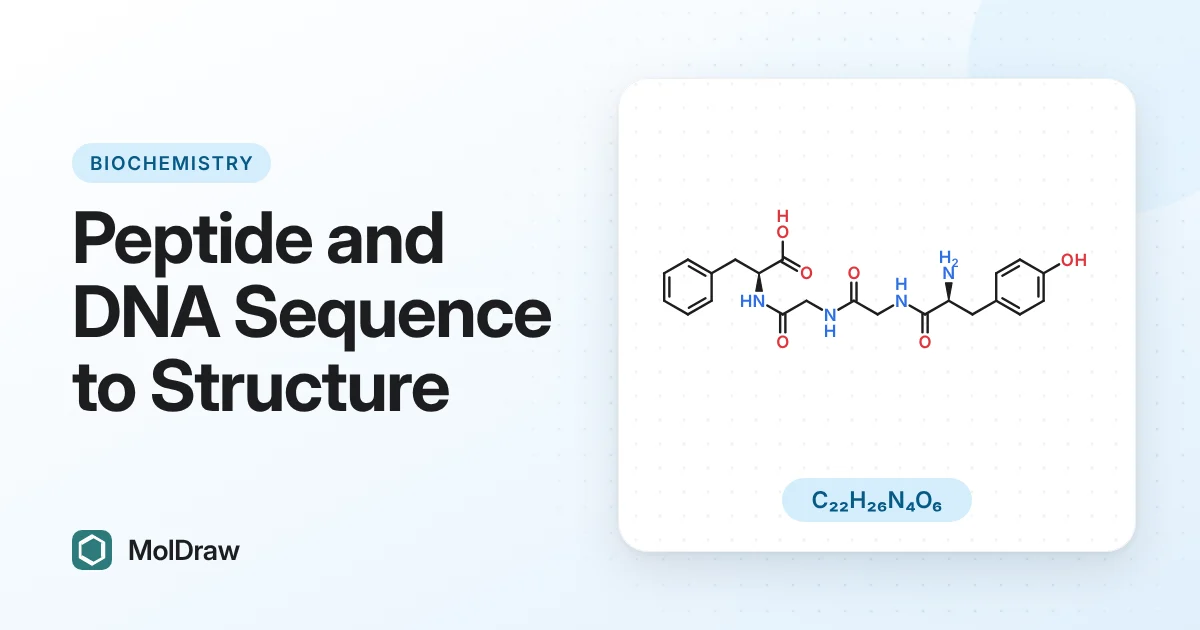
Short answer: A peptide structure is its amino acids joined by peptide bonds, written from the N-terminus to the C-terminus. A DNA or RNA structure is its nucleotides joined by 3′-5′ phosphodiester bonds, written 5′ to 3′. Paste a sequence into the peptide and DNA sequence to structure tool to get the full isomeric SMILES, a drawing, the formula and the masses. GGG is C6H11N3O4 (189.0750 Da), and 5′-ATGC-3′ is C39H50N15O22P3 (1173.82 g/mol).
Key terms in one line each
| Peptide bond | The amide C(=O)–NH link between the carboxyl carbon of one amino acid and the amino nitrogen of the next. |
|---|---|
| Residue | An amino acid inside a chain: the free amino acid minus one H2O. |
| N-terminus, C-terminus | The free amino end and the free carboxyl end. Sequences are written N to C. |
| Nucleotide | A base on carbon 1′ of a sugar, with a phosphate. DNA uses 2-deoxyribose, RNA uses ribose. |
| Phosphodiester bond | The O–P–O link from the 3′-oxygen of one sugar to the 5′-oxygen of the next. |
| Monoisotopic mass | Mass using the most abundant isotope of each element. Matches the first peak in high-resolution MS. |
| Average mass | Mass using natural isotope abundances. Use it for weighing and molarity. |
From peptide sequence to structure
Each peptide bond releases one water. So the formula of a linear peptide is the sum of its residue formulas plus one H2O for the two free ends.
Worked count, GGG: glycine is C2H5NO2. Three glycines give C6H15N3O6. Two peptide bonds remove 2 H2O. Result: C6H11N3O4, 189.0750 Da monoisotopic.
Order matters. Asp-Phe (DF) has a free NH2 on aspartic acid, while Phe-Asp (FD) has it on phenylalanine. They are different molecules with the same formula.
Every alpha carbon is L. By the CIP rules that is S for all standard residues except cysteine, which is R because sulfur outranks the carboxyl group. Glycine has no stereocentre. Isoleucine is (2S,3S) and threonine (2S,3R).
End groups change the formula:
- N-terminal acetyl: + C2H2O, +42.0106 Da.
- C-terminal amide: −OH becomes −NH2, −0.9840 Da.
- Head-to-tail cyclic: one more peptide bond, −H2O, −18.0106 Da.
- Disulfide bond: −2 H per S–S bond, −2.0157 Da.
pI, charge and extinction coefficient
The net charge of a peptide is the sum over all ionisable groups. A basic group adds +1 / (1 + 10pH − pKa). An acidic group adds −1 / (1 + 10pKa − pH). The isoelectric point (pI) is the pH where the net charge is zero.
The tool uses the EMBOSS pKa set: N-terminus 8.6, C-terminus 3.6, Asp 3.9, Glu 4.1, His 6.5, Cys 8.5, Tyr 10.1, Lys 10.8, Arg 12.5. For GGG the only groups are the two ends, so pI = (3.6 + 8.6) / 2 = 6.10.
The molar extinction coefficient at 280 nm comes from Trp, Tyr and cystines: ε280 = 5500 × n(Trp) + 1490 × n(Tyr) + 125 × n(cystine) M−1 cm−1 (Pace et al., 1995). A peptide with no Trp, Tyr or Cys does not absorb at 280 nm.
From DNA or RNA sequence to structure
Each nucleotide has a base on carbon 1′ of the sugar: adenine and guanine through N9, cytosine, thymine and uracil through N1. All sugars are β-D. A phosphate joins the 3′-oxygen of one nucleotide to the 5′-oxygen of the next, so every strand has a 5′ end and a 3′ end.
Worked count, 5′-ATGC-3′: the four deoxynucleosides are dA C10H13N5O3, dT C10H14N2O5, dG C10H13N5O4 and dC C9H13N3O4, together C39H53N15O16. Each of the 3 phosphodiester links adds H3PO4 and removes 2 H2O, a net PO2 minus one H. Result: C39H50N15O22P3, 1173.82 g/mol. A 5′-phosphate adds HPO3 (+79.9663 Da).
RNA has a 2′-OH on each ribose, one more oxygen per nucleotide, and U instead of T.
- GC content: (G + C) / N × 100 %.
- Complement: A pairs with T (U in RNA), G with C, read 3′ to 5′.
- Reverse complement: the complement written 5′ to 3′.
- Tm, Wallace rule (under 14 nt): 2 × (A + T) + 4 × (G + C) °C.
- Tm, basic GC formula (14 nt or more): 64.9 + 41 × (G + C − 16.4) / N °C.
How to use the MolDraw sequence to structure tool
- Open the peptide and DNA sequence to structure page and choose Peptide or DNA or RNA.
- Type or paste the sequence. Spaces, numbers, dashes and FASTA header lines are ignored. Input format detects one- or three-letter code by itself.
- For peptides, tick N-terminal acetyl (Ac-), C-terminal amide (-NH₂), Head-to-tail cyclic or Disulfide bonds (Cys 1–2, 3–4…) as needed. For DNA or RNA, tick 5′-phosphate if the 5′ end is phosphorylated.
- Press Build structure. Results update as you type.
- Use Copy SMILES, Download MOL, Download SDF or Open in MolDraw editor. Up to 30 residues or nucleotides are drawn. Longer sequences, up to 2000, still give the formula, masses and SMILES.
Worked examples
Example 1: angiotensin II for mass spectrometry
DRVYIHPF gives C50H71N13O12. Monoisotopic mass 1045.5345 Da, [M+H]+ 1046.5418, [M+2H]2+ 523.7745. pI 7.54, charge +0.22 at pH 7. One Tyr gives ε280 = 1490 M−1 cm−1.
Example 2: oxytocin with a disulfide and an amide
Type CYIQNPCLG and tick C-terminal amide and Disulfide bonds. Cys1 and Cys6 are joined, closing a 20-membered ring. Result: C43H66N12O12S2, 1007.19 g/mol, monoisotopic 1006.4365 Da.
Example 3: the M13 forward sequencing primer
5′-GTAAAACGACGGCCAGT-3′ has 17 nt with 9 G or C, so GC = 52.9 %. With 14 nt or more the basic GC formula applies: Tm = 64.9 + 41 × (9 − 16.4) / 17 = 47.1 °C. The reverse complement is 5′-ACTGGCCGTCGTTTTAC-3′.
Example 4: the EcoRI site
5′-GAATTC-3′ is its own reverse complement, as restriction sites usually are. GC = 33.3 %, Wallace Tm = 2 × 4 + 4 × 2 = 16 °C. As a single strand with free ends it is C59H75N22O34P5, 1791.22 g/mol.
Summary table
| GGG | C6H11N3O4, 189.0750 Da, pI 6.10 |
|---|---|
| Asp-Phe (DF) | C13H16N2O5, 280.1059 Da, pI 3.75 |
| Angiotensin II | C50H71N13O12, 1045.5345 Da, pI 7.54 |
| Oxytocin | C43H66N12O12S2, 1007.19 g/mol |
| DNA ATGC | C39H50N15O22P3, 1173.82 g/mol, GC 50 %, Tm 12 °C |
| M13 forward primer | 17 nt, GC 52.9 %, Tm 47.1 °C |
Common mistakes
- Writing a peptide from the wrong end. YGGFL is Leu-enkephalin. LFGGY is a different peptide.
- Adding a water per residue. A linear chain gets one H2O in total, not one per residue. A cyclic peptide gets none.
- Using average mass for MS peaks. High-resolution peaks match the monoisotopic mass.
- Forgetting disulfides. Each S–S bond is −2.016 Da.
- Mixing T and U. T is DNA, U is RNA.
- Ordering a primer as the plain complement. Oligos are synthesised 5′ to 3′, so you usually need the reverse complement.
- Using the Wallace rule for long primers. It overestimates Tm above about 14 nt.
Questions and answers
How do I turn a peptide sequence into a chemical structure?
Join the amino acids with peptide bonds from the N-terminus to the C-terminus, losing one water per bond. The MolDraw tool does this for you: type DRVYIHPF or Asp-Arg-Val-Tyr-Ile-His-Pro-Phe and it returns the isomeric SMILES, a drawing, the formula and the masses.
What is the molecular formula and mass of GGG?
Triglycine (GGG) is C6H11N3O4. Its monoisotopic mass is 189.0750 Da and its average molar mass is 189.17 g/mol.
What is the exact mass of angiotensin II?
Angiotensin II, DRVYIHPF, is C50H71N13O12. The monoisotopic mass is 1045.5345 Da, the [M+H]+ ion is at m/z 1046.5418 and the average mass is 1046.18 g/mol.
Why is a DNA sequence written 5' to 3'?
Each nucleotide is linked from the 3'-oxygen of one sugar to the 5'-carbon side of the next through a phosphate. The strand therefore has a 5' end and a 3' end, and by convention it is written starting at the 5' end.
How do I calculate the Tm of a primer?
For fewer than 14 nucleotides use the Wallace rule, Tm = 2(A+T) + 4(G+C) in °C. For 14 or more use Tm = 64.9 + 41(G+C − 16.4)/N. The M13 forward primer GTAAAACGACGGCCAGT (17 nt, 9 G or C) gives 47.1 °C.
What is the reverse complement of a DNA sequence?
Swap each base for its partner (A with T, G with C) and then reverse the order so the result reads 5' to 3'. The reverse complement of 5'-ATGC-3' is 5'-GCAT-3'. GAATTC, the EcoRI site, is its own reverse complement.
Which pKa values are used for the peptide pI?
The EMBOSS set: N-terminus 8.6, C-terminus 3.6, Asp 3.9, Glu 4.1, His 6.5, Cys 8.5, Tyr 10.1, Lys 10.8 and Arg 12.5. Other pKa sets give pI values that differ by a few tenths of a unit.
Does a disulfide bond change the mass of a peptide?
Yes. Each S–S bond removes two hydrogen atoms, so the monoisotopic mass drops by 2.0157 Da. Oxytocin with its one disulfide and C-terminal amide is C43H66N12O12S2, 1007.19 g/mol.