Newman Projections in MolDraw: Rotate a Bond, Name the Conformation and See the Strain
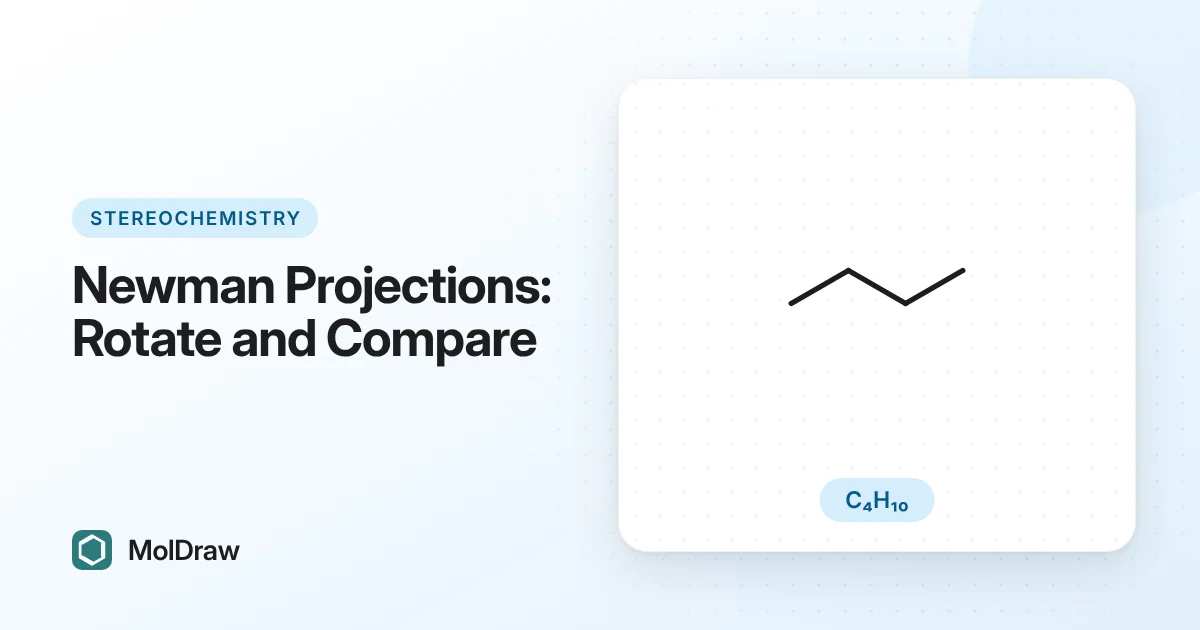
Short answer: Draw your molecule in the free MolDraw editor, right-click a single bond and choose Newman Projection (on a phone or tablet, long-press the bond and tap Newman). Drag Rotate the back carbon, or tap Anti 180°, Gauche 60°, Eclipsed 120° or Syn 0°. MolDraw names the conformation, shows the dihedral angle and an estimated strain energy, and lets you Add to canvas or Download PNG.
What a Newman projection shows
A Newman projection is the view straight down one carbon–carbon bond. The front carbon is a dot, the back carbon is a circle, and the three bonds on each carbon point outwards. Turning the back carbon around the bond changes the conformation without breaking any bond. The angle between a front bond and a back bond is the dihedral angle (also called the torsion angle).
| Staggered | Back bonds sit halfway between the front bonds, 60° apart. Lowest torsional strain. |
|---|---|
| Eclipsed | Back bonds line up behind the front bonds, 0° apart. Highest torsional strain. |
| Anti | Staggered, with the two largest groups 180° apart. Usually the most stable form. |
| Gauche | Staggered, with the two largest groups 60° apart. A little steric strain. |
| Syn (fully eclipsed) | Eclipsed, with the two largest groups on top of each other, 0° apart. Usually the least stable form. |
For the theory behind chairs, axial and equatorial groups and A-values, see the chair conformation and Newman projection guide. This article shows how to explore conformations hands-on with the Newman tool in the editor.
How to open a Newman projection
- Draw the molecule in the editor. For the classic example, draw butane as a zigzag of four carbons. You do not need to draw the hydrogens.
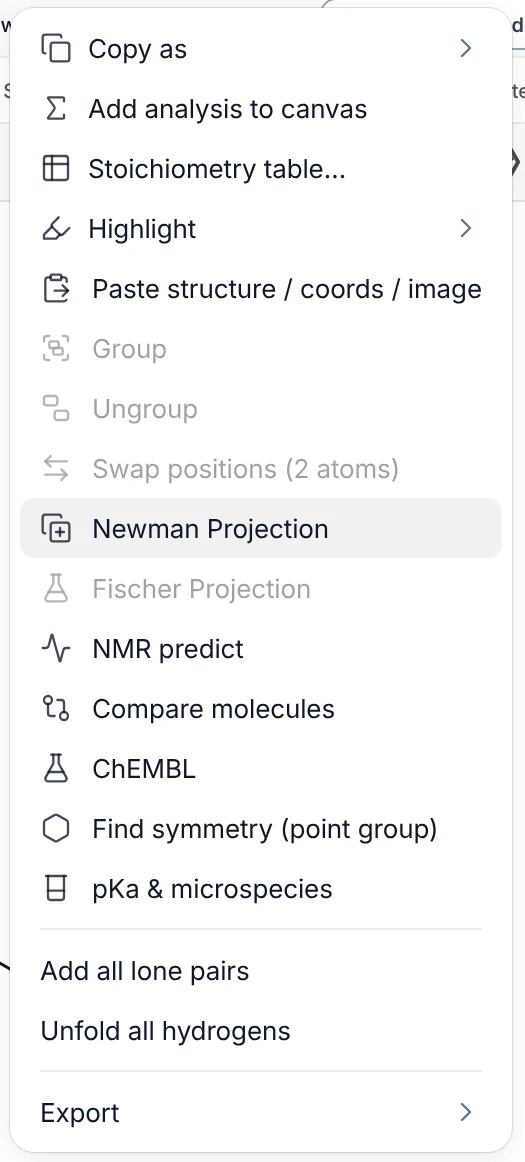
- Right-click the bond you want to look down, here the middle C–C bond, and choose Newman Projection. On a touchscreen, long-press the bond and tap Newman in the quick menu.
- The projection opens. It is built from a 3D model of your structure, so the angles you see are the real ones. If the 3D model is still being built, the dialog says so and the projection appears a moment later.
A tour of the Newman projection dialog
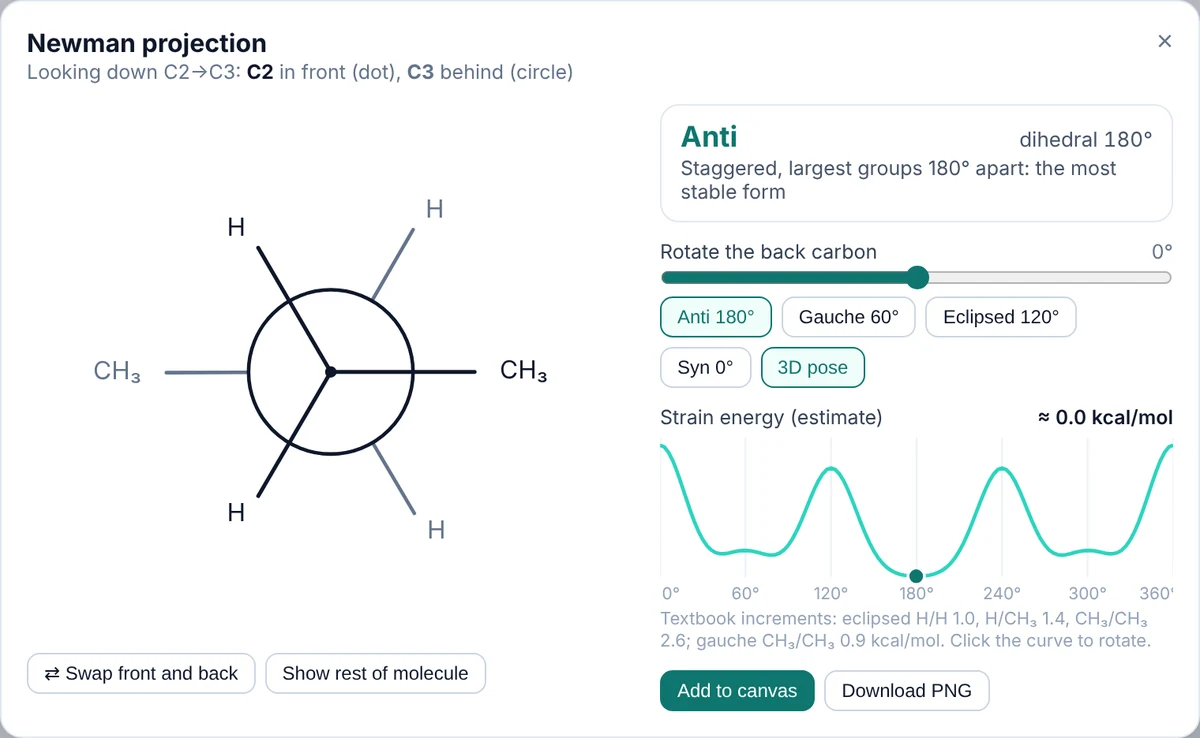
| Header | "Looking down C2→C3": the front atom (the dot) and the back atom (the circle), numbered as in your drawing. |
|---|---|
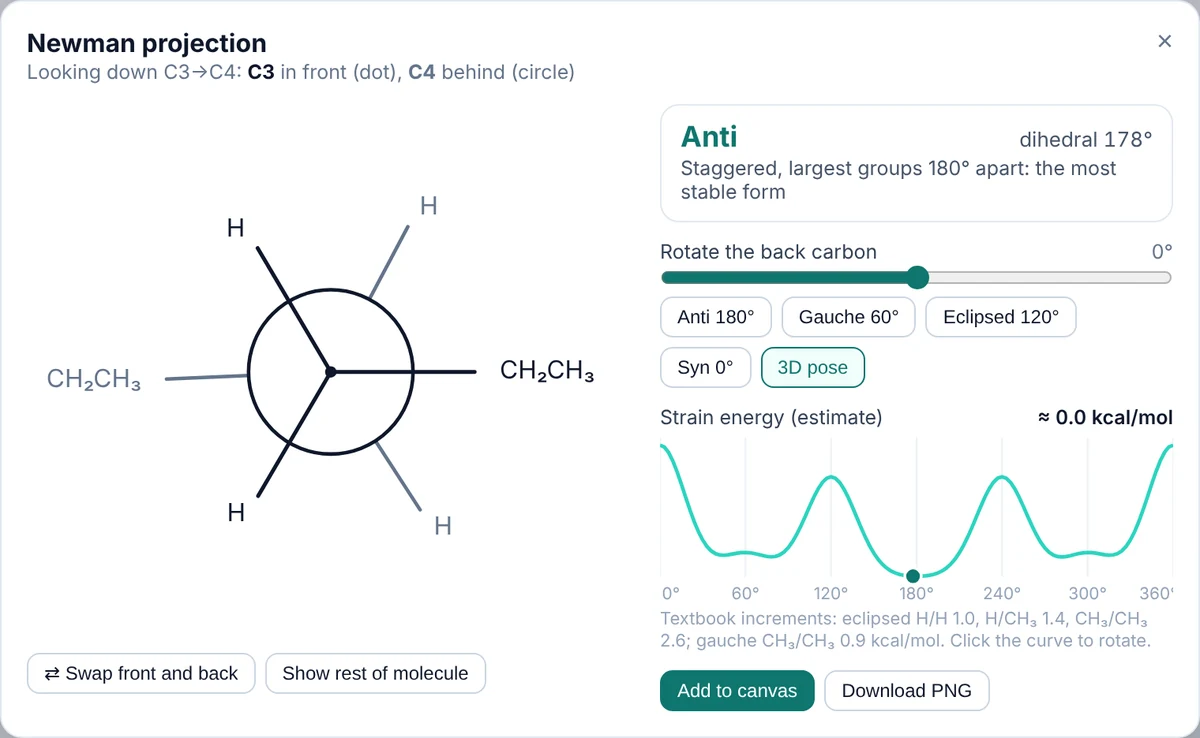
| Projection | Front bonds in dark ink from the centre, back bonds in grey from the circle. Groups are written as CH₃, CH₂CH₃, OH or CH(CH₃)₂. |
| Conformation badge | Anti, Gauche, Eclipsed, Syn or Staggered, with the dihedral angle between the largest groups and a one-line explanation. |
| Rotate the back carbon | A slider from −180° to +180°, plus one-tap buttons for each named conformation and 3D pose to go back to the starting geometry. |
| Strain energy (estimate) | The current value and a curve over the full 360° turn. Click the curve to jump to that angle. |
| Buttons | Swap front and back, Show rest of molecule, Add to canvas and Download PNG. Esc or a click outside closes the dialog. |
Rotate the bond: anti, gauche, eclipsed and syn
Drag the slider and watch the back carbon turn. The badge changes name as you pass each conformation, and the dot on the strain curve follows. The four buttons jump straight to the textbook conformations of the two largest groups.
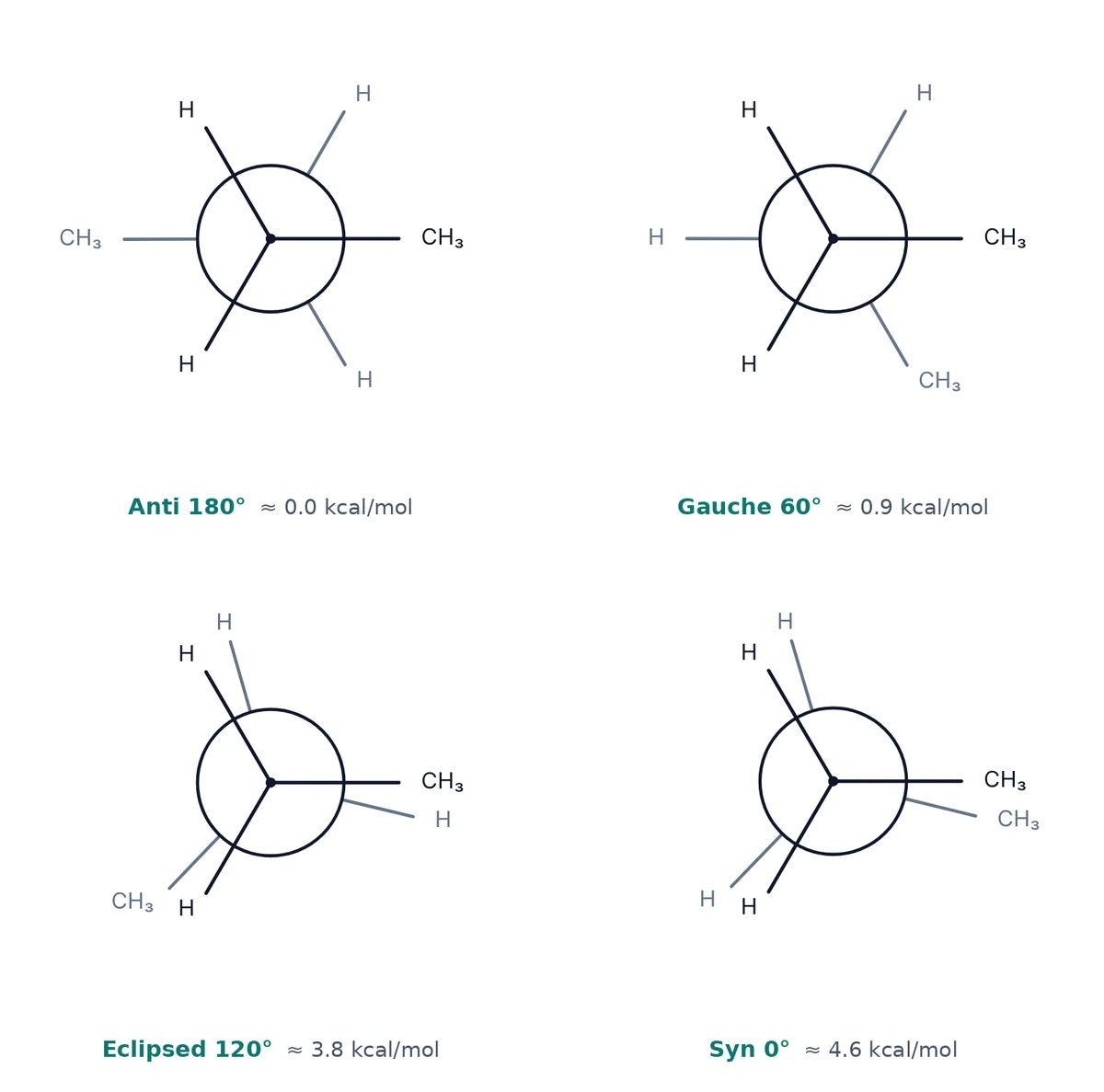
In an eclipsed conformation the back bond sits exactly behind the front bond. MolDraw draws it a few degrees to the side, as textbooks do, so you can still see and label both groups. The dihedral angle in the badge is the true value.
The strain energy curve
The curve shows how the energy of the bond changes over a full turn. It is estimated from the standard textbook increments for each pair of groups that eclipse or sit gauche:
| Eclipsed H / H | 1.0 kcal/mol |
|---|---|
| Eclipsed H / CH₃ | 1.4 kcal/mol |
| Eclipsed CH₃ / CH₃ | 2.6 kcal/mol (3.0 when a group is larger than methyl) |
| Gauche CH₃ / CH₃ | 0.9 kcal/mol |
For butane these increments give anti 0.0, gauche 0.9, eclipsed (CH₃ over H) 3.8 and syn 4.6 kcal/mol (0, 3.8, 16 and 19 kJ/mol), in line with the values in organic chemistry textbooks (gauche about 0.9, eclipsed about 3.6, syn about 4.5–5 kcal/mol). For ethane, three eclipsed H/H pairs give the familiar 3.0 kcal/mol barrier.
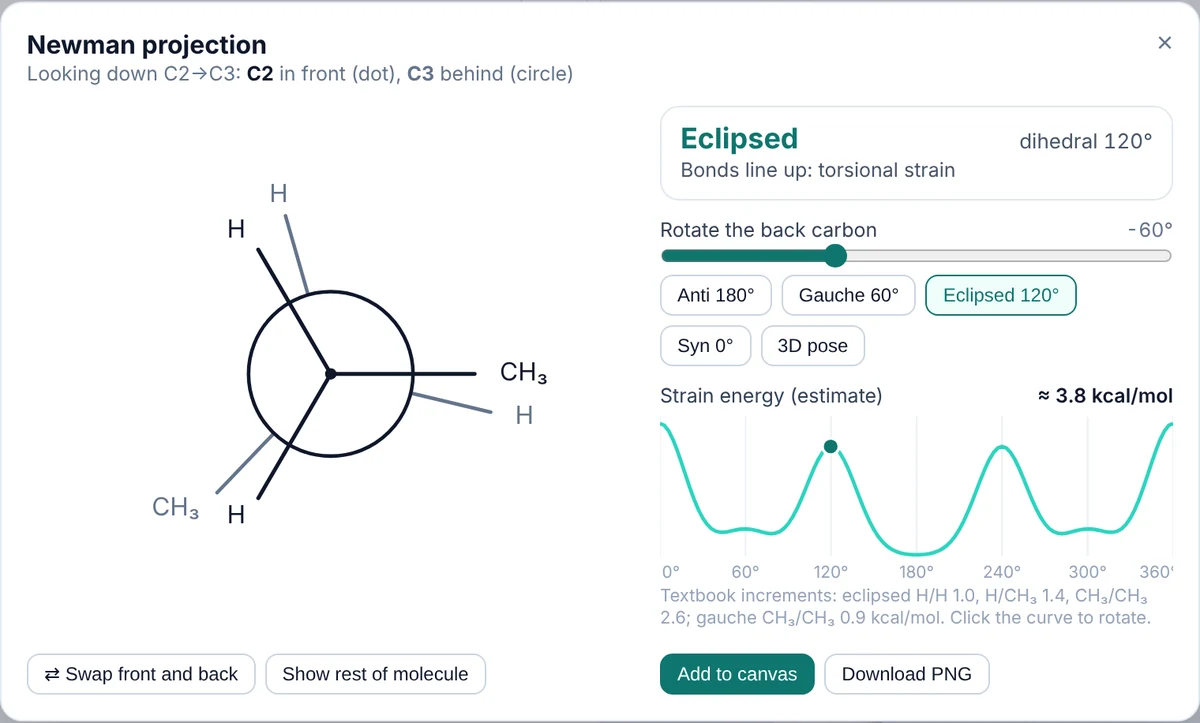
The numbers are a teaching estimate, not a force-field calculation. To rank real conformers of a whole molecule by energy, use Conformers… in the 3D panel, which relaxes each one with MMFF94.
Readable group labels
Each group is written the way you would write it in a textbook, using the hydrogens of the 3D model:
- One heavy atom: CH₃, OH, NH₂, Cl.
- A short chain: CH₂CH₃, CH₂OH, CH₂CH₂CH₃.
- A branch of identical groups: CH(CH₃)₂.
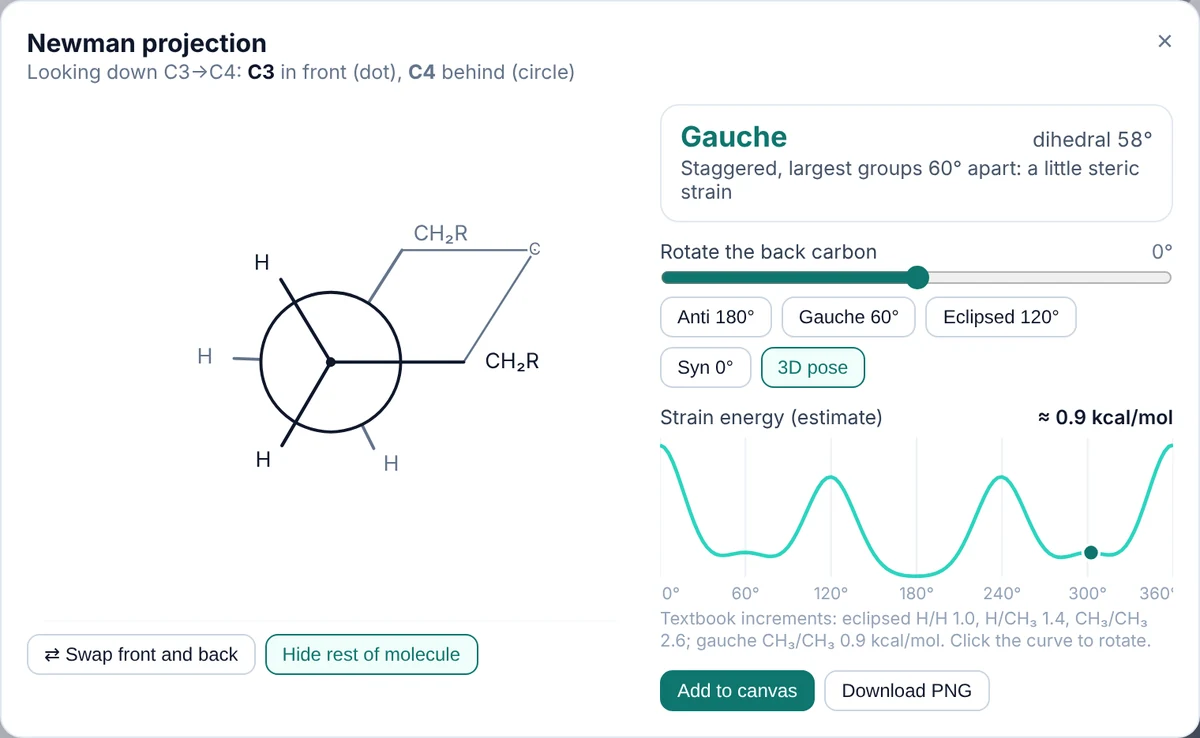
- Anything larger ends in R, for example CH₂R.
- An atom with an alias or abbreviation in your drawing (Ph, OTs, Boc) keeps that label.
Ring bonds and the rest of the molecule
Press Show rest of molecule to draw the atoms beyond the two bonded carbons as well. The back half turns with the slider. This is most useful for rings. In chair cyclohexane every ring bond is gauche, and the projection shows the ring closing behind the circle.
Swap front and back looks down the same bond from the other end. The conformation does not change, but the front and back groups trade places, which is a common exam question.
Put the projection in your worksheet
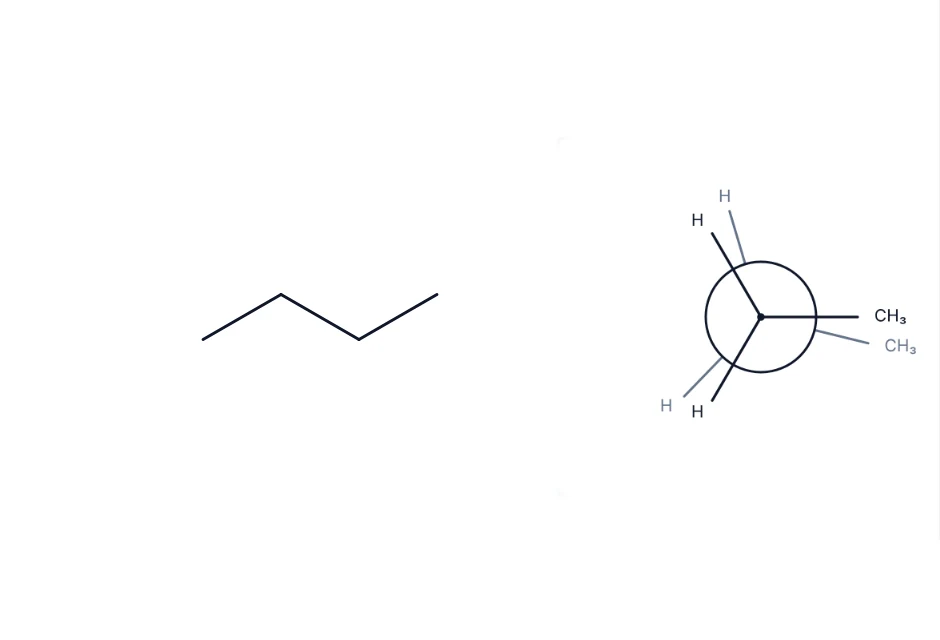
- Add to canvas places the projection next to your structure as an image. Move and resize it like any other object, and it is saved and exported with the drawing.
- Download PNG saves a high-resolution image (three times the on-screen size) for documents, slides and LMS quizzes.
Worked examples
1. Ethane: staggered and eclipsed
Draw two carbons and open the Newman projection. With hydrogens only, the badge reads Staggered or Eclipsed. The curve has three equal peaks of 3.0 kcal/mol, one for every 120° turn.
2. Butane down C2–C3
Start from the 3D pose (anti), then tap Gauche, Eclipsed and Syn. The energies go 0.0 → 0.9 → 3.8 → 4.6 kcal/mol. Anti is the global minimum and the two gauche forms are local minima.
3. Butane down C1–C2
Right-click the end bond instead. The front carbon carries three hydrogens, so only staggered and eclipsed exist. This shows why only the central bond of butane has anti and gauche forms.
4. Cyclohexane
Right-click any ring bond and press Show rest of molecule. The badge reads Gauche with a dihedral near 55–60°, the reason a chair has no eclipsing strain.
Summary
| Open | Right-click a single bond → Newman Projection (long-press → Newman on touch) |
|---|---|
| Rotate | Slider, the Anti / Gauche / Eclipsed / Syn buttons, or a click on the strain curve |
| Read | Conformation name, dihedral angle, estimated strain in kcal/mol |
| Views | Swap front and back, Show rest of molecule |
| Share | Add to canvas, Download PNG |
Common mistakes
- Choosing a bond to a terminal carbon. A CH₃ end has only hydrogens on one side, so there is no anti or gauche. Pick an internal bond.
- Mixing up front and back. The dot is the front carbon; bonds that start at the circle belong to the back carbon. Use Swap front and back to check.
- Calling every staggered form anti. Anti means the largest groups are 180° apart. At 60° it is gauche, even though it is still staggered.
- Reading the offset drawing as the angle. Eclipsed back bonds are drawn slightly to the side for clarity; the dihedral in the badge is the real angle.
- Treating the strain as an exact energy. It is an estimate from increments, ideal for comparing conformations, not for a computed energy.
Exam tips
- Draw the most stable conformation first: staggered, with the two largest groups anti.
- Count the interactions: each gauche CH₃/CH₃ adds about 0.9 kcal/mol, each eclipsed pair adds its increment.
- A rotation of 120° maps staggered to staggered and eclipsed to eclipsed; 60° switches between them.
- Practise by predicting the name and energy, then pressing the button to check.
Questions and answers
How do I draw a Newman projection online?
Draw the molecule in the free MolDraw editor, right-click the single bond you want to look down and choose Newman Projection. MolDraw builds the projection from a 3D model of your structure, with the front carbon as a dot and the back carbon as a circle.
Which conformation of butane is the most stable?
The anti conformation, with the two methyl groups 180° apart. Gauche (60°) is about 0.9 kcal/mol higher, the eclipsed forms with a methyl over a hydrogen are about 3.6–3.8 kcal/mol higher, and syn, with methyl over methyl, is the highest at about 4.5–5 kcal/mol.
What is the difference between staggered and eclipsed?
In a staggered conformation the bonds on the back carbon sit between the bonds on the front carbon, 60° apart. In an eclipsed conformation they line up behind each other at 0°. Eclipsed bonds repel, which is called torsional strain, so staggered forms are lower in energy.
What is a dihedral angle in a Newman projection?
The dihedral (torsion) angle is the angle between a bond on the front carbon and a bond on the back carbon, seen down the C–C bond. MolDraw measures it between the largest group on each carbon and shows it next to the conformation name.
How is the strain energy in MolDraw calculated?
It is an estimate from textbook increments: each eclipsed H/H pair adds 1.0 kcal/mol, each H/CH₃ pair 1.4, each CH₃/CH₃ pair 2.6, and each gauche CH₃/CH₃ pair 0.9. It is meant for teaching and comparing conformations, not as a force-field or quantum calculation.
Can I make a Newman projection of a ring bond?
Yes. Right-click a bond in the ring and choose Newman Projection. Press Show rest of molecule to see the ring continue behind the projection. In chair cyclohexane every ring bond is gauche, with a dihedral angle of about 55–60°.
How do I put the Newman projection into my worksheet?
Press Add to canvas to place the projection as an image next to your structure, where you can move and resize it and export the whole drawing. Or press Download PNG to save a high-resolution image for documents and slides.