Isotope Patterns in Mass Spectrometry: How to Read M+1, M+2 and Halogen Clusters
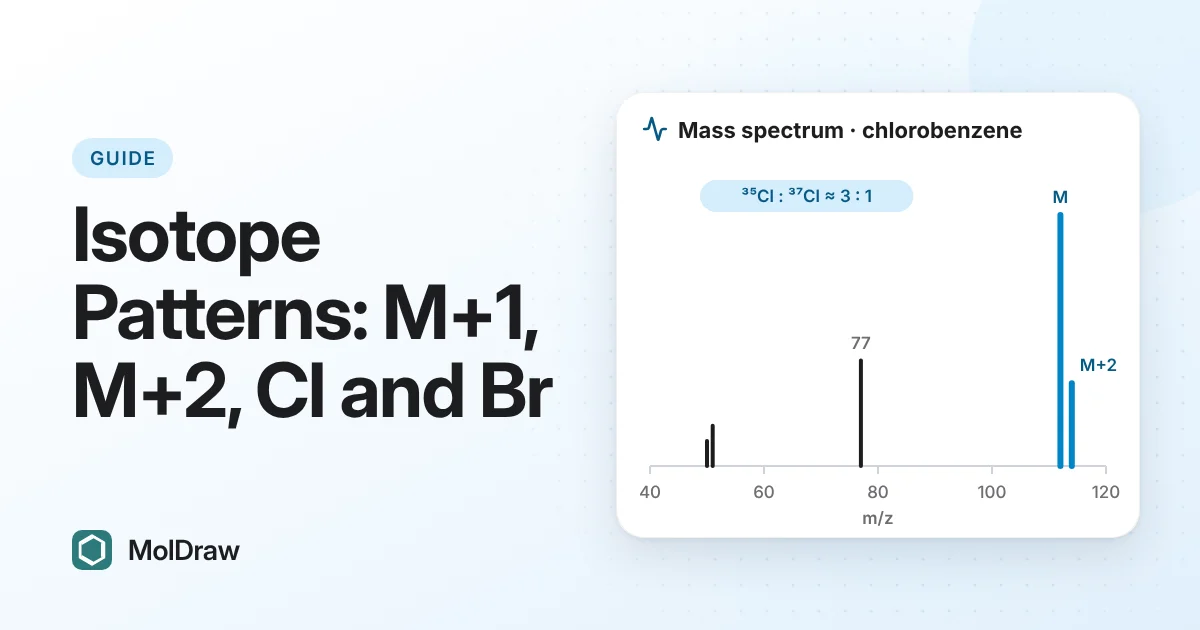
Short answer: An isotope pattern is the cluster of peaks a molecule gives because its atoms have several isotopes. Carbon adds about 1.1% of M per carbon at M+1. One chlorine gives M : M+2 ≈ 3 : 1, one bromine ≈ 1 : 1, and sulfur adds 4.4% at M+2. CH₂Cl₂ shows 100 : 64 : 10 at m/z 84, 86 and 88. The free isotope pattern calculator computes the exact pattern for any formula or SMILES, with adducts, resolution and a comparison with your spectrum.
Key terms in one place
| Isotope pattern | The cluster of peaks a molecule gives in a mass spectrum because its atoms come in different isotopes. |
|---|---|
| M, M+1, M+2 | M is the monoisotopic ion. M+1 and M+2 are 1 and 2 mass units heavier. |
| Monoisotopic mass | Mass using the most abundant isotope of each element. Caffeine C₈H₁₀N₄O₂: 194.0804. |
| Average mass | Mass using standard atomic weights. Caffeine: 194.19 g/mol. |
| Nominal mass | Integer mass from the most abundant isotopes. Caffeine: 194. |
| Resolving power | R = m/Δm, where Δm is the peak width at half height (FWHM). |
Isotope rules of thumb
| Element | Heavy isotope | Natural abundance | Effect on the pattern |
|---|---|---|---|
| C | ¹³C | 1.07% | M+1 ≈ 1.1% of M per carbon |
| N | ¹⁵N | 0.36% | M+1 ≈ 0.37% per nitrogen |
| O | ¹⁸O | 0.20% | M+2 ≈ 0.2% per oxygen |
| S | ³⁴S | 4.25% | M+2 ≈ 4.4% per sulfur |
| Cl | ³⁷Cl | 24.24% | M : M+2 ≈ 3 : 1 per chlorine |
| Br | ⁸¹Br | 49.31% | M : M+2 ≈ 1 : 1 per bromine |
| F, P, I, Na | none | 100% one isotope | no extra peaks |
With several halogens, multiply out the binomial. For n chlorines the pattern is (3 + 1)ⁿ, roughly. Two Cl give 100 : 64 : 10, three Cl give 100 : 96 : 31 : 3, two Br give 51 : 100 : 49 and three Br give 34 : 100 : 97 : 32.
How an exact isotope pattern is calculated
Each element contributes a small polynomial: its isotope masses with their abundances. For chlorine it is 0.7576 (mass 35) + 0.2424 (mass 37). A molecule with n chlorine atoms raises it to the power n. The polynomials of all elements are then multiplied together. This is called polynomial convolution.
The isotope pattern calculator does this exactly for every stable isotope of every element and keeps the mean mass of each peak. It drops only terms smaller than 10⁻¹² of the largest. For a profile spectrum it also keeps the fine structure, so peaks that differ by a few mDa can split at high resolving power.
How to use the isotope pattern calculator
- Open the isotope pattern calculator.
- Choose Input type: Molecular formula or SMILES. Type it in Formula or SMILES, for example
C6H5BrorPt(NH3)2Cl2. - Choose the Ion type: M+• for EI, [M+H]⁺, [M+Na]⁺ or [M+K]⁺ for positive ESI, [M−H]⁻ or [M+Cl]⁻ for negative mode, or Ion as written for a charged formula such as
[Pt(NH3)4]2+. - Read the monoisotopic, average and nominal mass, the most intense peak and the M+1 and M+2 values with their rule-of-thumb estimates.
- Set Display to Profile (choose resolution) and type a Resolving power (m/Δm) to see the shape on your instrument.
- Open Compare with an observed spectrum, paste your m/z and intensity pairs and read the match verdict. Press Load an example to try it.
- Save with Download SVG, Download PNG or Download CSV.
Worked examples
1. Dichloromethane, CH₂Cl₂
The ³⁵Cl₂, ³⁵Cl³⁷Cl and ³⁷Cl₂ ions appear at m/z 84, 86 and 88. Ratio = 0.7576² : 2 × 0.7576 × 0.2424 : 0.2424² = 100 : 64 : 10. The small M+1 (1.1%) comes from the one carbon.
2. Bromobenzene, C₆H₅Br
M at m/z 156 and M+2 at m/z 158 in the ratio 100 : 97.5, because ⁷⁹Br and ⁸¹Br are 50.69% and 49.31%. M+1 is 6.5% from six carbons.
3. Caffeine in positive electrospray
C₈H₁₀N₄O₂ has monoisotopic mass 194.0804. Adding a proton (1.00728) gives [M+H]⁺ at m/z 195.0877. M+1 is 10.3% of M: 8 × 1.08% from carbon plus 4 × 0.37% from nitrogen.
4. C₆₀ fullerene
Monoisotopic mass 720.0000. With 60 carbons, M+1 is 65% and M+2 is 21% of M. Above about 90 carbons, M+1 would be taller than M.
5. Vancomycin, C₆₆H₇₅Cl₂N₉O₂₄
[M+H]⁺ at m/z 1448.4375. The 66 carbons make M+1 about 77% and the two chlorines push M+2 to about 98%, so M, M+1 and M+2 are almost equal in height.
6. Cisplatin, Pt(NH₃)₂Cl₂
Platinum has four main isotopes (¹⁹⁴Pt 32.9%, ¹⁹⁵Pt 33.8%, ¹⁹⁶Pt 25.2%, ¹⁹⁸Pt 7.4%). Combined with Cl₂, the cluster spreads from m/z 296 to 306 and the tallest peak is at m/z 300, not at the monoisotopic 299.
Summary table: what the pattern tells you
| What you see | Likely cause |
|---|---|
| M+1 ≈ 1.1% × n of M | n carbon atoms |
| M+2 ≈ 33% of M | one chlorine |
| M+2 ≈ M | one bromine |
| M : M+2 : M+4 ≈ 100 : 64 : 10 | two chlorines |
| M : M+2 : M+4 ≈ 1 : 2 : 1 | two bromines |
| M+2 ≈ 4 to 5% of M | one sulfur |
| Isotope peaks 0.5 apart | a 2+ ion |
| Wide cluster of many peaks | a metal with several isotopes (Sn, Pt, Hg, Ru, Pd) |
Common mistakes
- Comparing an ESI peak with the neutral mass. Add or subtract the adduct first.
- Using average mass for high-resolution work. HRMS measures monoisotopic m/z.
- Assuming M is always the tallest peak. Large molecules and many metals have a tallest peak above M.
- Forgetting the electron mass for exact m/z. It is 0.000549 Da per charge, which matters at ppm level.
- Writing CO for cobalt or CL for chlorine. Use Co and Cl.
Exam tips
- A-level and IB: a 3 : 1 pair two units apart means one Cl; a 1 : 1 pair means one Br. Three peaks 1 : 2 : 1 means two Br; 9 : 6 : 1 means two Cl.
- A-level: number of carbons ≈ (height of M+1 / height of M) × 100 / 1.1.
- AP Chemistry: mass spectra of elements give isotope abundances directly. Average atomic mass = Σ (isotope mass × fraction).
- JEE and NEET: practise average atomic mass from isotope data, for example Cl: 0.7576 × 34.969 + 0.2424 × 36.966 = 35.45.
- University: use accurate mass (within 5 ppm) together with the isotope pattern to choose between candidate formulas, and use the A+2 peaks to count S, Cl and Br.
Check any formula with the isotope pattern calculator, then compare it with your spectrum in the mass spectrum viewer.
Questions and answers
What is an isotope pattern in mass spectrometry?
It is the group of peaks a molecule gives because its atoms exist as different isotopes. The relative heights of M, M+1, M+2 and so on depend on the elements and how many of each are present.
How do I recognise chlorine and bromine in a mass spectrum?
One chlorine gives M and M+2 in a 3 : 1 ratio. One bromine gives M and M+2 in a 1 : 1 ratio. Two chlorines give 100 : 64 : 10, and two bromines give about 1 : 2 : 1.
How do I find the number of carbon atoms from the M+1 peak?
Divide the M+1 height (as a percentage of M) by 1.1. An M+1 of 11% means about 10 carbons. Nitrogen adds about 0.37% per atom, so subtract that first if N is present.
What is the monoisotopic mass of caffeine?
Caffeine, C₈H₁₀N₄O₂, has a monoisotopic mass of 194.0804 and an average mass of 194.19. Its [M+H]⁺ ion appears at m/z 195.0877.
Why is the tallest peak not the monoisotopic peak for big molecules?
Each carbon has a 1.07% chance of being ¹³C. With about 90 or more carbons, most molecules contain at least one ¹³C, so the M+1 peak becomes taller than M.
What is the difference between centroid and profile mode?
Centroid mode shows one stick per isotope peak. Profile mode shows the real peak shape with a width set by the resolving power, FWHM = m/R, so close peaks merge at low resolution and split at high resolution.
Why are isotope peaks 0.5 apart for some ions?
The spacing is 1/z. A doubly charged ion such as [M+2H]²⁺ has isotope peaks 0.5 m/z apart, and a triply charged ion has peaks 0.33 apart.