MolDraw › Templates › Biochemistry › Ruff degradation
BiochemistryPremium
Ruff degradation template
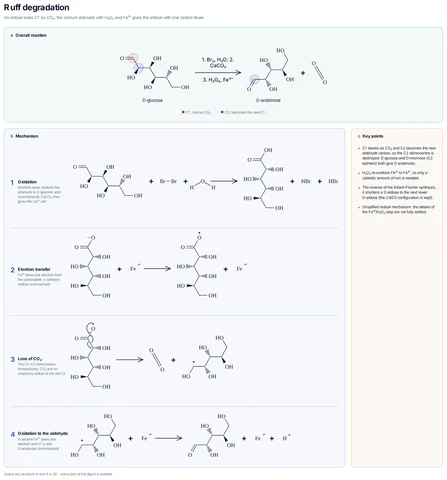
Premium template. Preview and edit it free in MolDraw; downloading and exporting it is part of MolDraw Pro.
D-Glucose is oxidised by bromine water to D-gluconic acid; its calcium salt with Fe³⁺ and H₂O₂ loses one electron, the carboxyl radical loses CO₂, and oxidation of the α-hydroxy radical gives the aldehyde of D-arabinose (simplified radical mechanism).
Mechanism step by step
An aldose loses C1 as CO₂: the calcium aldonate with H₂O₂ and Fe³⁺ gives the aldose with one carbon fewer
- Oxidation – Bromine water oxidises the aldehyde to D-gluconic acid (summarised); CaCO₃ then gives the Ca²⁺ salt
- Electron transfer – Fe³⁺ takes one electron from the carboxylate: a carboxyl radical (summarised)
- Loss of CO₂ – The C1–C2 bond breaks homolytically: CO₂ and an α-hydroxy radical at the old C2
- Oxidation to the aldehyde – A second Fe³⁺ takes one electron and H⁺ is lost: D-arabinose (summarised)
Key points
- C1 leaves as CO₂ and C2 becomes the new aldehyde carbon, so the C2 stereocentre is destroyed: D-glucose and D-mannose (C2 epimers) both give D-arabinose.
- H₂O₂ re-oxidises Fe²⁺ to Fe³⁺, so only a catalytic amount of iron is needed.
- The reverse of the Kiliani–Fischer synthesis; it shortens a D-aldose to the next lower D-aldose (the C4/C5 configuration is kept).
- Simplified radical mechanism: the details of the Fe³⁺/H₂O₂ step are not fully settled.
Drawn with 132 atoms, 8 arrows, 9 shapes – every one editable in MolDraw.
Sources
How to use this template
- Press Edit in MolDraw. The template opens on the canvas of the free MolDraw editor.
- Change anything: move structures, edit atoms and labels, recolour highlights or delete what you do not need.
- Add your own structures, arrows and text next to it, or combine several templates on one page.
- Export the drawing as PNG, SVG or PDF for slides, worksheets, theses and papers.
Frequently asked questions
Is the Ruff degradation template free?
You can preview the Ruff degradation template here and open and edit it in MolDraw for free. Downloading or exporting it is part of MolDraw Pro, together with the other premium templates.
Can I edit the Ruff degradation template?
Yes. It opens as an ordinary MolDraw drawing, so every structure, arrow, label and colour can be changed, and you can add your own content around it.
Is the chemistry checked?
Every structure is checked with RDKit and every curly arrow passes MolDraw’s electron-flow audit. The sources used are listed on this page.
Are the biochemical pathways drawn with structures?
Yes. Pathway templates show the intermediates as structures, with enzymes and cofactors (NAD⁺, FAD, ATP) on the arrows.