MolDraw › Templates › Physical chemistry › Rates: catalysts and the Arrhenius equation
Rates: catalysts and the Arrhenius equation template
Free template. Download it, or open it in MolDraw to change it first.
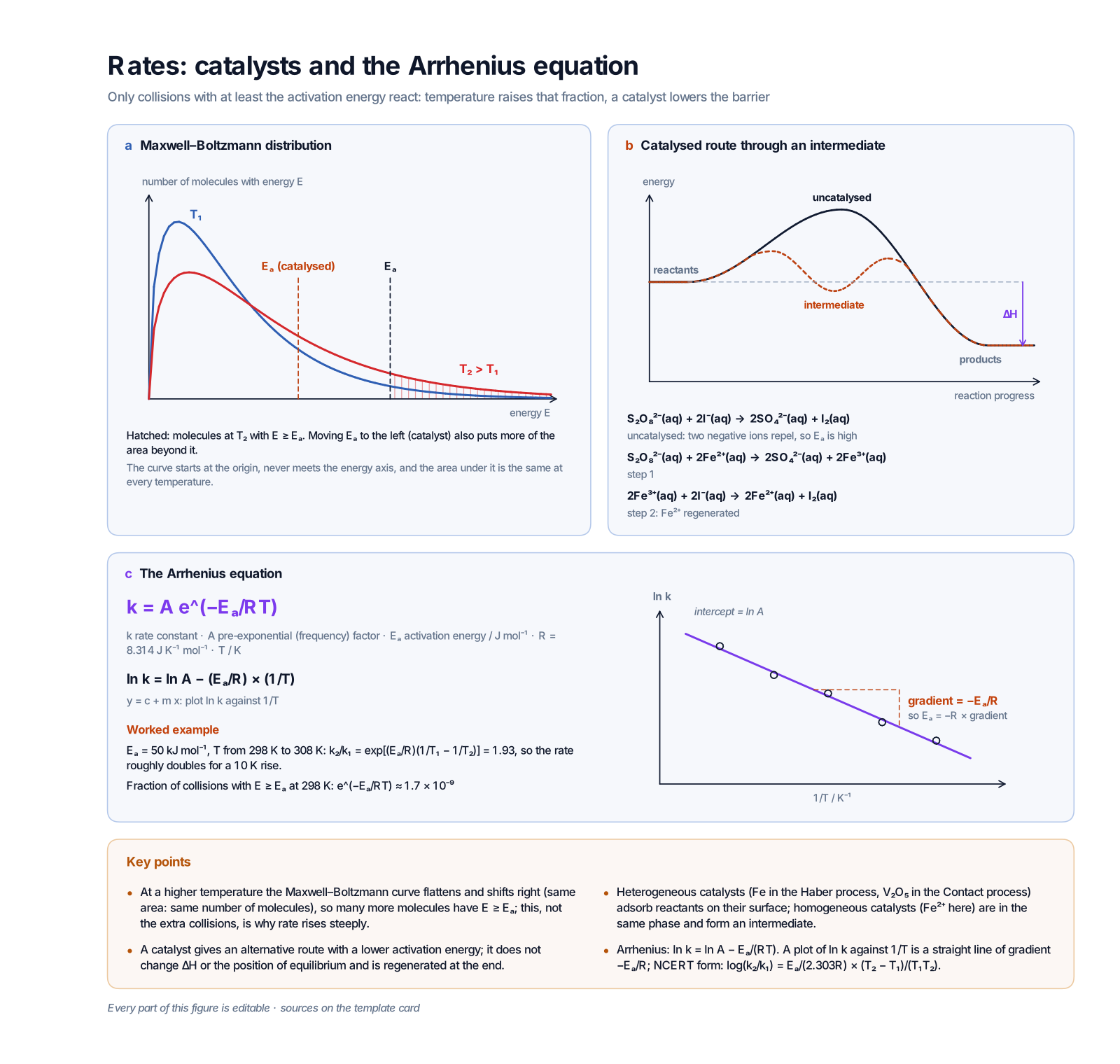
Reaction rates for A-level and NCERT Class 12: Maxwell–Boltzmann distributions at two temperatures with Eₐ and the catalysed Eₐ marked, an energy profile for a catalysed route through an intermediate (Fe²⁺ catalysis of S₂O₈²⁻ + I⁻), and the Arrhenius equation k = A e^(−Eₐ/RT) with its ln k against 1/T plot and a worked example.
What the template shows
- Only collisions with at least the activation energy react: temperature raises that fraction, a catalyst lowers the barrier
- Maxwell–Boltzmann distribution
- Catalysed route through an intermediate
- number of molecules with energy E
- Hatched: molecules at T₂ with E ≥ Eₐ. Moving Eₐ to the left (catalyst) also puts more of the area beyond it.
- The curve starts at the origin, never meets the energy axis, and the area under it is the same at every temperature.
- uncatalysed: two negative ions repel, so Eₐ is high
- step 2: Fe²⁺ regenerated
- The Arrhenius equation
- k rate constant · A pre-exponential (frequency) factor · Eₐ activation energy / J mol⁻¹ · R = 8.314 J K⁻¹ mol⁻¹ · T / K
- y = c + m x: plot ln k against 1/T
- Worked example
- Eₐ = 50 kJ mol⁻¹, T from 298 K to 308 K: k₂/k₁ = exp[(Eₐ/R)(1/T₁ − 1/T₂)] = 1.93, so the rate roughly doubles for a 10 K rise.
- Fraction of collisions with E ≥ Eₐ at 298 K: e^(−Eₐ/RT) ≈ 1.7 × 10⁻⁹
- At a higher temperature the Maxwell–Boltzmann curve flattens and shifts right (same area: same number of molecules), so many more molecules have E ≥ Eₐ; this, not the extra collisions, is why rate rises steeply.
- A catalyst gives an alternative route with a lower activation energy; it does not change ΔH or the position of equilibrium and is regenerated at the end.
- Heterogeneous catalysts (Fe in the Haber process, V₂O₅ in the Contact process) adsorb reactants on their surface; homogeneous catalysts (Fe²⁺ here) are in the same phase and form an intermediate.
- Arrhenius: ln k = ln A − Eₐ/(RT). A plot of ln k against 1/T is a straight line of gradient −Eₐ/R; NCERT form: log(k₂/k₁) = Eₐ/(2.303R) × (T₂ − T₁)/(T₁T₂).
- Every part of this figure is editable · sources on the template card
Drawn with 553 shapes – every one editable in MolDraw.
Sources
How to use this template
- Press Edit in MolDraw. The template opens on the canvas of the free MolDraw editor.
- Change anything: move structures, edit atoms and labels, recolour highlights or delete what you do not need.
- Add your own structures, arrows and text next to it, or combine several templates on one page.
- Export the drawing as PNG, SVG or PDF for slides, worksheets, theses and papers.
Frequently asked questions
Is the Rates: catalysts and the Arrhenius equation template free?
Yes. The Rates: catalysts and the Arrhenius equation template is one of the free MolDraw templates: open it in the editor or download it from this page as SVG or PNG and use it in your slides, worksheets and notes.
Can I edit the Rates: catalysts and the Arrhenius equation template?
Yes. It opens as an ordinary MolDraw drawing, so every structure, arrow, label and colour can be changed, and you can add your own content around it.
Is the chemistry checked?
Every structure is checked with RDKit and every curly arrow passes MolDraw’s electron-flow audit. The sources used are listed on this page.
Are activation energy and ΔH labelled?
Yes. Ea, ΔH, transition states and intermediates are labelled on each profile.