MolDraw › Templates › Physical chemistry › Le Chatelier's principle
Le Chatelier's principle template
Free template. Download it, or open it in MolDraw to change it first.
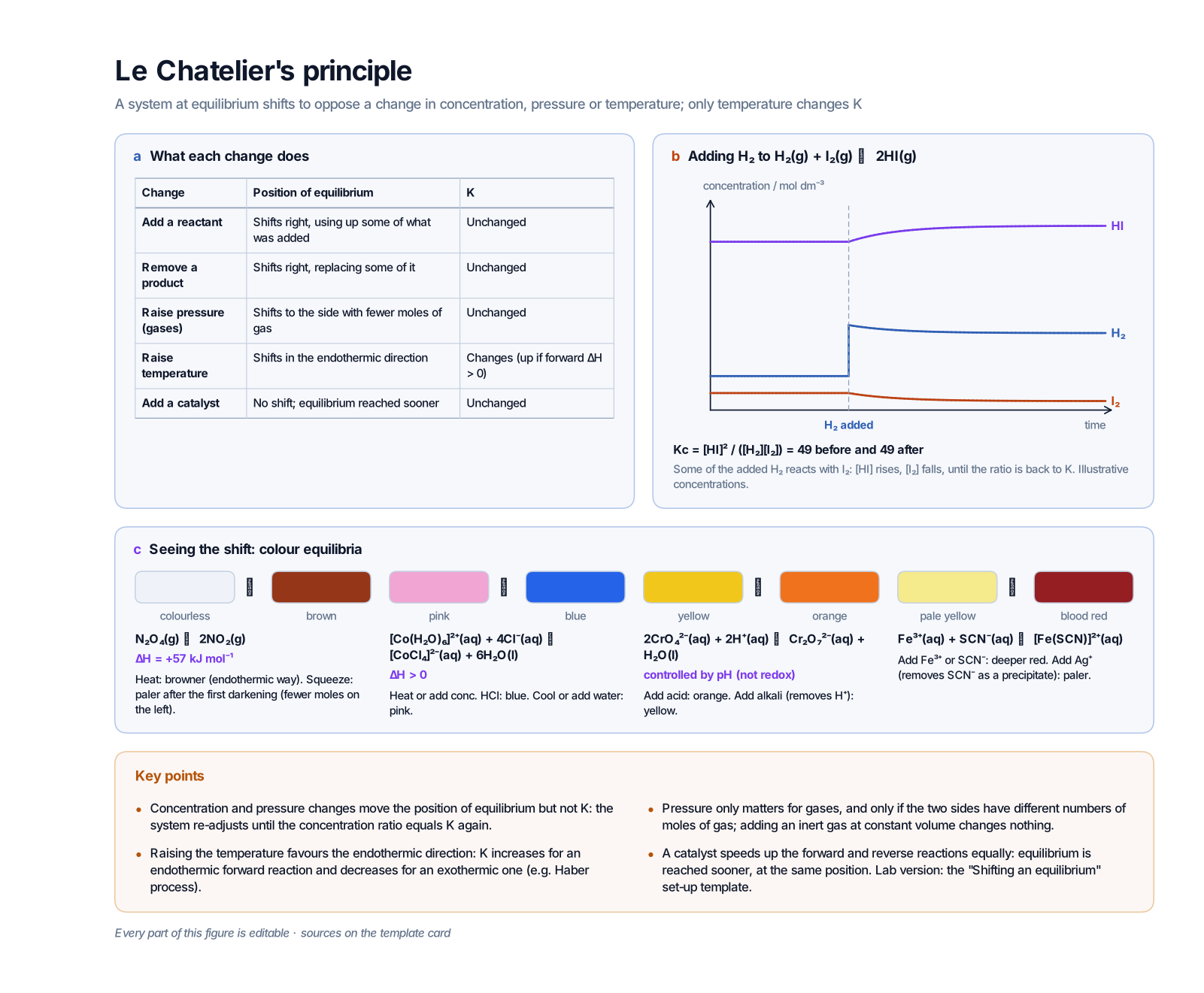
Le Chatelier's principle for GCSE, A-level and NCERT Class 11: what each change does to the position of equilibrium and to K, a concentration–time graph for adding H₂ to H₂ + I₂ ⇌ 2HI (K unchanged), and four colour equilibria (N₂O₄/NO₂, cobalt chloride, chromate/dichromate, iron(III) thiocyanate).
What the template shows
- A system at equilibrium shifts to oppose a change in concentration, pressure or temperature; only temperature changes K
- What each change does
- Position of equilibrium
- Add a reactant
- Shifts right, using up some of what was added
- Remove a product
- Shifts right, replacing some of it
- Raise pressure (gases)
- Shifts to the side with fewer moles of gas
- Raise temperature
- Shifts in the endothermic direction
- Changes (up if forward ΔH > 0)
- Add a catalyst
- No shift; equilibrium reached sooner
- concentration / mol dm⁻³
- Kc = [HI]² / ([H₂][I₂]) = 49 before and 49 after
- Some of the added H₂ reacts with I₂: [HI] rises, [I₂] falls, until the ratio is back to K. Illustrative concentrations.
- Seeing the shift: colour equilibria
- Heat: browner (endothermic way). Squeeze: paler after the first darkening (fewer moles on the left).
- Heat or add conc. HCl: blue. Cool or add water: pink.
- controlled by pH (not redox)
- Add acid: orange. Add alkali (removes H⁺): yellow.
- pale yellow
- blood red
Drawn with 357 shapes – every one editable in MolDraw.
Sources
How to use this template
- Press Edit in MolDraw. The template opens on the canvas of the free MolDraw editor.
- Change anything: move structures, edit atoms and labels, recolour highlights or delete what you do not need.
- Add your own structures, arrows and text next to it, or combine several templates on one page.
- Export the drawing as PNG, SVG or PDF for slides, worksheets, theses and papers.
Frequently asked questions
Is the Le Chatelier's principle template free?
Yes. The Le Chatelier's principle template is one of the free MolDraw templates: open it in the editor or download it from this page as SVG or PNG and use it in your slides, worksheets and notes.
Can I edit the Le Chatelier's principle template?
Yes. It opens as an ordinary MolDraw drawing, so every structure, arrow, label and colour can be changed, and you can add your own content around it.
Is the chemistry checked?
Every structure is checked with RDKit and every curly arrow passes MolDraw’s electron-flow audit. The sources used are listed on this page.
Are activation energy and ΔH labelled?
Yes. Ea, ΔH, transition states and intermediates are labelled on each profile.