MolDraw › Templates › General & inorganic › Ozone depletion by CFCs
General & inorganicPremium
Ozone depletion by CFCs template
Premium template. Preview and edit it free in MolDraw; downloading and exporting it is part of MolDraw Pro.
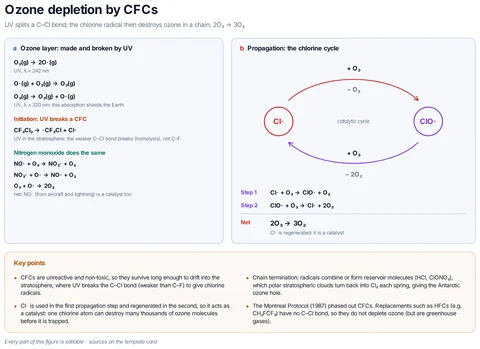
Free-radical destruction of stratospheric ozone for A-level and NCERT: how ozone forms and absorbs UV (Chapman cycle), initiation by UV homolysis of a CFC (CF₂Cl₂), the propagation steps Cl· + O₃ → ClO· + O₂ and ClO· + O₃ → Cl· + 2O₂ drawn as a catalytic cycle, the net 2O₃ → 3O₂, and the similar NO· cycle.
What the template shows
- UV splits a C–Cl bond; the chlorine radical then destroys ozone in a chain: 2O₃ → 3O₂
- Ozone layer: made and broken by UV
- Propagation: the chlorine cycle
- UV, λ < 320 nm: this absorption shields the Earth
- Initiation: UV breaks a CFC
- UV in the stratosphere: the weaker C–Cl bond breaks (homolysis), not C–F
- Nitrogen monoxide does the same
- net: NO· (from aircraft and lightning) is a catalyst too
- Cl· is regenerated: it is a catalyst
- CFCs are unreactive and non-toxic, so they survive long enough to drift into the stratosphere, where UV breaks the C–Cl bond (weaker than C–F) to give chlorine radicals.
- Cl· is used in the first propagation step and regenerated in the second, so it acts as a catalyst: one chlorine atom can destroy many thousands of ozone molecules before it is trapped.
- Chain termination: radicals combine or form reservoir molecules (HCl, ClONO₂), which polar stratospheric clouds turn back into Cl₂ each spring, giving the Antarctic ozone hole.
- The Montreal Protocol (1987) phased out CFCs. Replacements such as HFCs (e.g. CH₂FCF₃) have no C–Cl bond, so they do not deplete ozone (but are greenhouse gases).
- Every part of this figure is editable · sources on the template card
Drawn with 148 shapes – every one editable in MolDraw.
Sources
How to use this template
- Press Edit in MolDraw. The template opens on the canvas of the free MolDraw editor.
- Change anything: move structures, edit atoms and labels, recolour highlights or delete what you do not need.
- Add your own structures, arrows and text next to it, or combine several templates on one page.
- Export the drawing as PNG, SVG or PDF for slides, worksheets, theses and papers.
Frequently asked questions
Is the Ozone depletion by CFCs template free?
You can preview the Ozone depletion by CFCs template here and open and edit it in MolDraw for free. Downloading or exporting it is part of MolDraw Pro, together with the other premium templates.
Can I edit the Ozone depletion by CFCs template?
Yes. It opens as an ordinary MolDraw drawing, so every structure, arrow, label and colour can be changed, and you can add your own content around it.
Is the chemistry checked?
Every structure is checked with RDKit and every curly arrow passes MolDraw’s electron-flow audit. The sources used are listed on this page.
Which MO diagrams are included?
H₂ and He₂, N₂ and O₂ (showing s–p mixing and paramagnetic O₂), and carbon monoxide.