MolDraw › Templates › General & inorganic › Born–Haber cycle: NaCl
General & inorganicPremium
Born–Haber cycle: NaCl template
Premium template. Preview and edit it free in MolDraw; downloading and exporting it is part of MolDraw Pro.
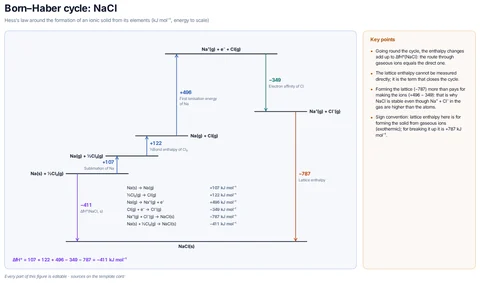
Enthalpy-level Born–Haber cycle for sodium chloride: sublimation +107, ½ bond enthalpy +122, ionisation +496, electron affinity −349, lattice −787 and ΔfH° −411 kJ mol⁻¹, with the sum shown.
What the template shows
- Hess's law around the formation of an ionic solid from its elements (kJ mol⁻¹, energy to scale)
- ½ Bond enthalpy of Cl₂
- First ionisation energy of Na
- Electron affinity of Cl
- Lattice enthalpy
- Going round the cycle, the enthalpy changes add up to ΔfH°(NaCl): the route through gaseous ions equals the direct one.
- The lattice enthalpy cannot be measured directly; it is the term that closes the cycle.
- Forming the lattice (−787) more than pays for making the ions (+496 − 349): that is why NaCl is stable even though Na⁺ + Cl⁻ in the gas are higher than the atoms.
- Sign convention: lattice enthalpy here is for forming the solid from gaseous ions (exothermic); for breaking it up it is +787 kJ mol⁻¹.
- Every part of this figure is editable · sources on the template card
Drawn with 26 shapes – every one editable in MolDraw.
Sources
How to use this template
- Press Edit in MolDraw. The template opens on the canvas of the free MolDraw editor.
- Change anything: move structures, edit atoms and labels, recolour highlights or delete what you do not need.
- Add your own structures, arrows and text next to it, or combine several templates on one page.
- Export the drawing as PNG, SVG or PDF for slides, worksheets, theses and papers.
Frequently asked questions
Is the Born–Haber cycle: NaCl template free?
You can preview the Born–Haber cycle: NaCl template here and open and edit it in MolDraw for free. Downloading or exporting it is part of MolDraw Pro, together with the other premium templates.
Can I edit the Born–Haber cycle: NaCl template?
Yes. It opens as an ordinary MolDraw drawing, so every structure, arrow, label and colour can be changed, and you can add your own content around it.
Is the chemistry checked?
Every structure is checked with RDKit and every curly arrow passes MolDraw’s electron-flow audit. The sources used are listed on this page.
Which MO diagrams are included?
H₂ and He₂, N₂ and O₂ (showing s–p mixing and paramagnetic O₂), and carbon monoxide.