MolDraw › Templates › General & inorganic › The Ostwald process
General & inorganicPremium
The Ostwald process template
Premium template. Preview and edit it free in MolDraw; downloading and exporting it is part of MolDraw Pro.
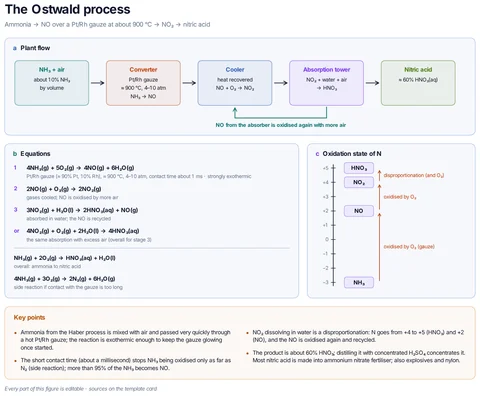
Nitric acid manufacture for A-level and NCERT: catalytic oxidation of NH₃ to NO on a platinum–rhodium gauze at about 900 °C, oxidation of NO to NO₂ on cooling and absorption in water, with balanced equations and the oxidation state of nitrogen at each stage (−3 → +2 → +4 → +5).
What the template shows
- Ammonia → NO over a Pt/Rh gauze at about 900 °C → NO₂ → nitric acid
- Plant flow
- heat recovered
- Absorption tower
- NO₂ + water + air
- Nitric acid
- NO from the absorber is oxidised again with more air
- Oxidation state of N
- Pt/Rh gauze (≈ 90% Pt, 10% Rh), ≈ 900 °C, 4–10 atm, contact time about 1 ms · strongly exothermic
- gases cooled; NO is oxidised by more air
- absorbed in water; the NO is recycled
- the same absorption with excess air (overall for stage 3)
- overall: ammonia to nitric acid
- side reaction if contact with the gauze is too long
- oxidised by O₂ (gauze)
- disproportionation (and O₂)
- Ammonia from the Haber process is mixed with air and passed very quickly through a hot Pt/Rh gauze; the reaction is exothermic enough to keep the gauze glowing once started.
- The short contact time (about a millisecond) stops NH₃ being oxidised only as far as N₂ (side reaction); more than 95% of the NH₃ becomes NO.
- NO₂ dissolving in water is a disproportionation: N goes from +4 to +5 (HNO₃) and +2 (NO), and the NO is oxidised again and recycled.
- The product is about 60% HNO₃; distilling it with concentrated H₂SO₄ concentrates it. Most nitric acid is made into ammonium nitrate fertiliser; also explosives and nylon.
- Every part of this figure is editable · sources on the template card
Drawn with 50 shapes – every one editable in MolDraw.
Sources
How to use this template
- Press Edit in MolDraw. The template opens on the canvas of the free MolDraw editor.
- Change anything: move structures, edit atoms and labels, recolour highlights or delete what you do not need.
- Add your own structures, arrows and text next to it, or combine several templates on one page.
- Export the drawing as PNG, SVG or PDF for slides, worksheets, theses and papers.
Frequently asked questions
Is the The Ostwald process template free?
You can preview the The Ostwald process template here and open and edit it in MolDraw for free. Downloading or exporting it is part of MolDraw Pro, together with the other premium templates.
Can I edit the The Ostwald process template?
Yes. It opens as an ordinary MolDraw drawing, so every structure, arrow, label and colour can be changed, and you can add your own content around it.
Is the chemistry checked?
Every structure is checked with RDKit and every curly arrow passes MolDraw’s electron-flow audit. The sources used are listed on this page.
Which MO diagrams are included?
H₂ and He₂, N₂ and O₂ (showing s–p mixing and paramagnetic O₂), and carbon monoxide.